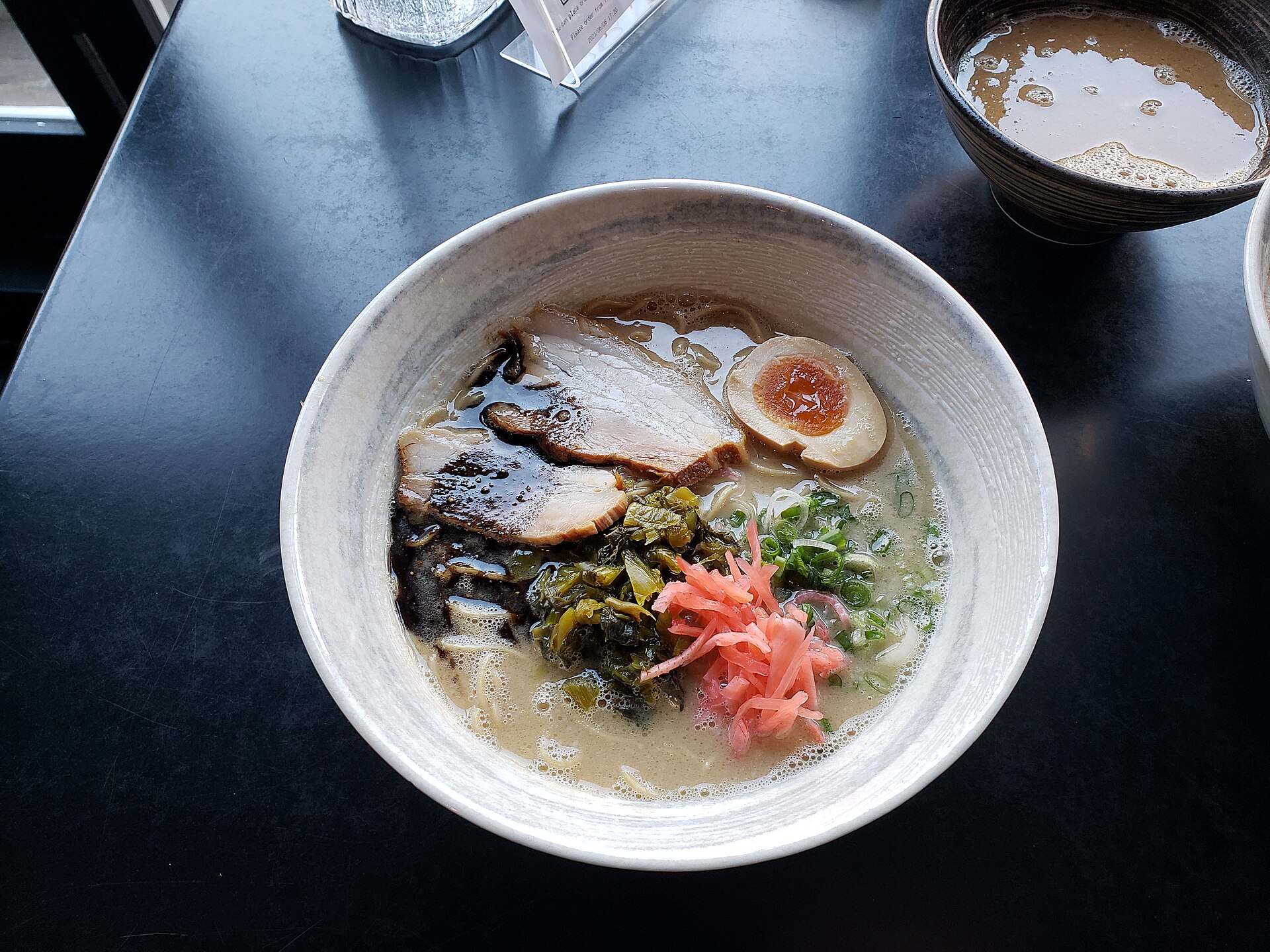
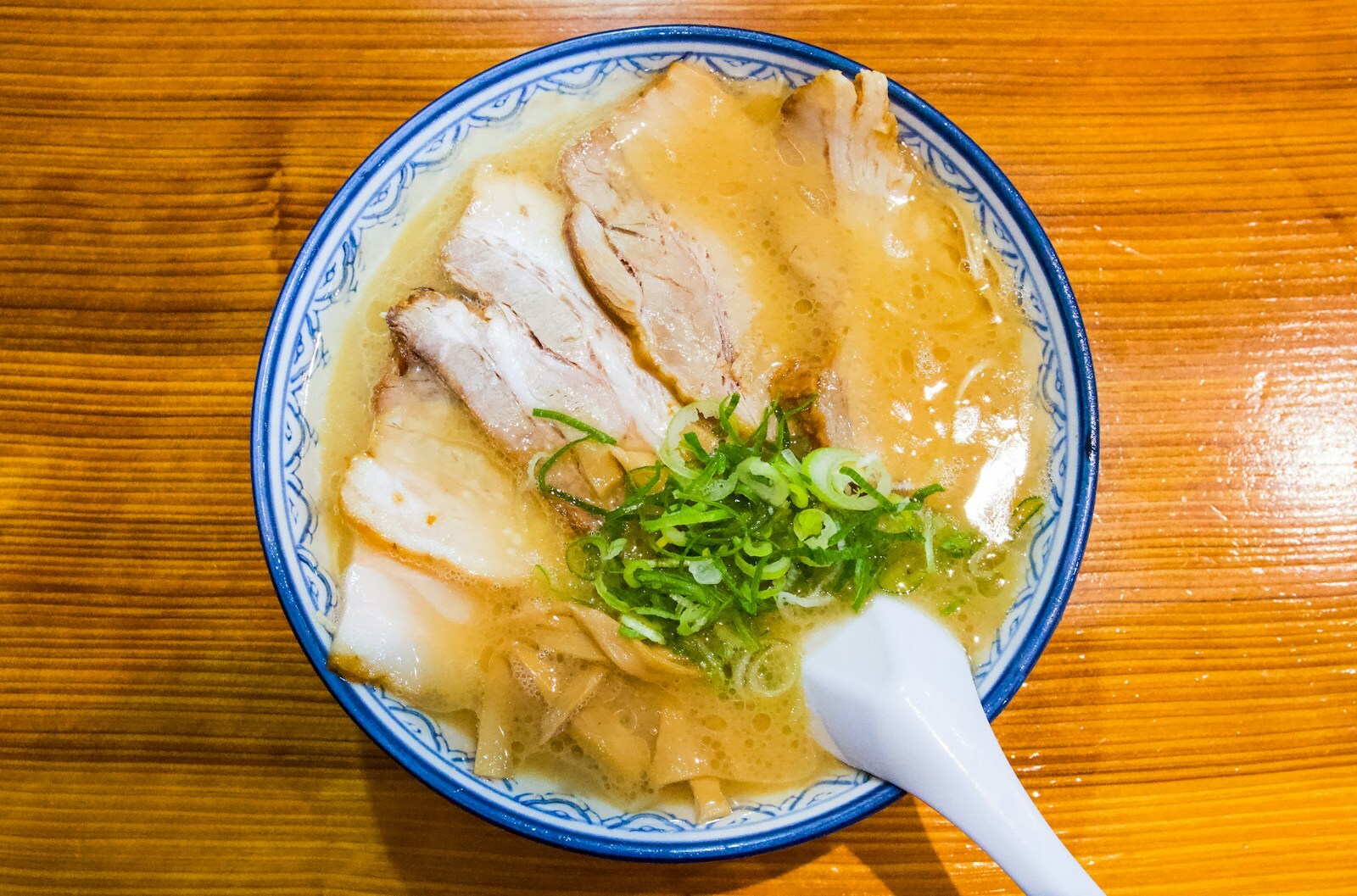
There is a sound to a proper bowl of tonkotsu that you only hear in places that know what they are doing. Not the sound of chopsticks or the soft clack of a porcelain spoon — the sound of the broth itself, dense enough that it rolls thickly as you tilt the bowl, slick enough that the surface ripples differently than a thinner soup would ripple. You lift your spoon and a film of pork fat coats the bottom of it. You taste the broth and you taste twelve hours of work: bones boiled into milk, fat emulsified into water, collagen reduced into something halfway between soup and sauce. It is the most labor-intensive bowl of soup in regular international circulation and one of the most rewarding.
Tonkotsu ramen comes from Kyushu, Japan’s southwestern island, where the ramen tradition diverged sharply from the lighter chicken-and-shoyu styles of Tokyo. The most famous expression is Hakata-style tonkotsu from the city of Fukuoka, characterized by thin straight noodles, a milky pork-bone broth, and aggressive tare. Kurume-style, slightly older and slightly heavier, is the broth’s structural origin. The dish reached Tokyo and then the United States via the late-1990s ramen boom that produced restaurants like Ippudo (founded 1985 in Hakata, US expansion 2008) and the David Chang-led Momofuku that turned tonkotsu into a global phenomenon by the mid-2010s.
Ivan Orkin, the American chef who built two successful Tokyo ramen shops before returning to New York to open Ivan Ramen, wrote in his 2013 book Ivan Ramen that the broth is “the only step that cannot be cheated.” The chashu, the egg, the tare, the noodles, the toppings — all can be assembled in an afternoon. The broth is twelve hours, every time, with no shortcuts. The rest of this article is how to make all of it at home, with the technical reasoning for every step.
Why a Rolling Boil, Not a Simmer
Every other long-cooked broth in classical cuisine — French fond brun, Italian brodo, Chinese stock — calls for a gentle simmer. Tonkotsu is the exception. The defining feature of tonkotsu, the opaque white color and the slick fat-and-water emulsion, requires a hard rolling boil sustained for 8 to 12 hours. At simmering temperature, fat rises and separates. At rolling boil, the constant agitation forces fat droplets and water into a stable emulsion held together by released gelatin. The result is what looks like milk and feels like cream on the tongue.
This is not a metaphor. The mechanism is the same as making mayonnaise: oil dispersed into water with an emulsifying agent. In mayo, the emulsifier is egg yolk lecithin. In tonkotsu, it is dissolved collagen from the bones. The rolling boil provides the mechanical energy for emulsification; without it, fat and water remain separate phases no matter how long you cook. A pressure cooker tonkotsu, while breaking down collagen quickly, lacks this agitation and produces a clearer broth that is structurally not tonkotsu.
Choosing the Right Bones
Tonkotsu broth needs a specific mix: bones rich in marrow and bones rich in collagen. Pork neck bones and femur bones (cut into 2-inch lengths by your butcher) provide the marrow and fatty richness. Pork trotters (pig’s feet) provide the collagen that emulsifies the fat into the broth and gives it body. The ratio is roughly 2:1 by weight, neck and femur to trotters. Without trotters, the broth will be flavorful but watery and will not develop the signature white color or slick mouthfeel.
Source from an Asian butcher or a Mexican carnicería — both routinely carry pork trotters and neck bones. Many regular butchers will order them on request with 24 hours notice. Avoid pork bones from supermarket meat departments if they are pre-packaged with skin removed; the skin contributes additional collagen. A larger pot of bones produces better broth than a smaller pot stretched with water — this is a recipe that rewards scale.
Chashu: The Pork Belly Method
Chashu is the rolled, braised pork belly that tops the bowl. The process is simple but slow: a skin-on pork belly is rolled into a tight log, tied with kitchen twine, seared hard on all sides, then braised in soy-mirin-sake liquid for ninety minutes. The slicing matters as much as the cooking — chashu cools in its braising liquid overnight, firms up, and can then be sliced thin and clean across the grain. The slices are warmed briefly by the hot broth in the bowl, never cooked through again.
Many ramen shops use a sous-vide method now (72°C for 12 hours produces an even more luxurious chashu), but the traditional braise produces an excellent home version. Save the braising liquid — it becomes the base for the egg marinade and adds depth to the tare. Reroll any leftover slices into ochazuke (over rice with hot tea) or fried rice the next day.
Tonkotsu vs Shoyu vs Shio vs Miso: A Quick Map
| Style | Region | Broth + Tare |
|---|---|---|
| Tonkotsu | Kyushu (Hakata) | Milky pork bone broth + shoyu or shio tare |
| Shoyu | Tokyo | Clear chicken/pork broth + soy sauce tare |
| Shio | Hakodate | Clear seafood/chicken broth + salt tare |
| Miso | Sapporo (Hokkaido) | Pork or chicken broth + fermented miso tare |
Ingredients
For the broth:
- 2.5 kg (5.5 lb) pork neck and femur bones, split
- 1 kg (2.2 lb) pork trotters
- 1 large yellow onion, halved
- 6 garlic cloves, smashed
- 1 piece fresh ginger (5 cm), sliced
- 1 dried shiitake mushroom
- 2 spring onions, whole
For the chashu:
- 800 g (1.75 lb) pork belly, skin on
- 60 ml (1/4 cup) soy sauce
- 60 ml (1/4 cup) mirin
- 30 ml (2 tbsp) sake
- 2 tablespoons sugar
For the ajitsuke tamago (egg) + tare:
- 4 large eggs
- 60 ml (1/4 cup) soy sauce + 60 ml mirin + 2 tbsp sake
- 1 sheet kombu (5 cm square)
To assemble:
- 4 portions fresh ramen noodles
- 2 spring onions, thinly sliced
- 2 sheets nori
- Toasted sesame seeds
- Chili oil, optional
Making It
- Blanch bones. Cover bones with cold water in a stockpot. Rolling boil 10 min. Drain. Rinse bones thoroughly, scrubbing off blood spots.
- Start long boil. Return bones to clean 12-qt pot. Cover with 6 liters cold water. Add aromatics. Rolling boil 8-12 hours. Stir hourly. Top up with hot water as needed.
- Make chashu. Roll pork belly skin-out, tie tightly. Sear all sides 8 min. Transfer to saucepan with soy, mirin, sake, sugar, and water to half-cover. Simmer covered 90 min, turning every 30 min. Cool in liquid. Refrigerate overnight.
- Make ajitsuke tamago. Boil eggs exactly 6 min 30 sec. Ice bath, peel. Submerge in soy-mirin-sake-water marinade. Refrigerate 4-24 hours.
- Make tare. Combine soy, mirin, sake, kombu in small saucepan. Heat gently 20 min. Remove kombu. Reserve.
- Finish broth. Strain through fine mesh. Should be opaque white and slick. Skim portion of surface fat into a bowl.
- Cook noodles. Boil fresh ramen 90 seconds to 2 minutes. Drain immediately.
- Assemble. Each warm bowl: 2 tbsp tare, then 350 ml hot broth, stir. Add noodles. Top with 3 chashu slices, half marinated egg cut-side up, scallions, nori sheet, sesame seeds, drizzle of pork fat. Serve immediately.
Common Mistakes
The most common mistake is skipping the blanch. Without it, the bones release blood and scum into the broth, producing an off-flavored gray soup instead of clean opaque white. Always blanch hard for 10 minutes, drain, rinse, return to a clean pot. The second mistake is simmering instead of rolling-boiling. Tonkotsu requires the rolling boil for emulsification — a gentle simmer for 12 hours produces a flavorful but separated broth. Keep the heat high, top up water as it boils off.
The third mistake is over-saucing the bowl. Tare is concentrated; 2 tablespoons per bowl is the maximum, often 1.5 tablespoons is correct depending on broth strength. Salt and umami balance is everything; oversalt and the bowl becomes flat. Always taste with a clean spoon after combining tare and broth, before adding noodles.
What to Serve With Ramen
Ramen is traditionally a complete meal, eaten quickly with focused attention. For a fuller spread, Japanese izakaya style adds gyoza (pan-fried dumplings), karaage (Japanese fried chicken), and a small green salad with sesame dressing. Cold beer (Sapporo, Asahi) is the standard pairing — lighter Japanese lagers cut through the fat of tonkotsu without competing. For something from our family, our Japanese tamago sando with Kewpie mayo is the konbini-culture counterpart, and our iced hojicha latte with vanilla cream is the post-meal drink Japanese cafes serve.
Storage and Make-Ahead
Tonkotsu broth refrigerates beautifully for up to 5 days — the fat solidifies on top and acts as a protective seal. Reheat gently in a saucepan; the fat reincorporates as it warms. The broth also freezes well for 3 months in airtight containers; pour into ice-cube trays for portion control. Chashu keeps refrigerated 5 days in its braising liquid; slice cold and warm briefly in hot broth at serving. Eggs keep 4 days in the marinade; longer makes them rubbery. Tare keeps refrigerated up to 2 weeks. Cook noodles fresh each bowl — ramen noodles do not hold once cooked.
Frequently Asked Questions
Why does tonkotsu broth take 12 hours?
The milky color and slick mouthfeel come from emulsification of bone fat and collagen with water at a rolling boil. Collagen breakdown plus mechanical agitation requires 8 to 12 hours of sustained high heat. Pressure cookers break down collagen faster but lack agitation, producing a clearer broth that is technically not tonkotsu.
What is tare and why does it matter?
Tare is the concentrated seasoning that goes in the bowl bottom before broth. It is what differentiates one ramen shop from another — broth is canvas, tare is brushstroke. Typical proportions: 2 tablespoons tare per 350 ml broth. Without tare, the broth tastes flat and underseasoned.
Can I substitute supermarket ramen noodles?
Not really. Fresh wheat ramen noodles are alkaline (with kansui) which gives them their springy texture. Instant deep-fried noodles cannot stand up to a real broth. Best substitutes: fresh chuka soba, Sun Noodle brand fresh ramen, or Marutai-brand dried as highest-quality dried option. Avoid instant ramen blocks.
Why blanch the bones before the long simmer?
Pork bones release blood, scum, and impurities in the first 10 minutes. If you skip the blanch, those impurities emulsify into the final broth, producing off-flavor and gray-brown color instead of clean white. The blanching step is non-negotiable: rolling boil 10 minutes, drain, rinse, scrub off blood spots, return to clean water.
Sources
- Serious Eats — How to Make Tonkotsu Ramen at Home — J. Kenji López-Alt’s 12-hour method with detailed emulsification science.
- NYT Cooking — Tonkotsu Ramen — Adapted home version with sourcing notes.
- USDA FoodData Central — Pork and Wheat Noodles — Nutritional data.
Each bowl contains roughly 790 calories, 42 g protein, 38 g fat, 68 g carbohydrates, 4 g fiber.
Please note: Contains pork, soy, wheat (in noodles), eggs, and sesame. Very high in sodium — not suitable for sodium-restricted diets. Consult a dietitian for specific needs.