In the summer of 2017, Anthony Bourdain made a video for his show Parts Unknown in which he stood outside a 7-Eleven in Tokyo eating an egg salad sandwich out of its plastic wrapper. He did not say much. He chewed. He looked at the camera. “Pillowy and fluffy,” he said, “with just that right amount of sweetness. Why are Japanese convenience store sandwiches so good?” The clip went viral. Within weeks, American food writers were attempting to explain the mystery. Eleven years later, no one has really succeeded. You can describe the ingredients. You can catalog the technique. But the specific perfection of a konbini tamago sando — soft, cold, intensely seasoned, geometrically exact — continues to elude casual recreation in a home kitchen.
Not because the sandwich is complicated. Because the sandwich is exactly as simple as it appears, and in that simplicity, every small decision matters. The bread has to be shokupan. The mayonnaise has to be Kewpie. The egg has to be cooked to a specific degree of firmness and chopped to a specific size. The butter has to be applied to both slices. The crusts have to come off. The cut has to be on the diagonal. Miss any one of these steps and what you have is an American egg salad sandwich with fancier condiments. Execute all of them and what you have is something that people literally fly across the Pacific to eat.
Namiko Hirasawa Chen, the founder of Just One Cookbook and one of the most trusted English-language Japanese food writers working today, has written that the tamago sando is “a perfect demonstration of why Japanese food culture is so obsessed with texture.” She is right. The sandwich is a four-layer study in softness: soft shokupan, soft butter, soft egg salad with textural variation in the chopped whites, soft shokupan again. There is no crunch. There is no sharpness. There is only the slow, comforting yield of each component against the teeth, and the bright creaminess of Kewpie weaving through everything. It is a lullaby of a sandwich.
Konbini Culture and the Cult of the Sandwich
The Japanese convenience store — konbini — is a genre of institution. There are roughly 56,000 of them across the country, three major chains (7-Eleven, Lawson, FamilyMart) dominating the market, each operating to standards of food quality that would shock an American shopper. Sushi is made fresh at regional commissaries twice a day. Onigiri (rice balls) are wrapped in a clever tab-pull seaweed sleeve that keeps the nori crisp until the moment of eating. Chicken karaage is fried behind the counter. And sandwiches — tamago, katsu, fruit, tuna — arrive daily from factories where the recipes have been iterated on for decades to hit specific texture, moisture, and shelf-life targets.
The 7-Eleven tamago sando in particular has become a tourist pilgrimage site. A 2019 New York Times piece titled “Why Japan’s 7-Eleven Is Better Than Yours” included an extended paean to the sandwich, and food writers from Eater to Bon Appétit have repeatedly tried to explain why it outperforms nearly every restaurant egg salad. The answer is mostly that Japanese food manufacturers take egg salad seriously in a way that nobody else does. The eggs are cooked to a specific degree of firmness. The mayonnaise is Kewpie, every time, no exceptions. The bread is shokupan milk bread baked in square pullman pans. The crusts are removed and sold back to wholesalers for other uses. The final sandwich is chilled, wrapped, labeled with a time-of-manufacture stamp, and sold for about $2.80. At home, you can match this. It requires only attention.
Kewpie: The Mayonnaise That Is Not Mayonnaise
Kewpie, first produced in Japan in 1925 by Shokuhin Kogyo Co. (now Q.P. Corporation), is a meaningfully different product from American mayonnaise. The differences are structural. Where Hellmann’s uses whole eggs for emulsification, Kewpie uses egg yolks only, which produces a significantly richer, creamier, more yellow mayonnaise. Where American mayo uses distilled white vinegar for acidity, Kewpie uses rice vinegar (and apple vinegar in some formulations), which is softer and slightly sweeter. And where American mayo has no added glutamate, Kewpie contains a small amount of MSG, which provides a savory depth that American mayo cannot produce no matter how much lemon you squeeze into it.
The result is that Kewpie tastes more like a dressing and less like a condiment. It is creamier, more umami-forward, and sweeter than Hellmann’s or Duke’s. In the tamago sando, it is not a binder — it is the dish. You can substitute homemade mayo or Duke’s in a pinch, but the sandwich becomes noticeably flatter. If you make tamago sando with any regularity, buy the Kewpie squeeze bottle with the red cap and the smiling baby mascot. Asian supermarkets universally carry it, and even many mainstream American groceries now stock it in the international aisle. The red-cap Kewpie is the Japan-market formulation with MSG; the green-cap American-market version is MSG-free and inferior.
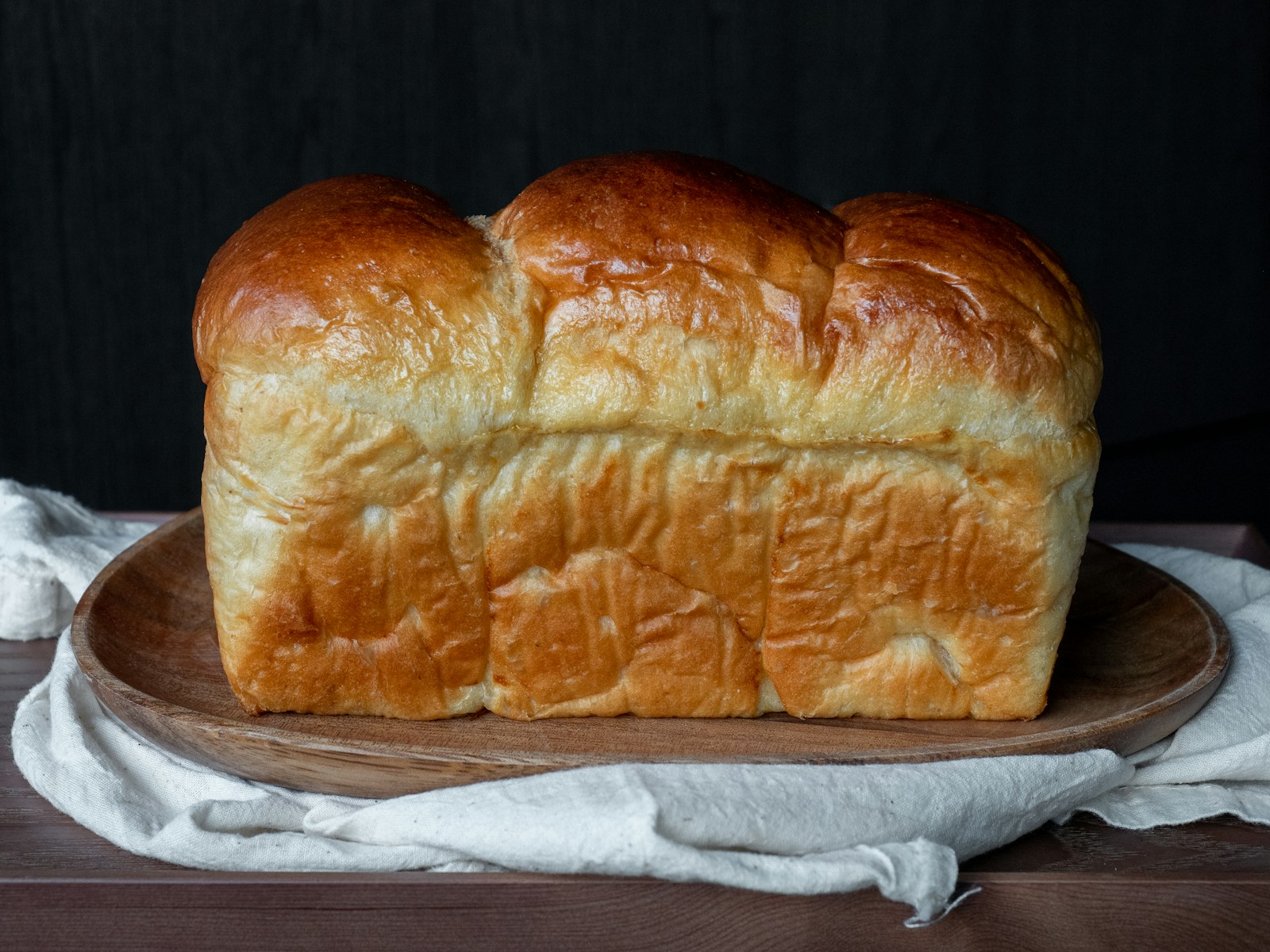
The Bread Question: Finding or Baking Shokupan
Shokupan — literally “eating bread” or everyday bread — is the Japanese square loaf that underpins almost all Japanese sandwich culture. It is made with the tangzhong technique: a cooked roux of flour and water (or milk) added to the dough, which gelatinizes the starch and produces a bread with extraordinarily tender crumb and long shelf life. The loaves are baked in square pullman pans with lids that produce perfectly flat tops. Standard thickness for Japanese sandwich bread is cut thicker than American standard — 8 slices per loaf is typical in Japan versus 20 slices for an American loaf of the same size. The thick slice is not optional. It is part of the textural identity.
Ivan Orkin, the American chef who built his ramen career in Tokyo, wrote in The Gaijin Cookbook that shokupan is “the thing you miss most when you leave Japan, and the thing that is hardest to replace.” He is right. Most American white bread is too dense and too crisp-crusted for tamago sando. The good news is that Japanese grocery chains (Mitsuwa, Nijiya, H Mart’s Japanese sections) sell pre-sliced shokupan loaves, and artisan bakeries in major cities increasingly offer it. If you cannot source it, thick-cut brioche or challah is a passable substitute. Thin-sliced American sandwich bread is a last resort. If you are committed, baking shokupan at home with a bread machine or stand mixer is a weekend project that produces spectacular results; King Arthur Baking has a well-reviewed recipe.
The Egg: Exactly 10 Minutes
The single most under-discussed element of tamago sando is egg timing. Different cook times produce dramatically different sandwich textures:
| Cook Time (Simmer) | Yolk Texture | Best For |
|---|---|---|
| 6 minutes | Fully runny, yolk pours | Ramen topping, not sandwich |
| 6½ minutes | Jammy, soft-set, slightly flowing | The “textural feature” egg placed whole in center |
| 9 minutes | Just-set, softly creamy yolk | Acceptable for egg salad; slightly wet |
| 10 minutes | Fully set, still creamy, not chalky | The konbini standard, ideal for egg salad |
| 12+ minutes | Chalky, gray-ringed | Overcooked; discard and start over |
Ingredients
- 4 thick slices Japanese shokupan milk bread (about 1 inch thick each)
- 5 large eggs, at room temperature
- 3 tablespoons Kewpie Japanese mayonnaise (red cap, with MSG)
- 1 teaspoon rice vinegar
- 1 teaspoon granulated sugar
- ½ teaspoon Dijon mustard (optional; very traditional versions omit)
- ¼ teaspoon fine sea salt
- ¼ teaspoon freshly ground white pepper
- 1 tablespoon unsalted butter, softened to room temperature
- 1 teaspoon finely chopped chives (optional, for garnish)
Making It
- Start with room-temperature eggs. Cold eggs straight from the refrigerator are more likely to crack when they hit boiling water. Take the eggs out 30 minutes before cooking, or warm them briefly in a bowl of warm tap water for 5 minutes.
- Boil the eggs. Bring a medium saucepan of water to a full rolling boil. Using a slotted spoon, gently lower 4 of the eggs into the water. Reduce heat slightly to maintain a steady simmer. Set a timer for exactly 10 minutes. At the 3½-minute mark, add the fifth egg — this one will get a total of 6½ minutes for the jammy center used as the “feature egg.” (If you are skipping the textural variation, cook all 5 eggs for the full 10 minutes and use them all in the salad.)
- Shock in ice water. At 6½ minutes, use the slotted spoon to lift out the jammy egg and transfer to a bowl of ice water. At 10 minutes, transfer the remaining four eggs. Let them all cool in the ice water for 5 minutes — this stops the cooking and makes peeling much easier.
- Peel carefully. Crack each egg gently all around against the countertop, then peel under cool running water, starting from the fat end where the air pocket is. Set the jammy egg aside on a small plate. Place the four fully-cooked eggs in a medium bowl.
- Separate and mash. Cut the four fully-cooked eggs in half. Pop the yolks into a second bowl. Mash the yolks with a fork until they are completely smooth and paste-like — no visible chunks. Chop the whites into small uniform cubes, about ¼ inch across. The visible egg-white pieces are part of the final sandwich aesthetic, so aim for consistency.
- Build the dressing. To the mashed yolks, add the Kewpie mayo, rice vinegar, sugar, Dijon mustard (if using), salt, and white pepper. Whisk with a fork until fully emulsified. Taste. The dressing should be rich, creamy, slightly sweet, with a clear umami thrum from the Kewpie. If it tastes flat, add a pinch more sugar; if too sweet, a few drops more vinegar.
- Fold the whites in. Add the chopped egg whites to the yolk-mayo mixture. Fold gently with a silicone spatula until every piece of white is coated in yellow dressing. Do not overmix or mash the whites — they should remain as distinct small cubes suspended in the creamy dressing, which is the konbini texture signature.
- Butter the bread. Spread the softened butter thinly but completely across one side of each slice of shokupan. Every edge should be covered. The butter is a moisture barrier that keeps the bread from absorbing dressing and going soggy. This step is easy to skip and devastating if you do.
- Assemble. Place two slices of buttered bread on a cutting board, buttered-side up. Divide the egg salad between them, mounding slightly higher in the center than at the edges — about three-quarters of an inch of filling. If using the jammy egg, slice it in half lengthwise and press one half cut-side up into the center of each mound of egg salad. This is the detail that makes the sandwich photograph beautifully when cut open. Top with the remaining buttered slices, buttered-side down. Press gently to adhere.
- Chill. Wrap each sandwich tightly in plastic wrap. Refrigerate for 15 to 30 minutes. This is non-negotiable for clean cuts. The filling firms, the bread sets, and the final presentation is dramatically cleaner.
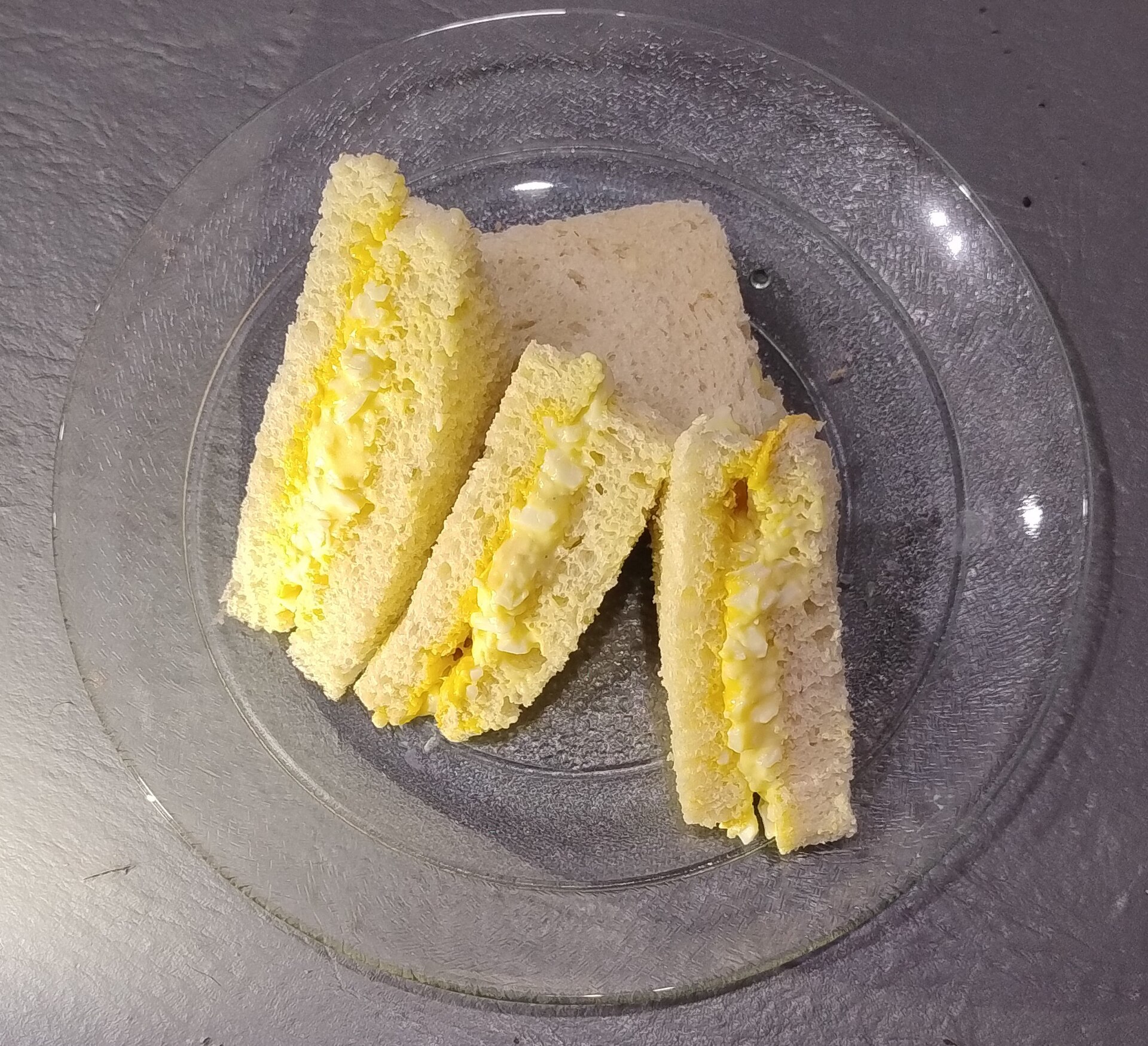
- Trim and cut. Unwrap the sandwiches. Using a very sharp serrated knife, cut off all four crusts in clean, perpendicular cuts. Wipe the knife between cuts. Then cut each sandwich in half diagonally from corner to corner, producing two triangles. Arrange each pair of triangles cut-side-up on a plate so the filling cross-section faces the diner. Scatter chives across the top if using. Eat immediately.
The Geometry of a Konbini Sandwich
Japanese convenience-store sandwiches follow an aesthetic rule that almost no Western sandwich culture observes: the filling cross-section should read cleanly when the sandwich is cut open. Soft, loose, blob-shaped filling fails this test. The goal, as any Lawson factory manager will tell you, is a sandwich where a photograph of the cut-side shows a flat plane of evenly distributed egg salad with crisp boundaries against the bread. This is why the filling is mounded slightly in the center (so the final geometry is triangle-inside-triangle), why the jammy feature egg is pressed into the center (so the yolk cross-section is visible in the final cut), and why chilling before cutting is non-negotiable (the filling must hold its shape).
A home version can approximate this discipline. Use a sharp serrated knife. Cut in single confident strokes rather than sawing motions. Keep the knife wiped clean between cuts. The difference between a home tamago sando that looks like a home sandwich and one that looks like something from a Tokyo 7-Eleven shelf is entirely in these last three steps. The ingredients are forgiving; the presentation is not.
Common Mistakes
Tamago sando is a 25-minute recipe with a very high ceiling and a very low floor. The traps:
- Overcooked eggs. Chalky, gray-ringed yolks make a chalky, gray sandwich. Eleven minutes is the ceiling; 10 minutes is the target.
- American mayo. Hellmann’s is a perfectly good product for a perfectly good American egg salad sandwich, but it is not Kewpie. The MSG and yolk-only formulation are not decorative; they are the character.
- Skipping the butter. The unbuttered shokupan will absorb dressing and go soggy in minutes. Buttered bread stays tender for hours.
- Over-mashing the whites. The visible egg-white cubes suspended in the dressing are the textural signature. If you mash them flat, you have a different dish.
- Skipping the chill. Cutting a just-assembled sandwich produces squished bread and a ragged cross-section. Fifteen minutes in the refrigerator fixes this.
- Keeping the crusts. There is no Japanese tradition of leaving crusts on a konbini sandwich. The crust is removed. Always.
Variations and a Larger Japanese Lunch
The tamago sando is a standalone meal, but a full Japanese convenience-store lunch traditionally pairs it with an onigiri, a small bottle of cold green tea or Calpis, and maybe a single strawberry mochi. If you want to build out a broader Japanese brunch, the natural extension is our Japanese soufflé pancakes guide — another exercise in Japanese texture obsession and cloud-soft engineering. For a full afternoon table that sweeps through East Asian sandwich and wrap traditions, the dim sum guide makes a natural weekend companion. Variations on tamago sando include katsu sando (breaded pork cutlet, tonkatsu sauce, shredded cabbage), fruit sando (whipped cream and fresh fruit on shokupan — yes, this is a real sandwich and it is excellent), and potato-egg sando (mashed potato mixed into the egg salad for extra body).
Storage and Make-Ahead
The egg salad itself keeps in the refrigerator for up to 3 days in a sealed container — in fact, overnight rest improves the flavor as the seasoning integrates. Assembled sandwiches are best eaten within 4 hours; after that, the bread begins to pick up moisture from the filling even with buttering. If packing for a lunch, wrap tightly in plastic wrap and keep cold until eating. The konbini-standard shelf life for commercially produced tamago sando is about 14 hours at refrigerated temperatures, after which Japanese 7-Eleven pulls them from shelves. At home, 6 to 8 hours is a safer window. Do not freeze — egg salad texture collapses entirely after thawing, and shokupan loses its characteristic softness.
Frequently Asked Questions
Why is Kewpie mayo different from regular mayo?
Three structural differences. Kewpie uses only egg yolks (not whole eggs), producing a richer and more intensely yellow mayonnaise. It uses rice vinegar or apple vinegar (not distilled white), giving a softer and slightly sweeter acidity. And it contains MSG, which provides a savory depth that no American mayo matches. Together these produce a condiment that tastes more like a creamy dressing than a spread. The red-cap Japan-market version has MSG; the green-cap American-market version is MSG-free and is noticeably flatter.
What is shokupan and can I use regular white bread?
Shokupan is Japanese milk bread — a square, pillowy loaf made with the tangzhong method (a cooked roux added to the dough) enriched with milk, butter, and sometimes a touch of honey. It is cloud-soft, slightly sweet, and sliced thick. American white bread is denser and dryer and will produce a noticeably less pillowy sandwich. Japanese markets and Asian supermarkets carry shokupan; artisan bakeries in major US cities increasingly offer it. Brioche or challah is an acceptable substitute; thin-sliced American bread is a last resort.
Why do konbini sandwiches look so perfect?
Industrial discipline that home cooks can approximate. Key moves: remove all crusts in clean perpendicular cuts; butter both bread slices for moisture barrier; chill the assembled sandwich 15 minutes before cutting so the filling holds its shape; use a sharp serrated knife and cut in single confident strokes; cut on the diagonal (triangles, not rectangles); arrange cut-side-up on a plate to display the filling cross-section. The target ratio is roughly two-thirds bread to one-third filling by height. Hit those marks and the sandwich looks like it came from a shelf in Shibuya.
Do I really need to chill the sandwich before cutting?
Yes, if you want clean cuts. A freshly assembled tamago sando has a warm, loose filling that squishes out sideways when the knife passes through, and the soft bread compresses. Fifteen minutes of refrigeration firms the egg salad enough to hold its shape and stiffens the bread enough for clean perpendicular crust cuts. Konbini sandwiches are chilled for hours in the factory, which is why the shrink-wrapped versions have such impossibly clean cross-sections. At home, 15 minutes is minimum, 30 minutes is better, an hour is optimal.
Sources
- Bon Appétit — The Case for the Japanese Egg Sandwich — Cultural and technical overview of the konbini tamago sando phenomenon.
- Serious Eats — Japanese Egg Salad Sandwich Recipe — Technical recipe development with attention to Kewpie, shokupan, and egg timing.
- USDA FoodData Central — Whole Chicken Eggs — Nutritional reference data for per-serving calculations.
Each sandwich contains roughly 468 calories, 18 g protein, 24 g fat, 42 g carbohydrates, and 2 g fiber — based on 2 sandwiches using 5 eggs, 3 tablespoons of Kewpie mayo, and 4 thick slices of shokupan. Sodium reflects Kewpie, salt, and bread content.
Please note: Nutritional estimates are derived from the USDA FoodData Central database and may vary depending on specific brands of mayonnaise, bread, and egg size. This recipe contains egg, dairy (butter), soy (in Kewpie), and wheat. Kewpie mayonnaise contains MSG in the red-cap Japanese formulation. Nothing in this article should be interpreted as medical or dietary guidance. If you have food allergies, sodium-sensitive conditions, or specific dietary needs, consult a registered dietitian or healthcare provider before preparing this recipe.