Walk any alley in the Old Quarter of Hanoi between eleven in the morning and two in the afternoon and you will find it — always — the particular smoke of bun cha. Not the thin, sharp smoke of a gas grill. Something rounder, fatter, a little sweet. It curls out of narrow doorways and low charcoal braziers set directly on the pavement. Women in aprons fan the coals with cardboard squares. Pork patties hiss. Strips of fatty belly drip fat into the fire and the flames leap up and the smoke thickens and turns caramel-brown. You smell it half a block before you see it.
Then you sit. Plastic stool, low table, another stool facing the first with nothing between them but a bamboo platter of herbs, a nest of rice vermicelli, a small ceramic bowl of warm amber liquid, and the grilled pork — still crackling — dropped directly into that liquid so it steams and seasons the sauce in the same motion. This is bun cha. It is not a soup, not a noodle bowl, not exactly a dipping dish. It is a way of eating that has been refined on Hanoi’s sidewalks for about 70 years, and it is, by a wide margin, the most perfectly calibrated lunch on earth.
Andrea Nguyen, the Vietnamese-American cookbook author and James Beard Award winner, writes in Into the Vietnamese Kitchen that bun cha is “Hanoi’s gift to the world of lunch.” She is not being cute. The dish is a structural triumph — hot pork, cold noodles, warm sauce, raw herbs — designed to be assembled bite by bite by the person eating it. You are not served bun cha. You build it. And every bite can be different from the last.
The Sidewalk and the President
In May 2016, Anthony Bourdain and Barack Obama sat on a pair of blue plastic stools at a place called Bun Cha Huong Lien on Le Van Huu Street in Hanoi. The table was metal, the height of a shin. The bowls were ordinary ceramic. A Hanoi beer stood sweating between them. They ate bun cha. The whole meal cost about six American dollars. Bourdain wrote later, in the episode notes for Parts Unknown, that the dish was “a perfect Vietnamese lunch” and that the charcoal smoke “does something to pork belly that nothing else does.” The restaurant has since installed a glass vitrine over the table where the two men ate, with the stools and the cleaned bowls preserved inside it like a museum diorama. The neighborhood started calling the place Bun Cha Obama and the name stuck.
This is not just tourist trivia. The scene matters because it captured something that Vietnamese food writers had been saying for decades — that bun cha is the most democratic dish in Vietnam. The coal brazier, the plastic stools, the table almost at floor level, the assembly of the bowl with your own hands: all of it is a ritual of equality. Presidents eat it. Office workers eat it. Rickshaw drivers eat it. They sit on the same stools and pay roughly the same price. There is no version of bun cha at a fine-dining establishment that is better than the version served on a sidewalk. In fact, the opposite is almost universally true.
The Two Pork Problem
Bun cha contains two kinds of pork, and both are non-negotiable. The first is cha mieng, pounded pork patties seasoned with fish sauce, palm sugar, shallot, garlic, and pepper, then formed into flat little discs and grilled until the edges are almost burnt. The second is cha mieng thit ba chi, slices of pork belly marinated in the same fundamental sauce and grilled over the same coals until the fat is crisp and the lean meat is dark. Together they give the sauce everything it needs: the ground patties contribute concentrated seasoned flavor, the belly contributes rendered fat. Without both, the dipping bowl is either too lean or too one-note.
Use 80/20 ground pork for the patties. Anything leaner will turn hard and dry on the grill. Ask a butcher for belly with a good mix of fat layers, skin removed, sliced to about a quarter-inch — you want strips that will render fast and char at the edges without becoming jerky. The marinade is the same for both meats except for ratios: the patties take more aromatics because they are being eaten whole; the belly takes less because its flavor comes mostly from the fat and smoke.
Caramel Sauce and the Color of Bun Cha
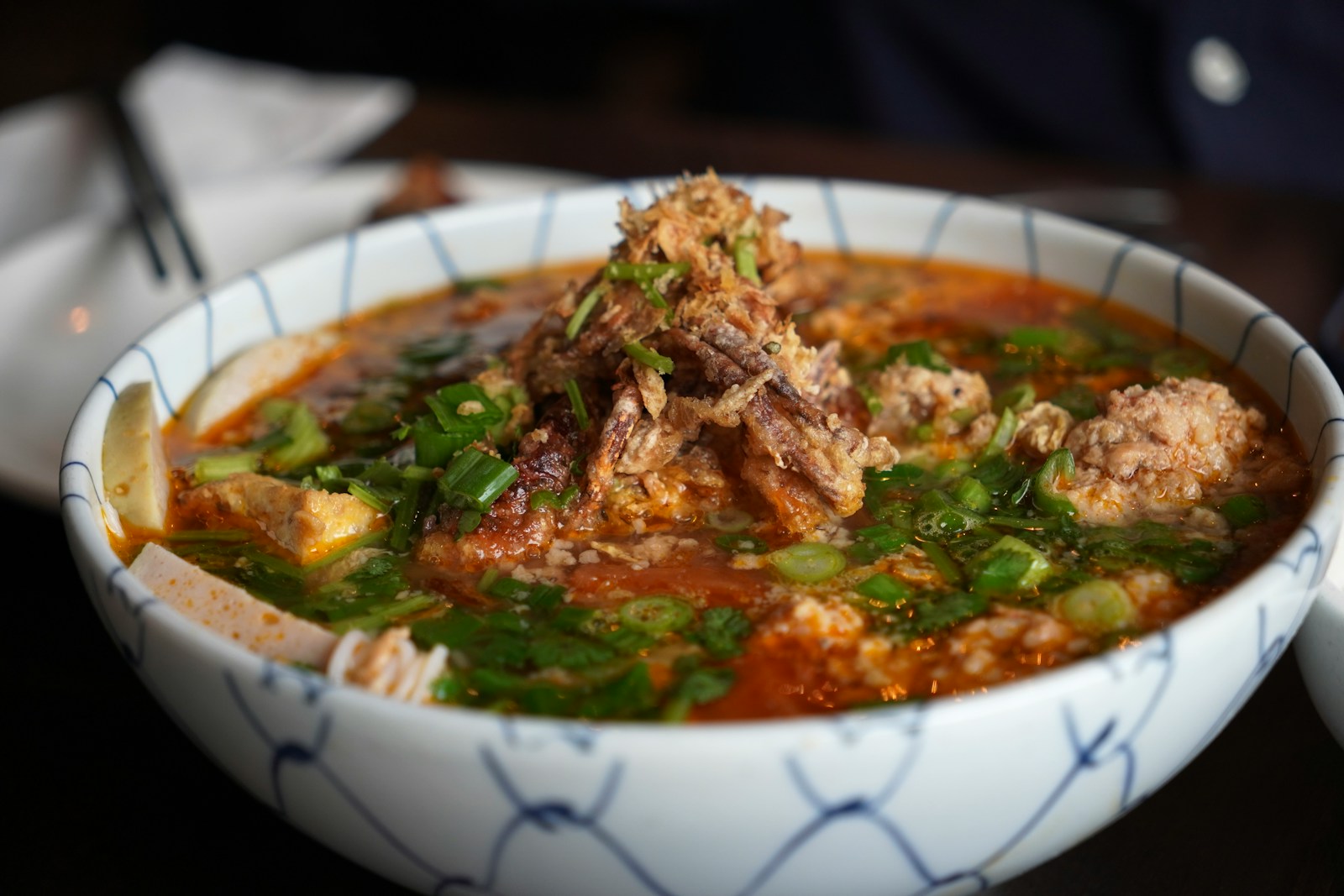
The deep mahogany color of a proper bun cha patty does not come from soy sauce. It comes from nuoc mau — Vietnamese caramel sauce, made by cooking sugar until it smokes just past the point of amber and arresting it with a splash of water. A teaspoon stirred into each marinade gives the meat a color that broils beautifully and adds a barely perceptible bitter edge that balances the palm sugar. You can buy nuoc mau in Vietnamese groceries. You can also make it in ten minutes: heat a quarter-cup of sugar in a small dry saucepan over medium-low, swirl as it melts, and at the moment it turns a deep reddish-brown and begins to smoke, pull it off the heat and very carefully stir in a tablespoon of water (stand back — it will sputter). Cool and store in a jar. One tablespoon will last months. A good nuoc mau is one of those kitchen things that quietly elevates a dozen dishes.
If you absolutely cannot find or make caramel sauce, dark soy is an acceptable (if imperfect) substitute. The color will be there; the bitter caramel edge will not. A quarter-teaspoon of molasses stirred in gets closer.
The Nuoc Cham Spectrum
Every Vietnamese cook has opinions about nuoc cham. Northern versions tend toward lighter, more balanced profiles with more water. Southern versions, heavier with sugar, are bolder and sweeter. The bun cha dipping bowl is a northern formulation — almost a broth, mildly seasoned, with the grilled pork itself providing the depth of flavor as it steeps.
| Component | Northern (Bun Cha) | Southern (Spring Roll) | Why the Difference |
|---|---|---|---|
| Water ratio | 1 cup to 2 tbsp fish sauce | ½ cup to 2 tbsp fish sauce | Northern version is a soaking liquid, not a dip |
| Sugar | 3 tablespoons palm sugar | 4 to 5 tablespoons | Southern palates run sweeter |
| Temperature served | Warm (room temp to 120°F) | Room temperature | Warm sauce activates pork aroma |
| Vegetable pickle | Carrot + green papaya | Carrot + daikon | Green papaya adds body and sour-bitter edge |
| Chili heat | Moderate, on the side | Mixed in, often aggressive | Diner controls heat in Hanoi style |
Ingredients
- 1 lb (450 g) ground pork, 80/20 fat ratio
- 10 oz (280 g) pork belly, skin off, sliced ¼-inch thick
- 4 tablespoons fish sauce (Red Boat or Three Crabs recommended)
- 3 tablespoons palm sugar or light brown sugar, divided
- 2 tablespoons shallots, finely minced
- 1 tablespoon garlic, finely minced (plus 4 cloves for dipping sauce)
- 1 teaspoon freshly ground black pepper
- 2 teaspoons caramel sauce (nuoc mau) or dark soy sauce
- 12 oz (340 g) dried rice vermicelli (bun)
- 1 cup (240 ml) warm water for the nuoc cham
- ¼ cup (60 ml) fresh lime juice, from 3 to 4 limes
- 3 tablespoons rice vinegar
- 3 Thai bird chilies, thinly sliced
- 1 large carrot, julienned into matchsticks
- 1 small green papaya or kohlrabi, julienned
- 1 large bunch fresh mint
- 1 large bunch fresh cilantro
- 1 bunch Thai basil or Vietnamese perilla (tia to)
- 1 small head red-leaf or butter lettuce
Making It
- Marinate the two pork preparations separately. In one bowl, combine the ground pork with 2 tablespoons of fish sauce, 1 tablespoon palm sugar, the minced shallots, 1 tablespoon garlic, black pepper, and 1 teaspoon caramel sauce. Mix gently with your hands — do not overwork or the patties will be dense. In a second bowl, toss the sliced pork belly with 1 tablespoon fish sauce, 1 tablespoon palm sugar, a pinch of pepper, and 1 teaspoon caramel sauce. Cover both and rest 30 minutes at room temperature, or up to 4 hours refrigerated.
- Make the nuoc cham. Dissolve the remaining 3 tablespoons palm sugar in 1 cup warm water. Add the lime juice, rice vinegar, and remaining 2 tablespoons fish sauce. Stir in the 4 cloves of finely minced garlic and the sliced chilies. Taste. It should hit four notes at once — salty, sour, sweet, fragrant — and none should dominate. If it tastes too sharp, add a bit more sugar; too flat, more lime. Add the julienned carrot and green papaya and let them pickle in the sauce while you cook the pork.
- Cook the noodles. Bring a large pot of water to a boil. Drop in the vermicelli and cook according to package directions — usually 4 to 5 minutes until just tender, not mushy. Drain, rinse under cold running water to stop the cooking and wash off surface starch, and arrange on a platter in small nest-shaped mounds. The noodles should be cool or room-temperature when served; this contrast with the warm sauce is part of the structure.
- Prepare the herb platter. Wash the mint, cilantro, Thai basil, and lettuce thoroughly. Dry in a salad spinner or between towels. Arrange loose on a large platter, tearing any particularly large lettuce leaves in half. Diners will grab handfuls as they eat.
- Form the patties. Scoop the marinated ground pork by heaping tablespoon and press into small flat discs about 2 inches across and half an inch thick. You should get about 16 patties. Arrange on a plate. A shallow dip in the center of each patty helps them cook evenly on the grill; commercial bun cha patties are often nearly flat, almost like small hamburger patties.
- Fire the grill. A charcoal grill is ideal — the smoke is what makes bun cha. If using charcoal, let the coals burn down to glowing red with gray ash on top. If using a cast-iron grill pan indoors, heat it over medium-high for 5 minutes until just smoking. Do not oil the meat; the fat content does the work.
- Grill the pork. Grill the patties 3 to 4 minutes per side, until deeply caramelized with dark char marks. Grill the belly slices 2 to 3 minutes per side, until the fat is crisp and the edges are dark golden. Pork belly drips fat — if the flames leap up, move the slices away from the hottest zone for a moment. The goal is dark but not carbonized; Hanoi bun cha patties are almost always cooked to the point where a few spots look nearly black at the edges.
- Drop into the sauce. As they come off the grill, slide the hot patties and belly directly into the nuoc cham. The heat of the pork warms the sauce and releases the caramelized fat into it. This is the move. Do not rest the pork on a plate first. The sauce should never be cold.
- Serve and assemble. Bring the pork bowl, vermicelli platter, and herb platter to the table. Each diner takes a small individual bowl. They pull a few noodles into it, tear in a mix of mint, cilantro, basil, and lettuce, ladle pork and sauce over everything, and eat with chopsticks and a small ceramic spoon. Every bite can be a different combination. That is the whole point.
Common Mistakes
Bun cha is forgiving at most points and brutally punishing at a few. The mistakes to avoid:
- Hot vermicelli. The noodles must be rinsed cold and served room-temperature. Warm noodles turn the sauce cloudy and muddle the temperature contrast that defines the dish.
- Lean pork. Ground pork below 80/20 will produce hard, dry patties. If your butcher only sells leaner grinds, add a tablespoon of minced pork fat or a teaspoon of neutral oil.
- Iced nuoc cham. Many American recipes tell you to chill the dipping sauce. Do not. Bun cha sauce is served warm — just barely warmer than room temperature — so it interacts with the hot pork without shocking the fat into re-solidifying.
- Under-charring the pork. The signature flavor is smoke and caramelization. If your patties come off pink-brown and juicy, you have not finished the dish. Push longer and let the edges get dark.
- Skimping on herbs. A Hanoi bun cha is served with more herbs than noodles. If it looks like a lot, you have the right amount.
Pairings and a Wider Vietnamese Meal
Bun cha is a complete meal on its own — protein, noodles, vegetables, sauce, all present in every bite. But if you are feeding a larger group or want to build a Hanoi-style spread, a plate of nem ran (fried spring rolls) is the traditional accompaniment, dunked into the same dipping bowl as the pork. A clear, strong Vietnamese iced tea or a cold Hanoi beer (Bia Hoi, in Vietnam) is the drink of choice. For dessert, a bowl of che ba mau — three-color bean pudding over crushed ice — closes the meal. If you want a broader tour of Vietnamese cooking, our complete guide to beef pho from scratch walks through the dish that Hanoi gave the world before bun cha, and authentic pad Thai at home makes a natural next stop for Southeast Asian home cooks building repertoire.
Make-Ahead and Storage
Every component of bun cha can be prepped ahead. The pork marinates up to 24 hours refrigerated — in fact, an overnight rest deepens the flavor significantly. The nuoc cham keeps for a week in the refrigerator (add the carrot and papaya pickle only a few hours before serving so they stay crisp). Cooked vermicelli holds well at room temperature for 3 to 4 hours; cover with a damp towel. The herbs should be washed the day of service and kept wrapped in paper towels inside a plastic bag. Grilled pork, however, must be served immediately — reheated pork patties lose the smoke-edge character that defines the dish. If you have leftovers, eat them cold the next day over fresh noodles as a second meal; it is almost a different dish, and almost as good.
The Fish Sauce Question
Not all fish sauce is the same, and bun cha’s nuoc cham lives or dies on the quality of the fish sauce at its center. A cheap supermarket fish sauce tends toward a single dimension — pure salt — while a good fish sauce has layers: salt, but also a round, almost meaty umami, a hint of caramel, a whisper of the ocean. The difference is dramatic in a dish like bun cha, where the fish sauce is not buried under aromatics but sits on the surface of the dipping bowl, perfumed only by grilled pork and lime. Red Boat, made in Phu Quoc from black anchovies aged in wooden barrels for a year, is the current gold standard and is available in most American supermarkets. Three Crabs is the traditional Vietnamese-American pantry brand and is excellent. Son is a newer premium option. What to avoid: anything labeled simply “fish sauce” with no origin statement, anything with added sugar or hydrolyzed plant protein, and anything older than a year after the bottle has been opened. Once opened, fish sauce oxidizes slowly but surely; a six-month-old opened bottle tastes flatter than a fresh one.
The nitrogen rating on a bottle of Vietnamese fish sauce is a quality indicator. Higher is better, and anything above 35°N is considered premium. The number reflects total nitrogen content in grams per liter and correlates directly with the amount of protein-derived flavor compounds the sauce contains. Red Boat 40°N, their flagship, sits at 40 grams per liter; their 50°N chef’s grade is higher still. You can taste the difference in a side-by-side comparison. For bun cha, any rating above 35 produces a noticeably deeper dipping bowl.
Frequently Asked Questions
What is the difference between bun cha and Vietnamese pho?
Pho is a northern Vietnamese noodle soup — hot broth, rice noodles, beef or chicken, herbs, served in a single bowl. Bun cha is a completely different structure: grilled pork in a bowl of warm nuoc cham dipping sauce, with room-temperature vermicelli and fresh herbs served alongside. Diners build each bite themselves. Pho is typically breakfast in Hanoi; bun cha is lunch. Both come from the same city, but they represent two entirely different traditions of assembly and service.
Can I make bun cha without a grill?
Yes, with caveats. Charcoal smoke is the defining flavor, so any indoor method is a compromise. A cast-iron grill pan over medium-high heat produces good caramelization and acceptable char. A broiler on high, with the rack positioned 4 inches from the element, is the next best option. Pan-frying is the worst option — it produces no smoke and no dry-edge texture. If you are cooking indoors, ventilation is essential; open windows and fans are not optional.
Is this the dish Anthony Bourdain ate with President Obama?
Yes. In May 2016, Anthony Bourdain and President Barack Obama ate bun cha at Bun Cha Huong Lien on Le Van Huu Street in Hanoi for the Parts Unknown Vietnam episode. They sat on blue plastic stools at a metal low-table, drank cold Hanoi beer, and the total bill came to about six dollars. The restaurant has since enshrined the table inside a glass display case and is informally known as Bun Cha Obama. The dish itself — pork patties and belly in nuoc cham with vermicelli and herbs — is the same preparation described in this recipe.
What is nuoc cham and why is it important here?
Nuoc cham is the foundational Vietnamese dipping sauce — fish sauce thinned with water, brightened with lime, sweetened with palm sugar, and sharpened with garlic and chili. In most Vietnamese dishes it is a condiment; in bun cha, it is the vehicle. The pork steeps in it. The noodles are pulled through it. The herbs carry it to the mouth. The Hanoi version is lighter and more brothy than the southern version — more water, less sugar — because the grilled pork itself contributes so much depth. Balance the four notes (salty, sour, sweet, fragrant) until no single element dominates.
Sources
- Serious Eats — Bun Cha Recipe and Technique — Technical breakdown of the Hanoi grilling method and nuoc cham ratios.
- The New York Times — Obama and Bourdain in Hanoi — Reporting on the 2016 Bun Cha Huong Lien meal and its cultural resonance.
- USDA FoodData Central — Ground Pork and Pork Belly — Nutritional reference for the per-serving calculations.
Each serving contains roughly 612 calories, 34 g protein, 28 g fat, 58 g carbohydrates, and 3 g fiber — based on 4 servings using ground pork, pork belly, rice vermicelli, and the listed vegetables and herbs. Sodium is high due to the fish sauce base.
Please note: Nutritional estimates are derived from the USDA FoodData Central database and may vary depending on specific brands of fish sauce, sugar content, and pork fat ratio. This recipe contains fish, soy, and wheat (from some fish sauce brands and the caramel sauce if it contains soy). Nothing in this article should be interpreted as medical or dietary guidance. If you have food allergies, sodium-sensitive conditions, or specific dietary needs, consult a registered dietitian or healthcare provider before preparing this recipe.