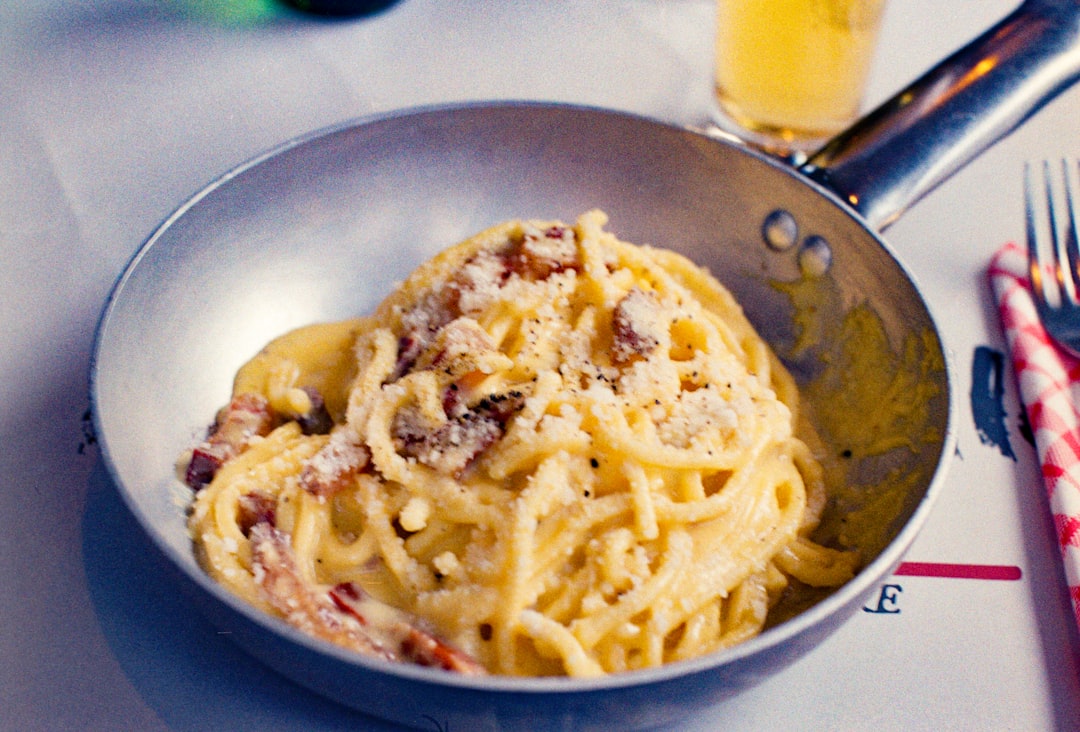
Carbonara is the ultimate test of a cook’s restraint. Four ingredients. No cream. No garlic. No onion. Just guanciale, Pecorino Romano, eggs, and black pepper, bound together by technique and the alchemy of starchy pasta water. When executed properly, this carbonara recipe produces one of the most satisfying pasta dishes on earth: silky, rich, deeply savory, and almost impossibly simple.
The dish originated in Rome in the mid-twentieth century, though its exact provenance remains debated. What is not debated is its canonical preparation. Roman cooks are fiercely protective of their carbonara, and with good reason. Every unnecessary ingredient added to this dish dilutes what makes it great. The cream that appears in countless non-Italian recipes is not just inauthentic; it actively undermines the delicate egg-cheese emulsion that defines true carbonara.
If you enjoy the simplicity of Italian pasta preparations, you may also appreciate our gochujang butter pasta, which takes a similarly minimalist approach with a Korean twist, or our baked feta pasta for another cheese-based sauce that comes together with minimal effort.
Why This Recipe Works
The egg-cheese emulsion is a feat of culinary science. When egg yolks, finely grated Pecorino Romano, and hot pasta water come together at the right temperature (around 145 to 160 degrees F), the egg proteins denature just enough to thicken into a creamy sauce without curdling. The cheese melts and emulsifies with the egg, creating a smooth, glossy coating that clings to each strand. This is the same principle behind hollandaise and custard, just applied to pasta. Too hot, and you get scrambled eggs. Too cold, and the cheese clumps. The sweet spot is narrow, which is what makes carbonara a skill worth mastering.
Starting guanciale in a cold pan renders fat slowly and evenly. Placing the strips of guanciale in a cold skillet and gradually increasing the heat allows the fat to render slowly without burning the exterior. This produces more usable fat (which becomes part of the sauce) and creates perfectly crisp, golden pieces. Starting in a hot pan would sear the outside before the interior fat melts, producing chewy, greasy results.
Starchy pasta water is the secret emulsifier. As pasta cooks, it releases starch into the water. This starch acts as a natural emulsifier, helping the fat from the guanciale, the oil in the cheese, and the water component of the eggs bind into a stable, creamy sauce. This is why you should never rinse your pasta and why heavily salted, well-starched cooking water is essential. Using too much water or cooking pasta in too large a pot dilutes the starch concentration.
Pecorino Romano provides salt, fat, and umami simultaneously. This aged sheep’s milk cheese from Lazio is intensely salty and sharp, with a granular texture that melts smoothly when finely grated. It contributes sodium (so you rarely need to add extra salt), milk fat that enriches the sauce, and glutamates that provide deep umami flavor. Parmigiano-Reggiano is an acceptable partial substitute, but it is milder and sweeter, producing a different flavor profile entirely.
Black pepper is not optional; it is a primary ingredient. In carbonara, black pepper is not a seasoning but a foundational element. The volatile compounds in freshly cracked pepper (particularly piperine) provide warmth and a gentle, sustained heat that balances the richness of the egg and cheese. Use a coarse grind and be generous. According to Serious Eats, the pepper should be visible and assertive in every serving.
Recipe Card
| Prep Time | 10 minutes |
| Cook Time | 20 minutes |
| Total Time | 30 minutes |
| Servings | 4 |
| Difficulty | Intermediate |
| Cuisine | Italian (Roman) |
Ingredients
The Pasta
- 1 pound (450g) spaghetti, rigatoni, or tonnarelli
- Kosher salt, for the pasta water (about 2 tablespoons per gallon)
The Guanciale
- 8 ounces (225g) guanciale, cut into 1/4-inch strips or lardons
The Egg-Cheese Mixture
- 6 large egg yolks
- 2 whole large eggs
- 2 ounces (60g) Pecorino Romano, very finely grated (about 1 packed cup), plus more for serving
- Freshly cracked black pepper, approximately 2 teaspoons (coarse grind)
Step-by-Step Instructions
- Boil the pasta water. Bring a large pot of generously salted water to a rolling boil. The water should taste noticeably salty, like the sea. This is your only opportunity to season the pasta itself. Use at least 4 quarts of water for 1 pound of pasta. Drop the pasta in and cook according to package directions until 1 minute shy of al dente. It will finish cooking in the pan. Before draining, reserve 2 full cups of the starchy pasta water. This liquid is critical to the sauce’s emulsification.
- Render the guanciale. While the water comes to a boil, place the guanciale strips in a large, cold, heavy-bottomed skillet (stainless steel or cast iron, not nonstick). Set the skillet over medium-low heat. Cook for 8 to 10 minutes, stirring occasionally, as the fat slowly renders and the edges turn golden and crisp. The guanciale should have clearly defined crispy edges with some chewy interior. Remove the skillet from the heat but leave the guanciale and rendered fat in the pan. You should have 2 to 3 tablespoons of clear, golden fat.
- Prepare the egg-cheese mixture. While the pasta cooks, whisk together the 6 egg yolks and 2 whole eggs in a medium bowl. Add the finely grated Pecorino Romano and a very generous amount of freshly cracked black pepper (at least 2 teaspoons). Whisk vigorously until the mixture is smooth, thick, and homogeneous. It should look like a pale yellow paste. Set this bowl near the stove where you can reach it quickly.
- Marry the pasta and guanciale. Transfer the drained pasta directly to the skillet with the guanciale and rendered fat. Set the skillet over low heat and toss the pasta for 30 seconds, coating every strand in the flavorful fat. The residual heat from the pasta begins to warm the guanciale fat and create a base for the sauce.
- Create the sauce (the critical step). Remove the skillet from the heat entirely. Wait 60 seconds. This cooling period is essential; the pan needs to drop below 160 degrees F to prevent scrambling. Pour the egg-cheese mixture over the pasta and immediately begin tossing vigorously with tongs or a fork and spoon, lifting the pasta high to expose it to air and promote emulsification. Add reserved pasta water one tablespoon at a time as you toss. The sauce should transform from a thick paste to a glossy, creamy coating that clings to the pasta. You will likely use 1/4 to 1/2 cup of pasta water total. The sauce should be fluid; it will thicken as it cools on the plate.
- Serve immediately. Divide the carbonara among warmed bowls (run them under hot water or warm them in a low oven). Finish each serving with additional grated Pecorino Romano and a final generous crack of black pepper. Carbonara waits for no one. The emulsion begins to set as it cools, so bring your diners to the table before you plate.
Substitution Guide
| Original Ingredient | Substitution | Notes |
|---|---|---|
| Guanciale | Pancetta or thick-cut bacon | Pancetta is the closest substitute. Bacon adds a smoky note not present in the original. Both render less fat than guanciale. |
| Pecorino Romano | 50/50 blend of Pecorino and Parmigiano-Reggiano | Pure Parmesan is too mild. A blend preserves some of the sharp, salty character essential to carbonara. |
| Egg yolks | All whole eggs (use 4 whole eggs) | The sauce will be lighter and slightly less rich. Yolks provide the bulk of the emulsifying power. |
| Spaghetti | Rigatoni, bucatini, or mezze maniche | Rigatoni is equally traditional in Rome. Avoid thin pasta like capellini. Short tube shapes trap sauce inside beautifully. |
| Black pepper | No adequate substitute | Black pepper is a fundamental ingredient, not optional seasoning. Use freshly cracked from a mill, never pre-ground. |
| Pork (for dietary needs) | Crispy mushrooms or smoked tempeh | Saute sliced king oyster mushrooms until deeply golden for a vegetarian version. Not traditional but delicious. |
Storage and Reheating Instructions
The honest truth: Carbonara is best eaten within 5 minutes of preparation. The egg-cheese emulsion is at its most beautiful and fluid immediately after tossing. However, leftovers happen, and they can be managed well.
Refrigerator: Transfer cooled carbonara to an airtight container. It keeps for up to 2 days. The sauce will solidify and the pasta will absorb moisture, becoming denser.
Reheating (the gentle method): Place a portion in a skillet over the lowest possible heat. Add 2 to 3 tablespoons of water or pasta water if you saved some. Toss gently and continuously as it warms. The goal is to re-emulsify the sauce without cooking the eggs further. Remove from heat before it is fully hot; the residual heat will finish the job. This takes patience but produces results far superior to microwaving.
Freezer: Carbonara does not freeze well. The egg-cheese emulsion breaks during freezing and thawing, producing a grainy, separated texture that cannot be restored.
For another Italian pasta dish that reheats more gracefully, our lemon asparagus pasta actually improves overnight as the flavors meld.
Nutrition Facts (Per Serving)
| Nutrient | Amount | % Daily Value |
|---|---|---|
| Calories | 580 kcal | 29% |
| Total Fat | 26g | 33% |
| Saturated Fat | 11g | 55% |
| Cholesterol | 210mg | 70% |
| Sodium | 720mg | 31% |
| Total Carbohydrates | 58g | 21% |
| Dietary Fiber | 2g | 7% |
| Sugars | 2g | — |
| Protein | 28g | 56% |
Nutrition values are estimates based on USDA FoodData Central. Actual values vary by specific ingredients, brands, and serving sizes. Guanciale fat content varies significantly by producer.
The History of Carbonara
The origins of carbonara are contested and delightfully murky. The most widely cited theory connects it to the carbonari (charcoal workers) of the Apennine mountains, who supposedly combined their available provisions: cured pork, eggs, cheese, and pepper. Another theory credits American GIs stationed in Italy during World War II, who may have combined their ration bacon and powdered eggs with local pasta, inspiring Roman cooks to refine the concept with their own superior ingredients.
What is certain is that carbonara does not appear in Italian cookbooks before the late 1940s. The first known published recipe dates to 1952, in a guide to Italian restaurants in the United States. By the 1960s, it had become firmly established in Roman culinary identity. According to Bon Appetit’s historical research, the dish evolved through the postwar period as Roman trattorias standardized what had been a loosely defined preparation.
Today, carbonara occupies a nearly sacred position in Roman cuisine, alongside cacio e pepe, amatriciana, and gricia, the four canonical Roman pastas. Each shares a foundation of Pecorino Romano and black pepper, with carbonara distinguished by its addition of eggs and guanciale.
Common Mistakes and How to Avoid Them
Mistake: Adding cream. This is the cardinal sin. Cream masks the egg flavor, dilutes the Pecorino, and produces a heavy, one-dimensional sauce. The creaminess in authentic carbonara comes from the egg-cheese emulsion. Trust the technique.
Mistake: Scrambling the eggs. This happens when the pan is too hot when you add the egg mixture. Always remove the pan from heat, wait a full 60 seconds, then add the mixture while tossing vigorously. The pasta’s residual heat (not direct flame) should cook the eggs gently.
Mistake: Using pre-grated cheese. Pre-grated cheese contains anti-caking agents (typically cellulose) that prevent it from melting smoothly. Always grate Pecorino Romano from a block using a Microplane or the finest holes on a box grater. The finer the grate, the smoother the sauce.
Mistake: Discarding the pasta water. Reserve at least 2 cups before draining. This starchy water is the emulsifier that binds your sauce. Without it, you will have clumpy cheese instead of a smooth coating.
Mistake: Not being generous with pepper. Carbonara should have a visible, assertive amount of black pepper. It is one of only four ingredients. If you cannot see and taste the pepper distinctly, you have not used enough.
Frequently Asked Questions
Why does carbonara have no cream?
Authentic Roman carbonara has never included cream. The creamy texture comes entirely from the emulsion of egg yolks, finely grated Pecorino Romano cheese, and starchy pasta water. When combined at the correct temperature (around 145 to 160 degrees F), these ingredients form a smooth, glossy sauce that clings to the pasta. Adding cream actually dilutes the concentrated flavors of egg and cheese and produces a heavier, less nuanced result. Every Roman cook and every serious Italian cookbook confirms this.
What is the difference between guanciale and pancetta?
Guanciale is cured pork jowl (cheek), while pancetta is cured pork belly. Guanciale has a significantly higher fat-to-meat ratio, typically around 70% fat, which means it renders more flavorful liquid fat for the sauce and becomes crispier when cooked. Its flavor is richer, more delicate, and slightly sweeter than pancetta. If guanciale is unavailable, unsmoked pancetta is the best substitute, followed by thick-cut unsmoked bacon as a last resort.
How do I prevent scrambled eggs in carbonara?
Temperature control is the entire answer. Remove the pan from heat before adding the egg-cheese mixture. Wait a full 60 seconds for the pan to cool slightly below 160 degrees F. Then pour the mixture over the pasta while tossing vigorously and continuously with tongs. The residual heat from the pasta and pan gently cooks the eggs into a creamy sauce without curdling them. If you are nervous, temper the eggs first by whisking a few tablespoons of hot pasta water into the egg mixture before adding it to the pan.
Can I use Parmesan instead of Pecorino Romano?
A blend of half Pecorino Romano and half Parmigiano-Reggiano is used by many Roman trattorias and is entirely acceptable. However, using only Parmesan changes the character of the dish significantly. Pecorino Romano is sharper, saltier, and more assertive, which is essential to carbonara’s bold, punchy flavor. Pure Parmesan makes a milder, sweeter sauce that, while still delicious, is a different dish. Grate either cheese on a Microplane for the smoothest sauce.
What pasta shape is best for carbonara?
Spaghetti is the most traditional choice in Rome, and it is what you will find at the majority of trattorias. Rigatoni is the second most popular option, and many Romans actually prefer it because its ridges and hollow tubes trap the sauce beautifully. Tonnarelli (a thick, square-cut egg pasta) is another authentic Roman option. Bucatini (thick spaghetti with a hole through the center) also works well. Avoid thin, delicate pasta like angel hair or capellini, which overcook easily and cannot support the rich, heavy sauce.
Disclaimer
Nutritional information is provided as a general estimate and should not be considered a substitute for professional dietary advice. Values are calculated using USDA FoodData Central data and may vary depending on specific brands, ingredient sizes, and preparation methods. This recipe contains eggs, dairy, pork, and wheat. If you have food allergies or dietary restrictions, consult a healthcare professional before preparing this recipe. This article contains links to external websites for informational purposes; cookingzone.org is not responsible for the content of external sites.

Rachel Summers
Rachel grew up in a Pacific Northwest kitchen, learning Sunday roasts from her mother and pie crust from a grandmother who never wrote a recipe down. CookingZone began as a way to save her family's cooking before it was forgotten, and grew when her cousins started sending in their own. Her work covers foundational American, Italian, French, and Mexican recipes, with an emphasis on weekend baking, comfort food, and the techniques that span both European and American home kitchens.
Please note: Nutritional estimates in our recipes are derived from the USDA FoodData Central database and may vary based on specific brands and ingredient sizes. If you have food allergies, dietary restrictions, or medical conditions, consult a registered dietitian or healthcare provider before preparing this recipe. Always follow safe food-handling guidelines, including proper cooking temperatures for meat, poultry, fish, and eggs. Nothing in this article should be interpreted as medical, nutritional, or dietary advice.