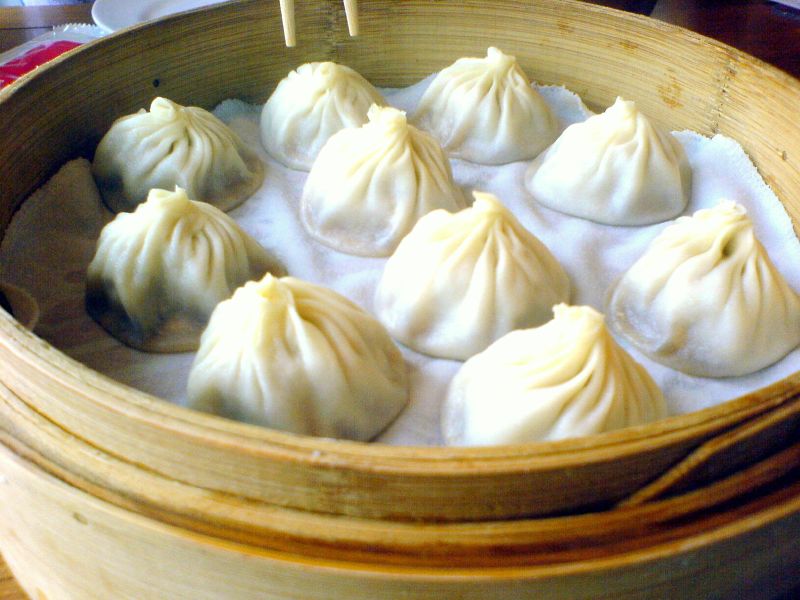
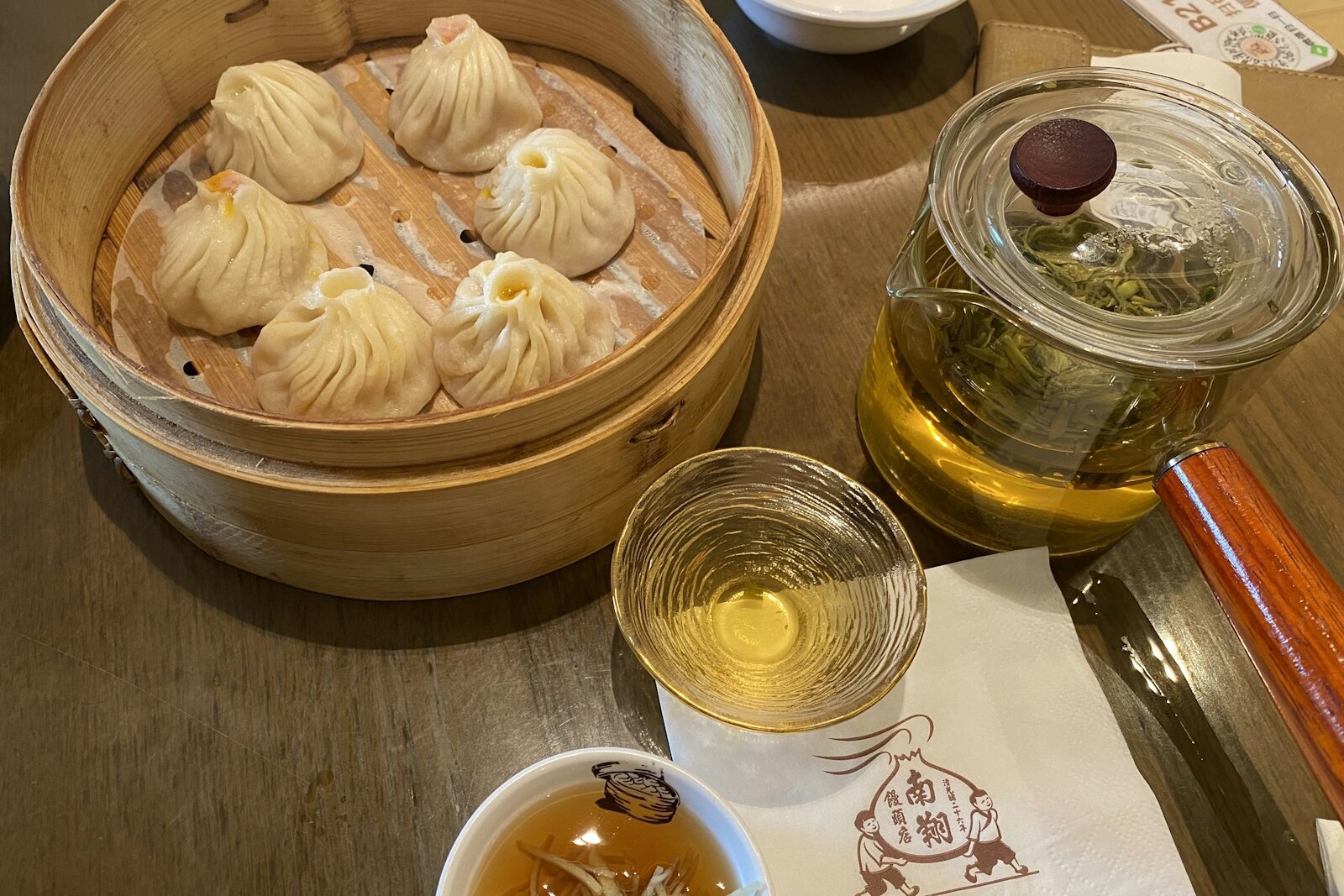
There is no other dumpling in the world that asks you to drink it. Xiaolongbao — the Shanghai soup dumpling, called “little basket buns” for the bamboo steamers they arrive in — contains hot pork broth inside a thin wheat-flour skin that has been pleated eighteen times by hand. You pick one up with chopsticks, lower it onto a spoon, and pierce the side with a tooth or chopstick tip. A jet of fragrant pork broth fills your spoon. You sip it. Only then do you eat the dumpling. The whole sequence is choreographed by the architecture of the food. There is no other way to consume one without burning yourself and losing the soup entirely.
Xiaolongbao originated in the late nineteenth century in Nanxiang, a township outside Shanghai, where a teahouse owner named Huang Mingxian is credited with the innovation: gelatinized pork broth folded into a pork filling, sealed in a delicate wheat skin, steamed in small bamboo baskets. The dumpling spread to central Shanghai by the 1900s and became one of the city’s defining dishes. In the late twentieth century, the Taiwanese chain Din Tai Fung — founded in 1958 in Taipei, originally as an oil shop — codified the precise modern version with eighteen pleats, 21 grams of filling per dumpling, and timed bamboo steaming. Din Tai Fung now has restaurants in fourteen countries and has effectively become the international standard.
Andrea Nguyen, the cookbook author whose Asian Dumplings and Vietnamese Food Any Day have taught generations of American home cooks the technical foundations of dumpling-making, called xiaolongbao “the patience test of Asian dumpling craft” in her 2009 book. The recipe is not complicated — pork filling, wheat-flour dough, gelatinized broth, hand-pleating, bamboo steaming — but each step requires the right execution and the whole thing takes the better part of a day. Most home cooks succeed at xiaolongbao on the second or third attempt. The first batch usually leaks. The rest of this article is how to minimize that.
The Gelatinized Broth: The Secret Inside the Dumpling
The soup inside xiaolongbao is solid when the dumpling is assembled. This is the central technical innovation. A high-collagen broth — made from pork skin, chicken feet, or pork knuckles — is simmered for 3 to 4 hours, strained, and chilled overnight. The gelatin extracted from the connective tissue causes the broth to set into a firm jelly. The jelly is diced and folded into the meat filling. During steaming, the gelatin melts back into liquid soup inside the now-sealed dumpling.
The collagen content of your broth is the variable that decides whether your dumplings will succeed. Pork skin produces the cleanest, most neutral-flavored gelatin and is the traditional choice. Chicken feet add depth and umami. Pork knuckles (cut by your butcher) work but produce a slightly cloudier broth. Avoid using powdered gelatin as a shortcut — the texture and flavor of the resulting soup is noticeably inferior. Source pork skin from an Asian or Mexican butcher, scrape clean of any remaining fat with a knife, and proceed.
The 18-Pleat Standard and Why It Matters
Din Tai Fung established the eighteen-pleat standard in the 1980s as a quality control measure for their Taipei restaurant. The number was chosen for visual symmetry (each pleat occupies twenty degrees of the circumference, dividing the wrapper into eighteen equal segments) and for structural integrity. Tight, uniform pleats produce a strong seal that withstands the pressure of steam-heated soup inside the dumpling. Loose or uneven pleats are the most common cause of dumpling failure: the dumpling leaks during steaming and the soup ends up in the steamer rather than the dumpling.
For home cooks, 12 to 18 pleats is the realistic target. Fewer than 12 produces visibly amateur dumplings but can still be functional if the pleats are tight. More than 18 begins to thicken the top to the point where it does not steam through evenly and produces a doughy bite at the closure. Practice the technique on plain dough first — pleat dummy dumplings filled with nothing — until your hands know the motion. The pleat is created by pinching at the wrapper edge, folding toward the center, then rotating the dumpling a small amount before pinching the next. The motion is muscle memory.
The Hot-Water Dough
Xiaolongbao wrappers are made from a hot-water dough (sometimes a hybrid of hot and cold water for slightly more structure). The hot water partially gelatinizes the wheat starch, which produces a dough that is more elastic and easier to roll thin without tearing — essential for the translucent skin that distinguishes xiaolongbao from coarser dumplings. Many recipes use warm water (40°C / 105°F) for a balance of elasticity and ease of handling; pure boiling water produces a very soft dough that some find difficult to work with at home.
Knead by hand for ten minutes. The dough should be smooth, elastic, and slightly tacky but not sticky. Cover with a damp towel and rest at room temperature for 30 minutes before rolling — resting allows the gluten to relax, which makes rolling thin wrappers significantly easier. Divide the dough into 36 pieces (about 13 grams each). Roll each into a ball, then into a circle about 8 centimeters across. The center should be slightly thicker than the edges — this is what creates the strong base that holds the filling while the thin edges pleat together cleanly at the top.
Xiaolongbao vs Soup Dumpling Variants: A Quick Map
| Dumpling | Region | Distinguishing feature |
|---|---|---|
| Xiaolongbao | Shanghai | Thin wheat skin, 18 pleats, pork-broth jelly, steamed |
| Sheng Jian Bao | Shanghai | Yeasted thick dough, pan-fried bottom, soup inside |
| Tang Bao | Yangzhou | Much larger version with crab roe broth, drunk through a straw |
| Guotie (potstickers) | Northern China | Pan-fried bottom, no soup, larger |
Ingredients
For the gelatinized broth (make 1 day ahead):
- 500 g (1.1 lb) pork skin, scraped clean of fat
- 2 chicken feet, blanched
- 1.5 liters (6 cups) water
- 2 spring onions, knotted
- 1 piece fresh ginger (5 cm), sliced
- 2 tablespoons Shaoxing wine
For the dough:
- 300 g (10.5 oz) all-purpose flour
- 160 ml (2/3 cup) warm water (40 C / 105 F)
For the filling:
- 300 g (10.5 oz) ground pork (80% lean)
- 3 tablespoons light soy sauce
- 1 tablespoon Shaoxing wine
- 1 teaspoon toasted sesame oil
- 1 teaspoon ground white pepper
- 1 teaspoon sugar
- 1 teaspoon grated ginger
- 2 tablespoons chicken stock
To serve:
- Chinkiang black vinegar
- Fresh ginger, cut into very thin threads
Making It
- Make broth (1 day ahead). Blanch pork skin and chicken feet 5 min. Drain, rinse. Combine with water, aromatics, Shaoxing wine. Simmer covered 3-4 hours until reduced by half. Strain. Chill overnight. Must set firm.
- Make dough. Combine flour and warm water. Knead 10 min until smooth and elastic. Cover, rest 30 min.
- Make filling. Dice chilled broth jelly into 5-mm cubes. Mix ground pork with soy, Shaoxing, sesame oil, white pepper, sugar, grated ginger, chicken stock. Stir one direction 2 min until sticky. Fold in jelly cubes gently.
- Roll wrappers. Divide dough into 36 pieces (~13 g each). Roll into balls, then circles 8 cm across, thicker center, thinner edges.
- Fill and pleat. Place 1 tbsp filling in center. Pinch pleat at edge, fold toward center. Rotate, pleat every 5 mm. Aim for 18 pleats. Pinch top sealed.
- Steam. Place in bamboo steamer lined with parchment, 2 cm between each. Steam over rolling-boil water 7-8 min until wrappers translucent.
- Serve. Serve immediately with black vinegar + ginger threads. Eat carefully — soup is scalding.
Common Mistakes
The most common failure is broth that does not set firm enough. If your gelatinized broth is still semi-liquid the next morning, you under-reduced or under-cooked. The fix: re-simmer the broth uncovered for another hour to concentrate further, then re-chill. Without firm jelly cubes, you cannot fold solid soup into the filling and the dumplings will leak. The second mistake is wrappers rolled to an even thickness. They must be thicker in the center than at the edges — this creates a strong base for filling and thin edges for clean pleating. A rolling pin held at a slight angle and rolled in a circular motion produces this naturally.
The third mistake is over-steaming. Eight minutes is the maximum; the wrapper becomes overly soft and tears when you lift it after ten minutes. The fourth mistake is filling the dumplings too aggressively. One tablespoon (about 20 g) per dumpling is the right amount; more than that strains the pleats and increases the risk of bursting during steam. Beginners should err on the side of less filling until pleating skill develops.
What to Serve Alongside
A bamboo basket of xiaolongbao (typically 8 to 10 dumplings) is a meal in itself in Shanghai. For a larger spread, add a cold cucumber salad with sesame oil and chili, scallion pancakes, and steamed greens like baby bok choy with oyster sauce. Hot Chinese tea — especially a tongue-cleansing oolong or pu-erh — cuts the richness of the soup beautifully. For something from our family, our Cantonese congee with century egg offers the southern Chinese rice-porridge counterpart, and our authentic Sichuan mapo tofu rounds out a broader Chinese rotation.
Storage and Make-Ahead
Xiaolongbao do not refrigerate well after steaming — the soup absorbs back into the wrapper and the texture is lost. They freeze beautifully before steaming: arrange pleated dumplings on a parchment-lined tray, freeze until solid (2 hours), then transfer to a freezer bag. Steam directly from frozen (no thawing) for 9 to 10 minutes. Frozen dumplings keep 2 months. The dough and the broth can each be made up to 2 days ahead and refrigerated separately; assemble and steam to order. Many home cooks dedicate an afternoon to a large batch, freeze most, and have a Saturday dinner ready in 10 minutes.
Frequently Asked Questions
How is the soup inside the dumpling not a leak risk?
The soup starts solid. A gelatin-rich broth is chilled overnight into firm jelly, diced, and folded into the meat filling. During steaming, the gelatin melts back into liquid soup inside the sealed dumpling. Failed dumplings (those that leak) usually have incomplete pleat seals or wrappers too thin at the closure.
Why exactly 18 pleats?
Din Tai Fung standardized 18 pleats in the 1980s for visual symmetry (twenty degrees per pleat) and structural integrity. For home cooks, 12-18 is realistic. Fewer than 12 looks amateur but functions; more than 18 thickens the top too much. Practice on plain dough first.
Can I make xiaolongbao with store-bought wrappers?
No. Xiaolongbao wrappers are a hot-water dough that produces a thin, strong, slightly translucent skin that holds soup. Wonton wrappers (too thick, wrong texture), gyoza wrappers (too thin), and siu mai wrappers (lack strength) cannot substitute. The dough is simple — flour, water, kneading time — and worth making from scratch.
What is the proper way to eat xiaolongbao?
Lift dumpling carefully with chopsticks supported by a spoon. Place on spoon. Puncture small hole with chopstick. Sip out hot soup. Then dip empty dumpling in black vinegar with ginger threads and eat. Allow 30 seconds of cooling before first sip — dumplings straight from steam have caused real burns.
Sources
- Serious Eats — Xiaolongbao Soup Dumplings — Detailed pleating walkthrough and gelatinized broth technique.
- Bon Appétit — Soup Dumplings — Andrea Nguyen-style adaptation for the home kitchen.
- USDA FoodData Central — Pork and Flour — Nutritional data.
Each dumpling contains roughly 58 calories, 3 g protein, 2.5 g fat, 6 g carbohydrates.
Please note: Contains pork, soy, sesame, wheat. Not suitable for vegan, halal/kosher, or wheat-allergic diets. The hot soup inside can cause burns — allow brief cooling before consuming.