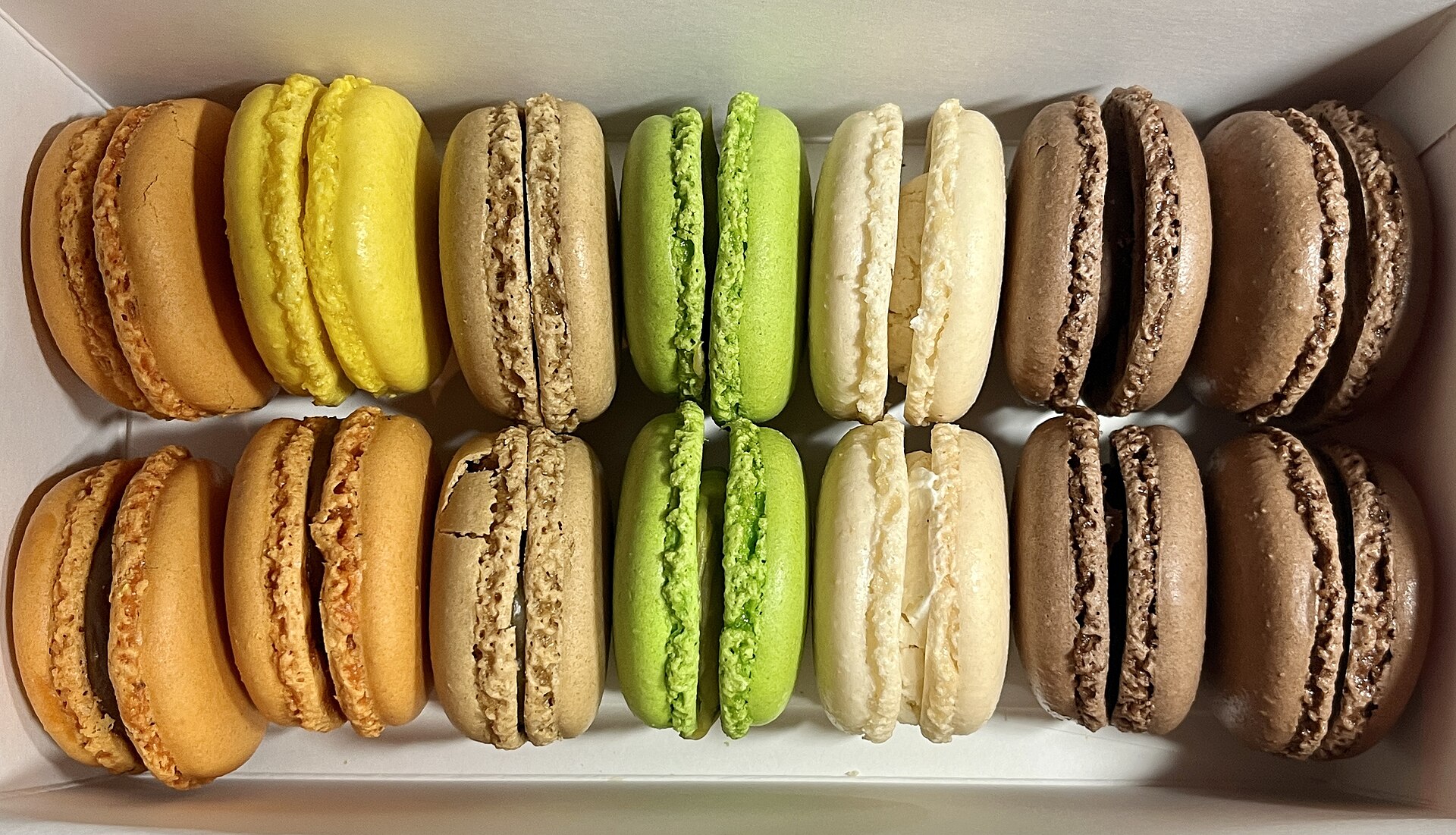
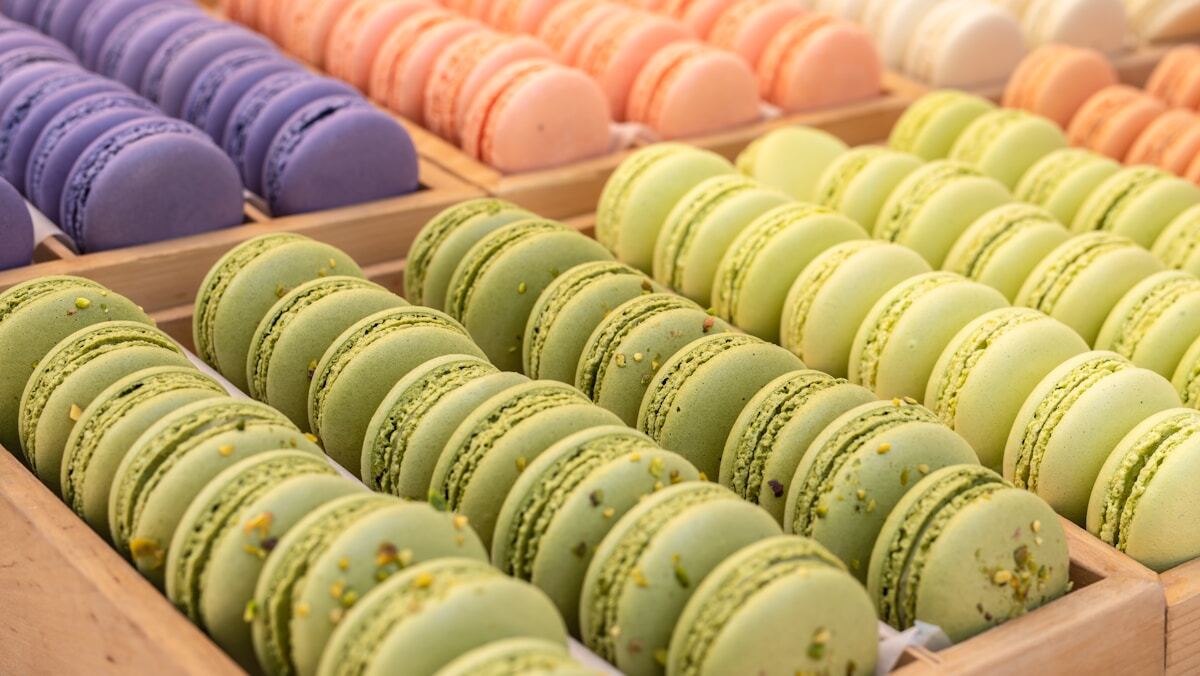
There is a particular kind of silence that descends on a kitchen when the macarons come out of the oven. You crouch in front of the open oven door. You see the smooth domes. You see the ruffled feet, that crinkled skirt of meringue that distinguishes a real macaron from any other cookie. You exhale. The shells slid cleanly off the parchment. None cracked. None spread into ovals. None turned into flat discs of meringue with no foot at all. This is a quiet victory in any home kitchen, and an act of accumulated technique — the result of getting two dozen variables right at once, when getting any one of them wrong produces a tray of failures.
Macarons appear simple. Almond flour, sugar, egg whites, color. Pipe, rest, bake. Sandwich with buttercream. That is the entire recipe in one sentence, and it is the reason so many home cooks attempt them with the wrong respect — the cookies look fancy but the ingredients are pantry staples, and so they must be easy. They are not. Macarons are physics held in suspension: a foamy meringue, a saturated sugar matrix, and almond particles that all must agree to behave for fifteen minutes at exactly 150°C. Get the meringue too stiff, you trap air voids inside the shell. Fold too much, you produce flat puddles. Skip the rest, the tops crack. Run the oven hot, the feet collapse and the shells spread. Run it cool, no feet form at all. Each variable depends on the others.
Pierre Hermé, the patissier who reinvented macarons for the modern Parisian palate in the 1980s and 1990s, said in his 2008 cookbook that a young patissier needs 200 attempts before reliably producing perfect macarons. Christophe Felder, in his teaching materials at École Ferrandi, settles on 150. Stella Parks, writing for Serious Eats in 2017, suggested 80 attempts for a determined home cook. The number changes; the principle does not. Macarons reward repetition, not creativity. The rest of this article is the recipe that finally worked for me after my own 60-attempt arc — the Italian meringue method, with explanations of every variable that matters, and what each one means if you get it wrong.
The Almond Flour Sift That Decides Everything
Watch a professional macaron line and the first thing you will notice is the sieve. Every batch starts with the patissier sifting the almond flour and powdered sugar together — not once, but twice. They press the mixture through a tamis (a drum-shaped fine sieve), discard any larger almond particles that do not pass through, then re-sift the result. The whole step takes ten minutes for a small batch. Home recipes routinely tell you to “briefly sift the almond flour” or skip the step entirely. The result is the difference between a smooth-domed macaron and one that looks bumpy or grainy across the top.
The reason is granular geometry. Almond flour, even the finest commercial brands, contains a range of particle sizes — some as fine as powdered sugar, others as coarse as semolina. The coarse particles do two bad things in macaron batter: they refuse to incorporate smoothly during macaronage (the folding step), leaving streaks of un-folded almond that hold air pockets, and they sit on the surface of the shell after piping, producing a visibly bumpy top. The double-sift removes the worst offenders. Commercial almond flour brands vary in quality — King Arthur and Bob’s Red Mill produce reliable medium-grind; Honeyville and Anthony’s sell “super-fine” almond flour that is closer to professional standard and needs less sifting. For best results, buy the finest commercial flour you can find, then sift it twice anyway. The five minutes save you a tray of disappointment.
Italian vs French Meringue: The Choice That Sets Your Success Rate
There are three meringue methods for macarons: French (cold egg whites whipped with sugar gradually added), Italian (hot sugar syrup streamed into whipping whites), and Swiss (whites and sugar warmed over a bain-marie, then whipped). Each produces a slightly different texture profile, but the practical difference for home cooks is reliability. The French method is the simplest but the least forgiving: the meringue is delicate and prone to over-whipping, and the unsweetened proteins are more vulnerable to deflation during macaronage. A bad day — humid weather, an off-temperature egg white, a moment too long in the mixer — and your batch fails.
The Italian method, used in this recipe, is the professional standard for production patisseries precisely because it tolerates small mistakes. The hot 118°C sugar syrup partially cooks the egg whites as it streams in, denaturing some proteins and producing a more stable, glossier meringue that holds its structure through aggressive macaronage. It is also slightly sweeter and more elastic, which makes piping easier. The trade-off is one additional piece of equipment (a candy thermometer) and one additional step (the syrup). Both are worth it for a 30 to 40 percent higher success rate. Swiss method falls between the two in difficulty; we will not cover it here, but it is the choice if you find Italian intimidating but want more stability than French allows.
Macaronage: The Lava-Flow Stage You Cannot Photograph
Macaronage is the folding stage where the meringue and the almond-sugar mixture become batter. It is also the single hardest step to teach because the endpoint is a texture that does not photograph well. The batter should fall from the spatula in a thick ribbon that disappears back into itself in about 10 seconds. Patissiers call this the “ruban” (ribbon) or the “magma” or “lava-flow.” Under-folded batter holds its shape rigidly after piping — the macarons have peaks and bumps that do not settle. Over-folded batter flows too readily — the macarons spread into thin discs with no internal structure.
The correct technique: add one-third of the meringue to the almond paste and fold vigorously to lighten the mixture — this initial fold is meant to deflate. Then add the remaining meringue and fold gently. Use a flexible silicone spatula. Press the spatula down through the center of the bowl, then sweep it up and around the side, turning the bowl quarter-turn after each fold. Count the folds — 30 to 50 is typical for a properly hydrated batter. Test by lifting the spatula and letting a small amount drip; if it forms a ribbon that smooths back into the bowl in 8 to 12 seconds, stop. If it stays in distinct peaks, fold a few more times. If it flows freely without ribbon structure, you have over-folded and the batch will spread. There is no recovery from over-folding; the batter is finished. Better to under-fold by a few strokes than over-fold by one.
French Macarons vs Italian Macaroons vs Coconut Macaroons: A Quick Map
| Cookie | Origin | Main Ingredients | Texture |
|---|---|---|---|
| French Macaron | France (modern: Paris, 1830s) | Almond flour, powdered sugar, egg whites, meringue, ganache filling | Crisp shell, chewy interior, smooth dome, ruffled foot |
| Italian Macaron (Amaretto-style) | Italy (Renaissance origin) | Almond paste, sugar, egg whites | Dense, chewy, no shell, no filling |
| Coconut Macaroon (American) | American (20th century) | Shredded coconut, condensed milk, egg whites | Crispy outside, soft moist interior |
The confusion of spelling (macaron vs macaroon) reflects a real historical connection — all three trace back to Italian Renaissance almond cookies — but the modern recipes have nothing in common. The French macaron is the one with the smooth dome and ruffled foot. The Italian amaretto-style and the American coconut macaroon are entirely different desserts despite the linguistic similarity.
Ingredients
For the macaron shells (yields 48 shells / 24 sandwiches):
- 150 g (1 1/4 cups) blanched almond flour, finely ground
- 150 g (1 1/4 cups) powdered (icing) sugar
- 110 g (about 4) egg whites, divided into two 55 g batches, aged 24 hours
- 150 g (3/4 cup) granulated sugar
- 50 g (3 tablespoons + 1 teaspoon) water
- 1/4 teaspoon cream of tartar
- Gel food coloring as needed (powder works too; avoid liquid food coloring)
For the pistachio buttercream filling:
- 1 cup (115 g) unsalted shelled pistachios, blanched (skins removed)
- 200 g (1 cup) unsalted butter, room temperature
- 150 g (1 1/4 cups) powdered sugar, sifted
- 1/4 teaspoon fine sea salt
- 1/2 teaspoon pure vanilla extract
- 1 to 2 teaspoons heavy cream, as needed for consistency
Making It
- Age the egg whites. The day before baking, separate eggs and store whites in a covered container in the refrigerator overnight. Bring to room temperature before using.
- Double-sift dry ingredients. Combine almond flour and powdered sugar in a fine-mesh sieve over a bowl. Press through with a spatula. Discard any larger pieces. Re-sift the mixture a second time.
- Make the Italian meringue syrup. Combine 150 g granulated sugar and 50 g water in a small saucepan. Clip on a candy thermometer. Heat over medium-high without stirring until syrup reaches 118 C (245 F).
- Whip the first egg white batch. While syrup heats, begin whipping 55 g whites in a stand mixer on medium. When syrup hits 115 C, add cream of tartar and increase to medium-high.
- Stream syrup into whites. When syrup reaches 118 C, immediately pour in a slow steady stream down the side of the bowl. Whip on high until the meringue is glossy, holds firm peaks, and has cooled to body temperature, 6 to 8 minutes.
- Make the tant pour tant. Add remaining 55 g unbeaten whites plus any gel coloring directly to the almond-sugar mixture. Stir with a spatula until you have a thick smooth paste.
- Macaronage. Add 1/3 of the meringue to the almond paste; fold vigorously to lighten (this deflates the first portion). Add remaining meringue; fold gently. The batter is done when it falls from the spatula in a ribbon that disappears back into itself in about 10 seconds. Stop the moment you reach this.
- Pipe. Transfer to a piping bag with a 10 mm round tip. Pipe 3.5 cm rounds on silicone or parchment, leaving 2 cm between each. Tap the pan firmly on the counter 3 to 5 times to release bubbles.
- Rest. Let shells sit at room temperature for 30 to 60 minutes until dry to the touch and not sticky. This creates the foot.
- Bake. Preheat oven to 150 C (300 F), rack in lower-middle. Bake one tray at a time for 13 to 16 minutes, rotating halfway. Shells are done when they slide cleanly off the parchment. Cool completely on the tray.
- Pistachio buttercream. Pulse pistachios in a food processor until fine. Beat butter until pale and fluffy, 3 minutes. Add powdered sugar gradually, then pistachio powder, salt, vanilla. Beat until smooth; add cream if needed.
- Assemble and mature. Pair shells by size. Pipe buttercream onto one shell of each pair, sandwich with the other. Refrigerate in an airtight container for 24 hours. Bring to room temperature 30 minutes before serving.
Troubleshooting: The Five Most Common Failures
Hollow shells: Caused by over-whipped meringue, under-folded batter, or wrong oven temperature. Whip to firm glossy peaks (not stiff/dry). Verify oven with a thermometer — many home ovens run 10 to 15 degrees hot or cold. Cracked tops: Insufficient rest before baking, or oven heat too direct from below. Rest until completely dry to the touch (longer on humid days). Place an empty sheet pan on the rack below to deflect direct heat. No feet: Rest was too long, oven too cool, or batter was over-folded. The foot forms when the rested skin holds while steam escapes sideways from the base.
Spread / flat discs: Almost always over-folded macaronage. The batter flows out of its piped shape. There is no save; bake them as cookies and start over with the next batch, folding fewer times. Bumpy tops: Insufficient sifting of almond flour. The coarse particles produce visible bumps on the shell. Sift twice; for problematic batches, sift three times or buy super-fine almond flour. Tap the piped trays harder on the counter to release internal bubbles. Each failure mode tells you a specific thing about your technique — do not just retry the same recipe; identify the variable that went wrong and adjust only that.
Filling Variations and Maturation Time
The maturation step — sandwiching the shells with filling and refrigerating for 24 hours before serving — is essential. During this rest, moisture from the buttercream migrates outward into the dry meringue shells, transforming them from crisp/dry to crisp-then-chewy with the famous tender interior. Macarons eaten within an hour of assembly are too crunchy and one-note. Macarons after 24 hours have the textural sophistication that makes them famous. After 36 to 48 hours the shells begin to soften too much; serve within 5 days for best texture.
Beyond pistachio buttercream, classic French fillings include dark chocolate ganache, vanilla bean crème au beurre, raspberry jam (sandwiched with a thin disc of chocolate to prevent over-softening), salted caramel, lemon curd with French buttercream, and rose-water-scented white chocolate ganache. For something more in our family register, our Basque burnt cheesecake with pistachio uses pistachio in a richer, simpler dessert that pairs well alongside a small selection of macarons. For an alternative cookie experience, our triple chocolate brownies with fudgy center and crackly top are the casual home-baking counterpart.
Storage and the 24-Hour Rule
Filled, matured macarons keep refrigerated in an airtight container for 5 to 7 days. The flavor and texture peak between 24 and 48 hours after assembly, then slowly decline. Unfilled shells store at room temperature in an airtight container for 3 days. Macarons freeze beautifully: arrange filled, matured macarons in single layers separated by parchment paper in a freezer-safe container. They keep for up to 3 months frozen and lose almost no quality. To serve, thaw in the refrigerator overnight, then bring to room temperature 30 minutes before eating. Many Parisian patisseries freeze their entire daily production and only thaw what is needed throughout the day — the practice is standard, not a compromise. The texture of properly frozen macarons is indistinguishable from fresh.
Frequently Asked Questions
Why are my macarons hollow inside?
Hollow shells are the most common macaron failure with three causes. First, over-whipped meringue creates internal voids during baking — whip to firm glossy peaks, not stiff and dry. Second, under-folded macaronage leaves the batter too thick. Third, oven temperature too high or too low: above 160 C the shell sets too fast trapping a hollow underneath; below 145 C the structure cannot support itself. Verify your oven with a thermometer — many home ovens run 10 to 15 degrees off.
Italian method vs French method – which is better for home cooks?
The Italian method (used in this recipe) is more forgiving and reliable. The hot sugar syrup partially cooks the egg whites, creating a more stable meringue. French method (just whipping whites with sugar gradually) requires precise timing and is more prone to deflation during macaronage. Start with Italian; master the texture; then try French if curious. The end result is nearly identical when both are executed properly — it is the failure rate that differs.
Why do my macarons crack on top?
Cracked tops indicate insufficient resting before baking or oven heat too direct from below. The 30 to 60 minute rest creates a dry skin that allows steam to escape sideways (forming the foot) rather than upward. Humidity above 60 percent extends rest time — on humid days, allow 90 minutes or use a fan. For oven issues, place an empty baking sheet on the rack below to deflect heat. The bake should be a gentle dry-out, not a roast.
How long do macarons last and should I freeze them?
Filled macarons require a 24-hour maturation in the refrigerator after assembly — the shells absorb moisture from the filling and develop the famous tender-crisp texture. After maturation, they keep refrigerated for 5 to 7 days. Unfilled shells keep at room temperature for 3 days. Macarons freeze beautifully — up to 3 months frozen, thawed overnight in the refrigerator. Many Parisian patisseries freeze their entire daily output. The texture is unaffected when frozen properly.
Sources
- Serious Eats — The Science of Macarons — Stella Parks’ detailed scientific breakdown of the meringue chemistry and macaronage hydration ratios.
- Bon Appétit — French Macarons — A reliable Italian-method version with notes on the resting environment and humidity considerations.
- USDA FoodData Central — Nuts and Sugars — Nutritional data for per-serving calculations.
Each sandwich macaron contains roughly 118 calories, 2 g protein, 7 g fat, 12 g carbohydrates, and 0.5 g fiber — based on a 4-cm shell with 8 g of pistachio buttercream.
Please note: Nutritional estimates are derived from the USDA FoodData Central database and may vary by brand of almond flour and butter. This recipe contains tree nuts (almonds, pistachios), dairy (butter, cream), and eggs. Nothing in this article should be interpreted as medical or dietary guidance. Macarons are not suitable for individuals with severe nut allergies. If you have specific dietary needs or are pregnant, consult a registered dietitian.