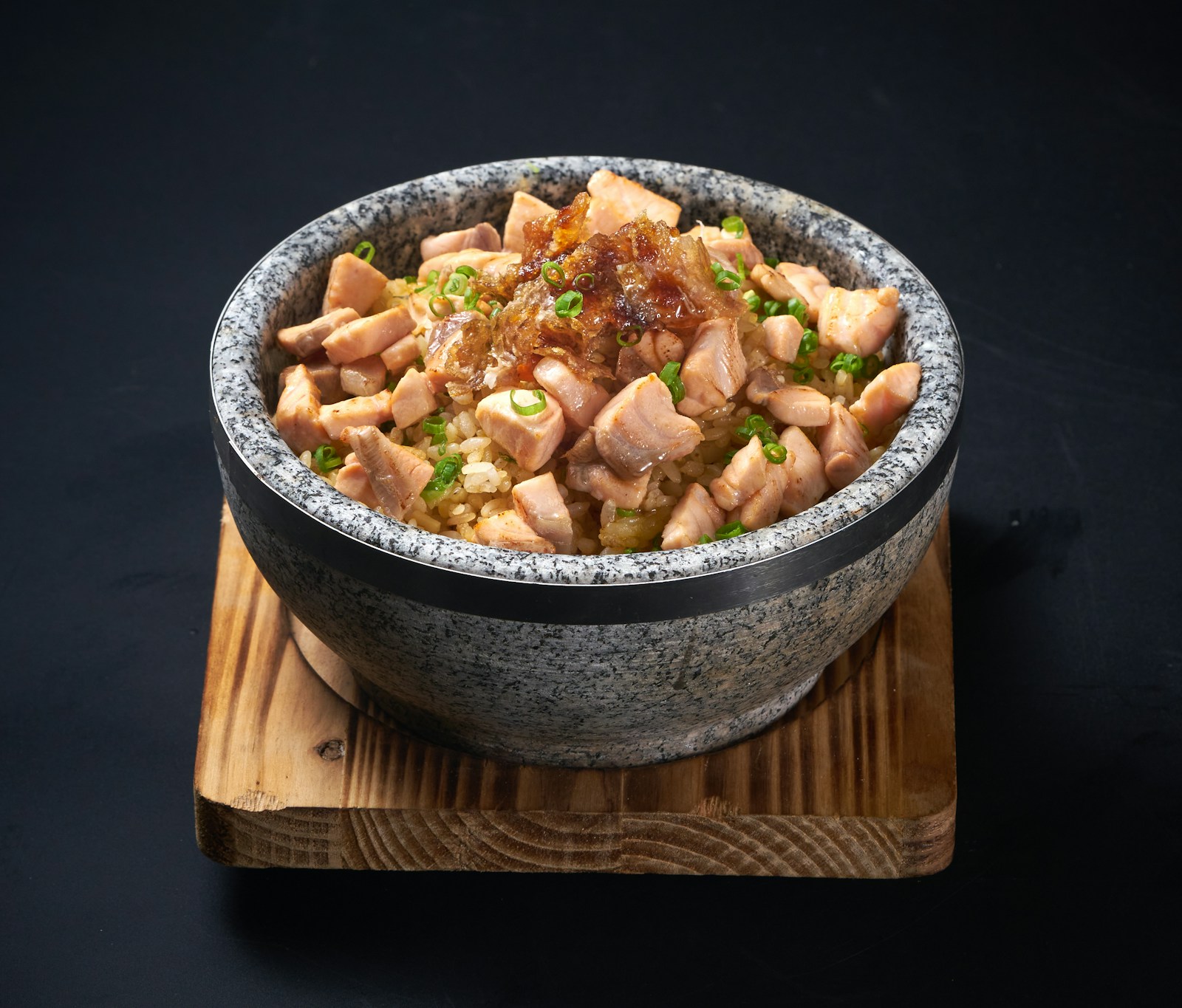
The bowl arrives and you hear it before you see it. Not a crackle exactly — more like the small, barely audible groan of fat cooling on hot rice. The salmon sits in pink-orange flakes on top of pearly short-grain rice, glossy with a lacquer of gochujang red. The skin, pulled aside and laid across the top, shatters under the spoon the moment you try to scoop. Somewhere in the bowl there is avocado, cucumber, a green scatter of scallion, the black-and-gold prickle of furikake, a crumble of toasted nori. The whole thing smells like the Korean dinner you wish your grandmother had made you, even if your grandmother was, like mine, a woman from Osaka who had never cooked salmon with chili paste in her life.
Eric Kim, the Korean-American cooking writer at NYT Cooking who has done more than anyone else to bring gochujang out of the specialty-food aisle and into the weekday repertoire of American home cooks, described this kind of bowl in a 2023 column as “the comfort of rice, turned up to eleven.” His gochujang sauce — a version of which appears, lightly modified, in this recipe — went viral on its own terms two years before Tini Younger’s TikTok video catapulted the salmon rice bowl into the national food conversation. Kim’s version was quieter and better. Tini’s was louder and more photogenic. Both were right about the underlying idea: that a weeknight dinner can be built, in about 25 minutes, from rice, a piece of fish, a jar of fermented chili paste, and a handful of garnishes, and it can taste like something you would happily eat three times a week for a year.
This recipe is not the TikTok version. It is the version that the TikTok version was reaching for — a bowl built with actual Korean technique, where the salmon is cooked fresh with crispy skin, the glaze is applied at the right moment, the rice is treated with the respect it deserves, and every garnish has a reason for being there. If the internet ate the salmon rice bowl for two years, this is what it was trying to teach you.
The Dish the Internet Found
In October 2023, a 26-year-old Los Angeles creator named Tini Younger posted a 45-second video in which she scraped day-old salmon into a Tupperware container, added rice, a splash of soy sauce, a scoop of Kewpie mayo, and a big squeeze of sriracha, microwaved it briefly, topped it with avocado and furikake, and ate it with a spoon. The video received 25 million views in its first week. Within a month, variations were everywhere: crispy rice salmon bowl, bibigo salmon bowl, microwave salmon bowl, spicy tuna salmon bowl. Most used canned or leftover fish. Most leaned on a mayo-sriracha sauce instead of the gochujang-honey combination that is the actual Korean tradition.
What the viral video got right was the bones: rice, fish, chili, creamy garnish, crunchy garnish, all layered. What it got wrong was everything about cooking from scratch. Fresh salmon produces an infinitely better bowl than leftover salmon. A real gochujang glaze produces an infinitely better flavor than mayo and sriracha. A short-grain rice cooked correctly produces an infinitely better texture than anything reheated in a microwave. The version in this recipe takes 25 minutes — not much more than the TikTok shortcut — and produces a bowl you would pay thirty dollars for at a Koreatown cafe. That is the trade.
The Fish and the Fat
Buy center-cut, skin-on salmon. A thick, uniformly-shaped piece cooks evenly; a tail piece will overcook on the thin end before the thick end is done. If your fish monger offers a choice between wild and farmed, wild Alaskan sockeye or king is the flavor winner but the more delicate flesh requires careful cooking. Farmed Atlantic salmon is fattier, more forgiving, and easier to crisp. Both work. Avoid pre-packaged salmon that has been sitting under plastic for days — the surface dries unevenly and the skin loses its crisping potential. Ask for it cut from the fillet that morning.
The most important piece of salmon technique is also the least intuitive: dry the fillet obsessively. Pat it with paper towels. Leave it uncovered in the refrigerator for 15 to 30 minutes before cooking, skin side up. Pat it again. Water is the enemy of crispy skin — any moisture between the skin and the pan will steam instead of sear, and the result is a chewy, rubbery skin that the gochujang glaze makes worse. Kenji López-Alt made this point in a widely cited Serious Eats piece: “The path to crispy salmon skin runs entirely through moisture removal.” He is right.
Gochujang: The Paste, the Brand, the Heat
Gochujang is a fermented Korean chili paste made from gochu chili powder, glutinous rice, fermented soybeans, and salt, aged in earthenware crocks called hangari. Maangchi, the Korean cooking authority and YouTube pioneer, notes in her book Maangchi’s Real Korean Cooking that proper gochujang should be “spicy but also sweet, deeply funky, and never one-dimensionally hot.” That balance is what distinguishes gochujang from other fermented chili pastes. It is funkier than sambal, sweeter than doubanjiang, thicker than sriracha, and more complex than any of them.
Brand matters. Chung Jung One Sunchang is the traditional reference standard — Sunchang County in Jeollabuk-do has been the center of Korean gochujang production for centuries. Mother-in-Law’s is a newer US-made brand that Eric Kim has called the best Americanized gochujang on the market. Both work beautifully here. What to avoid: any gochujang with high-fructose corn syrup listed in the first three ingredients (the older Korean brands use rice syrup or cane sugar). Check the heat rating on the tub — Korean brands mark it with chili-pepper icons, from one (mild) to four (hot). Medium, which is two or three chilies, is the default for this recipe. If you are heat-sensitive, start with the mild; if you like serious burn, go hotter.
Glaze Composition and Ratios
The gochujang glaze is the personality of the bowl. Its four core components should hit in balance; small adjustments change the dish substantially.
| Component | Amount | Role | Adjustment Note |
|---|---|---|---|
| Gochujang | 2 tablespoons | Fermented funk, heat, body | Do not substitute with sriracha or sambal |
| Honey | 2 tablespoons | Caramelization, balance | Maple syrup works; corn syrup does not |
| Soy sauce | 1 tablespoon | Salt and umami | Use Kikkoman; tamari tastes too sharp |
| Rice vinegar | 1 tablespoon | Acid, brightness | Critical for balance; do not omit |
| Sesame oil | 1 tablespoon | Aromatic finish | Toasted only, not raw sesame oil |
Ingredients
- 12 oz (340 g) skin-on salmon fillet, center-cut, at room temperature
- Fine sea salt and freshly ground black pepper
- 1 cup (200 g) short-grain sushi rice
- 1¼ cups (300 ml) water for the rice
- 2 tablespoons gochujang (medium heat)
- 2 tablespoons honey
- 1 tablespoon Kikkoman soy sauce
- 1 tablespoon rice vinegar (plus 1 tablespoon for pickle)
- 1 tablespoon toasted sesame oil
- 2 teaspoons grated fresh ginger
- 1 garlic clove, finely grated
- 1 tablespoon neutral oil for searing
- 1 medium Persian or Japanese cucumber, thinly sliced
- ½ teaspoon sugar for pickle
- 1 ripe avocado, sliced
- 2 tablespoons furikake
- 1 sheet toasted nori, crumbled
- 2 scallions, thinly sliced on the bias
- 1 teaspoon toasted white sesame seeds
Making It
- Rinse and start the rice. Place the short-grain rice in a fine-mesh sieve and rinse under cool running water, agitating with your fingers, until the water runs almost clear. This removes the excess surface starch that turns rice gluey. Transfer to a rice cooker with 1¼ cups water and press start. If cooking on the stovetop, bring rice and water to a boil in a heavy saucepan, reduce to low, cover, and simmer 18 minutes. Do not lift the lid. When finished, let the rice rest covered for 10 minutes — this is when the grains settle and redistribute moisture.
- Dry the salmon. Pat the fillet dry on both sides with paper towels. Press firmly, paying special attention to the skin. Season both sides with salt and a small amount of pepper. Let it sit at room temperature while the rice cooks — the salt will draw a little moisture to the surface, which you will pat away one more time before cooking.
- Whisk the glaze. In a small bowl, combine the gochujang, honey, 1 tablespoon soy sauce, 1 tablespoon rice vinegar, 1 tablespoon toasted sesame oil, grated ginger, and grated garlic. Whisk until perfectly smooth. Taste. It should be thick but pourable, sweet-hot-savory-bright in one spoonful, and so good you want to eat it off the whisk. Divide in half: one portion for glazing the salmon, one for drizzling at the end.
- Quick-pickle the cucumber. In a small bowl, toss the sliced cucumber with 1 tablespoon rice vinegar, ½ teaspoon sugar, and a pinch of salt. Let sit 10 minutes. The cucumber will release water and become softer, more tangy, and slightly translucent. Drain before plating.
- Sear the skin. Pat the salmon one final time. Heat 1 tablespoon neutral oil in a cast-iron or heavy nonstick skillet over medium-high heat until the oil shimmers but does not smoke. Lower the salmon into the pan skin-side down. For the first 30 seconds, press gently with a spatula — salmon skin has a tendency to curl up and off the pan as the proteins contract, and the press forces it flat. After the initial press, leave the fillet completely undisturbed for 5 to 6 minutes. Do not move it, do not lift it, do not look under it. The skin needs to brown and release on its own.
- Flip and glaze. After 5 to 6 minutes, the skin should be deep golden-brown and the flesh should be cooked about two-thirds of the way up from the bottom. Flip the fillet. Cook the flesh side for 2 minutes. Spoon or brush the reserved glaze onto the top of the salmon — the side that was skin-side up. Avoid getting glaze on the skin, which would soften it. Reduce the heat to medium-low and cook another 1 to 2 minutes, just until the glaze is bubbling and caramelized. The salmon interior should still be a touch translucent at the center.
- Rest and flake. Transfer the salmon to a cutting board. Let it rest 2 minutes — the carryover heat will finish cooking the center. Using a fork, break the fillet into large chunks. If the skin separated during cooking, lift it off in one piece and set aside to crown the bowl; it will stay crisp longer that way.
- Assemble. Divide the hot rice between two bowls, fluffing gently with a rice paddle or wooden spoon. Do not press it down. Mound the flaked salmon on top. Arrange the pickled cucumber, avocado slices, and a generous pinch of furikake around the salmon in neat sections. Drizzle the reserved glaze over everything. Scatter crumbled nori, scallions, and toasted sesame seeds across the top. Lay the crispy skin across the mound like a sail. Eat immediately with chopsticks or a spoon. The skin will not be crisp in five minutes.
The Rice Has to Be Right
People underestimate how much the rice is doing in a bowl like this. The salmon and glaze get the Instagram attention, but the rice is the stage they perform on. Short-grain sushi rice — Japanese koshihikari, Korean CJ Hetbahn, or Nishiki — is the correct choice. Long-grain jasmine does not have the right moisture and starch profile; basmati is entirely wrong. The grains should be plump, faintly sticky to each other but not mashed, shiny but not wet. Namiko Hirasawa Chen of Just One Cookbook recommends a 1:1.15 water-to-rice ratio by volume for sushi rice, which is a touch less water than the back of most rice packages suggests. She is right — the bowl is better when the rice has a clean, slightly firm bite rather than a porridge slump.
If you want to go one step further, season the cooked rice like sushi rice: while it rests, fold in 1 tablespoon rice vinegar, 1 teaspoon sugar, and ½ teaspoon salt. The bowl becomes noticeably brighter and more dimensional. This is optional but transformative.
Common Mistakes
The bowl is a quick recipe, but it hides a few traps:
- Wet salmon. Skipping the dry-patting step means no crispy skin. Period. Dry it, season it, dry it again before it hits the pan.
- Glazing too early. Applying the gochujang glaze while the salmon is still skin-side-down will burn the sugars onto the bottom of the pan and infuse a bitter note through the fillet. Glaze only after the flip.
- Overcooking. Salmon is done when it flakes but still looks faintly translucent at the thickest part. A fully opaque center means you have cooked it too long. Residual heat does real work — pull it at medium-rare.
- Cold avocado. Pull the avocado out of the refrigerator with the salmon, not at plating. Cold avocado is waxy and mutes the warm bowl.
- Skipping the rice vinegar in the glaze. Without the acid, the glaze tastes flat and heavy — gochujang and honey are both sweet-dominant ingredients that need a counterweight.
Variations and a Larger Table
The format is flexible. A thick slab of tofu — pressed, dried, and seared the same way — is an excellent vegetarian substitute, and the glaze works beautifully on it. For a tuna bowl, skip the cooking entirely and cube a chunk of sashimi-grade raw tuna, toss it in half the glaze, and assemble over rice. For a weeknight chicken version, use skin-on boneless thighs. If you want to expand the bowl into a larger Korean-American spread, pair it with tteokbokki with chewy rice cakes in gochujang sauce for a second gochujang expression at the same table, or explore the same flavor palate in a pasta format with gochujang butter pasta with crispy shallots.
Storage Notes
Every component except the cooked salmon stores well. The glaze keeps a month refrigerated in a sealed jar. Cooked rice holds three days refrigerated, reheated with a splash of water in the microwave or a steamer. Pickled cucumber holds a week. Cooked salmon, however, is not a great leftover — the skin goes soft, the glaze dulls, and the texture shifts. If you do have leftover salmon, it makes a solid cold bowl the next day over fresh rice with a squeeze of lime, but do not expect it to taste the same. Fresh is the whole point.
Why This Bowl Works
Step back and consider what the bowl is doing structurally. Warm rice at the bottom — carbohydrate comfort, neutral starch canvas. Flaked salmon with crispy skin on top — rich, fatty protein with textural contrast. A sweet-hot-savory-tangy glaze running through — the spice-heat axis and the acid-sweetness axis both satisfied. Pickled cucumber — cooling, acidic, crunchy, resetting the palate between bites. Avocado — creamy, neutral, a fat counterweight to the spice. Furikake and nori — toasted seaweed umami, nutty sesame, tiny flecks of salt. Scallions — a sharp allium lift. Every bite, if you engineer it right, is a rotating combination of four or five of these notes, and no two bites in a row are identical. This is why the bowl is addictive in a way that a simpler preparation of the same salmon is not. The variance holds your attention.
The other reason it works is honesty about what it is. A weeknight dinner. Not a special occasion, not a project, not something that needs a tablecloth. Twenty-five minutes, one pan, some rice, and a handful of garnishes. Korean-American cooking at its most confident tends to live in this register — meals that are not trying to be anything they are not, built from a pantry that skews toward gochujang, sesame oil, soy sauce, rice vinegar, and the produce aisle. Eric Kim’s cookbook Korean American: Food That Tastes Like Home, which came out in 2022 and won a James Beard nomination, is essentially an extended argument that this kind of weeknight cooking is a legitimate and beautiful tradition in its own right. He is right. The gochujang salmon bowl is a representative example.
Frequently Asked Questions
Is this the TikTok salmon rice bowl from 2024?
This is its more technical cousin. Tini Younger’s viral 2024 video used day-old salmon, a mayo-sriracha sauce, and a microwave. This recipe uses fresh salmon, a proper gochujang-honey glaze adapted from Korean tradition, and cast-iron searing for the crispy skin. The structure — fish on rice with creamy and crunchy garnishes — is the same format. The execution is meaningfully better and takes only about five minutes longer than the shortcut version.
What brand of gochujang should I use?
Chung Jung One Sunchang is the traditional Korean reference, made in the gochujang heartland of Sunchang County. Mother-in-Law’s is an excellent US-made newer brand endorsed by Eric Kim of NYT Cooking. Both use real fermented chili base. Avoid any product with high-fructose corn syrup in the first few ingredients — quality gochujang uses rice syrup or pure cane sugar. Korean brands mark heat levels with chili-pepper icons on the tub: two chilies (mild) to four (hot). Two or three is the right range for this bowl.
Can I use frozen salmon?
Yes, but thaw it fully and then dry it aggressively. Thawed salmon releases extra surface moisture, which is the main obstacle to crispy skin. Thaw overnight in the refrigerator, place skin-side up on paper towels, rest uncovered in the refrigerator another 30 minutes to air-dry, and pat one more time before seasoning. Frozen-at-sea wild salmon is often better quality than the fresh salmon in most US supermarkets, so do not dismiss it as second-rate.
How do I keep the salmon skin crisp under the glaze?
Do not glaze the skin. Apply the gochujang mixture only to the flesh side, after the fillet is flipped skin-side up. The sugar in the glaze will soften the skin on contact. When you flake the finished salmon, lift the skin off in one piece and lay it on top of the bowl rather than folding it through — air exposure keeps it crisp. Some cooks even remove the skin before flaking and place it whole across the rice like a chip.
Sources
- NYT Cooking — Eric Kim’s Gochujang-Glazed Salmon — The canonical modern Korean-American reference for this glaze technique.
- Serious Eats — Crispy Pan-Seared Salmon — Kenji López-Alt’s methodology on salmon skin and moisture management.
- USDA FoodData Central — Atlantic Salmon — Nutrition reference for per-serving calculations.
Each serving contains roughly 684 calories, 42 g protein, 32 g fat, 58 g carbohydrates, and 5 g fiber — based on 2 servings using 12 oz of skin-on salmon, 1 cup of uncooked short-grain rice, and the listed glaze and garnishes. Fat content is elevated due to salmon oils and added sesame oil.
Please note: Nutritional estimates are derived from the USDA FoodData Central database and may vary depending on specific brands of gochujang, honey, and salmon fat content. This recipe contains fish, soy, sesame, and wheat (from gochujang fermentation). Nothing in this article should be interpreted as medical or dietary guidance. If you have food allergies, sodium-sensitive conditions, or specific dietary needs, consult a registered dietitian or healthcare provider before preparing this recipe.