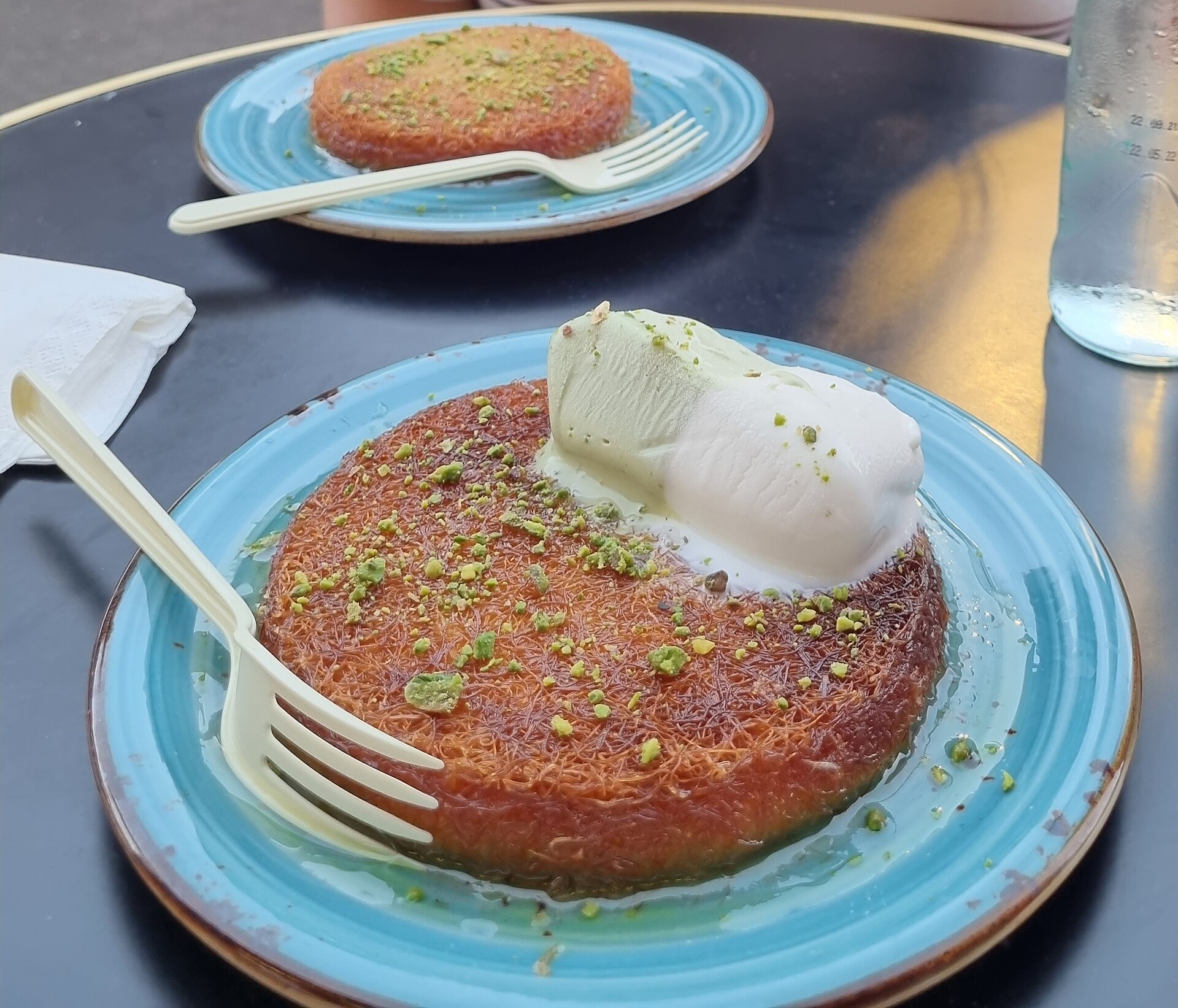
The sound is what you remember. The moment the cold syrup meets the hot kataifi and the pan hisses, bubbling into every crack and crevice, releasing a cloud of orange blossom that fills the kitchen like a small explosion of spring. Then the pistachios fall — a green so vivid it looks almost artificial against the burnished amber of the baked pastry. A wedge lifts. The ashta cream stretches and gives way. Underneath, the kataifi holds its shape for exactly one bite before shattering on the tongue into syrup-soaked threads, crunch and silk in the same mouthful.
Knafeh is having what can only be described as a moment. In 2024, a chocolate bar made in Dubai by a pastry chef named Sarah Hamouda went viral on TikTok — milk chocolate filled with crunchy kataifi and pistachio cream, eaten with a distinctive cracking sound that became its own visual meme. Within a year, “Dubai chocolate” was being sold at Lidl in Germany, at Trader Joe’s in the United States, at Selfridges in London. Pastry chefs everywhere started reverse-engineering it. Home bakers started asking what kataifi was. And quietly, in the background, the dessert that actually uses kataifi — the one kataifi was made for — started winning back attention from its own descendant. Searches for “knafeh recipe” rose 340 percent on Google in 2025.
Claudia Roden, the Egyptian-born food writer whose A Book of Middle Eastern Food has remained in print since 1968, describes knafeh in its Palestinian form as “the dessert that tastes of home for anyone who has ever left.” Reem Kassis, the Palestinian cookbook author behind The Palestinian Table, writes that knafeh — specifically Nablus-style knafeh, made with the soft white cheese the West Bank city is famous for — is “less a dessert than a badge of regional identity.” Yotam Ottolenghi has championed a variation in Jerusalem, cowritten with Sami Tamimi. And across Saveur and Bon Appétit and NYT Cooking, the last two years have produced a wave of coverage that treats knafeh as what it is: one of the great desserts of the world, now finally getting its due.
The Nablus Original and the Cream Variation
Knafeh’s hometown is Nablus, a West Bank city that has been making the dessert in roughly its current form since the tenth century. The Nablus original uses nabulsi — a soft, slightly salty white cheese native to the region — soaked in water overnight to reduce its saltiness, then layered between buttered kataifi and baked. The result is a dessert that is salty, sweet, and chewy-crunchy all at once, with a cheese pull so dramatic that Nablus knafeh masters compete informally on how far the strands will stretch before breaking.
Outside Nablus — in Lebanon, Egypt, Turkey, the diaspora communities of Dearborn and Paterson and Brooklyn — a second style dominates: knafeh bil ashta, made with a cooked milk cream instead of cheese. Ashta is essentially a savory-leaning Middle Eastern pastry cream, thickened with cornstarch, perfumed with orange-blossom water, and typically much thicker than a French crème pâtissière. This version is what most home cooks will have access to and what I am teaching here — nabulsi and akkawi cheeses are difficult to source outside specific communities, and the cream version is universally loved regardless of region.
Kataifi: The Pastry Behind the Pastry
Kataifi is phyllo, pushed through a specialized machine that turns the thin sheets into hair-like strands. Most commonly spelled kataifi or kadaifi in Arabic, kadayif in Turkish, kadaifi in Greek. It is impossible to make at home without specialized equipment — the machine that produces it is a rotating drum with holes that extrudes a thin stream of batter onto a hot surface, where it cooks almost instantly and is scraped off as delicate threads. Commercial kataifi is sold frozen in 1-pound packages at Middle Eastern, Greek, and Turkish grocers, and increasingly in the international aisle of larger American supermarkets.
Once thawed, kataifi must be handled gently but quickly. The strands dry fast and become brittle, snapping into useless fragments if you leave them exposed to air. Work in batches. Pull the strands apart with your fingers to separate them, coat thoroughly with melted butter (and, if you want the classic warm-orange color, a drop of food coloring or a pinch of saffron steeped in the butter), and press into the pan immediately. The buttering step is not optional — under-buttered kataifi bakes into pale, papery threads that do not crisp properly. Each strand needs to be lightly glossed to achieve that shattering amber crunch.
The Syrup Rule: Cold on Hot, Always
Middle Eastern sugar-soaked pastries are built around a single technical rule that is non-negotiable: the syrup must be cold when it meets the hot pastry. This is true for baklava, for basbousa, for atayef, and it is true for knafeh. The science is straightforward: hot pastry is full of expanded air pockets and slightly dehydrated layers that draw liquid inward through capillary action. Cold, thick syrup pours slowly and absorbs into the hot pastry exactly where you want it — into the strands, not on top of them. Hot syrup on hot pastry collapses the structure and produces a greasy, limp result. Cold syrup on cold pastry sits on top without penetrating.
Because of this rule, the syrup is always the first thing you make. Prepare it, cool it in the refrigerator until fully cold, and only then start the rest of the dessert. When the knafeh comes out of the oven hot and golden, the syrup is waiting, frigid, to be poured over in three deliberate pours — with a pause between each pour to let the pastry absorb before the next wave goes in. The sizzle you hear is the sound of hot steam forcing syrup into the deepest layers. It is the sound of a successful knafeh.
Knafeh Versions: A Regional Comparison
One dessert, many forms. Knowing which tradition you are working within helps when troubleshooting and when choosing a filling.
| Region | Pastry Style | Filling | Signature Flavor |
|---|---|---|---|
| Nablus (Palestine) | Finely ground kataifi, warm orange color | Nabulsi cheese (soaked, unsalted) | Salty-sweet, chewy cheese pull |
| Lebanon | Coarse kataifi strands, preserved shape | Ashta cream or akkawi cheese | Orange blossom, rich and creamy |
| Egypt | Thicker kataifi with semolina | Ashta, sometimes clotted cream | Rose-forward syrup |
| Turkey (künefe) | Tightly pressed kataifi, pan-fried | Unsalted fresh cheese only | Intensely buttery, served with kaymak |
| Dubai-style bar | Kataifi as crunchy filling | Pistachio cream + milk chocolate shell | Modern fusion, no syrup |
Ingredients
Orange-blossom syrup:
- 1¼ cups (250 g) granulated sugar
- ¾ cup (180 ml) water
- 1 tablespoon fresh lemon juice
- 1 tablespoon orange-blossom water
- 1 teaspoon rose water (optional)
Ashta cream filling:
- 2 cups (480 ml) whole milk
- 1 cup (240 ml) heavy cream
- 3 tablespoons cornstarch
- 3 tablespoons granulated sugar
- 1 teaspoon orange-blossom water
Kataifi shell:
- 1 pound (450 g) kataifi, thawed
- 1 cup (227 g) unsalted butter, melted and cooled
- 2 tablespoons neutral oil
- A few drops orange food coloring, or a pinch of saffron steeped in the butter (optional)
Finishing:
- 1 cup (120 g) raw pistachios, finely ground
- Edible dried rose petals (optional, for garnish)
Making It
- Make the syrup first. In a medium saucepan, combine sugar, water, and lemon juice. Bring to a simmer over medium heat, stirring only until the sugar dissolves. Once clear, stop stirring and let it cook for eight to ten minutes until slightly thickened — it should coat the back of a spoon but still flow freely, not yet sticky. Remove from heat. Stir in orange-blossom water and rose water. Transfer to a heatproof pitcher or bowl and refrigerate until fully cold, at least thirty minutes. The syrup must be cold when it meets the hot knafeh.
- Make the ashta. In a small bowl, whisk the cornstarch with ½ cup of the milk until completely smooth with no lumps. In a saucepan, combine the remaining milk, cream, and sugar. Bring to a gentle simmer over medium heat, stirring occasionally. Once simmering, whisk in the cornstarch slurry in a steady stream. Continue whisking constantly for three to four minutes — the mixture will thicken rapidly into a spoonable cream thicker than pudding. Remove from heat. Stir in the orange-blossom water. Scrape into a bowl, press a sheet of plastic wrap directly against the surface to prevent a skin, and chill thirty minutes. The ashta must be cold and firm before assembly.
- Prepare the kataifi. Unwrap the thawed kataifi onto a clean work surface — it will come in a dense coil. Using both hands, gently pull the strands apart to separate them into a loose pile, breaking up any clumps. Transfer to a large bowl. If you want the classic warm-orange color, add a few drops of food coloring to the melted butter, or steep a pinch of saffron threads in the warm butter for ten minutes before pouring. Pour the melted butter and oil over the kataifi. Using clean hands, work the butter through every strand, lifting and turning for four to five minutes until the kataifi is uniformly glossy and slightly golden. Every strand should be lightly coated — this is what creates the crackling crust.
- Assemble. Butter a 10-inch oven-safe skillet (cast iron works beautifully) or a round cake pan with an additional tablespoon of butter. Press half the buttered kataifi firmly into the pan, creating an even layer about ¾ inch thick. Use the bottom of a measuring cup or a flat-bottomed glass to compact — firmer is better; loose kataifi will fall apart when inverted. Bring the kataifi slightly up the sides of the pan to create a shallow wall. Spread the chilled ashta evenly over the kataifi base, leaving a one-inch border of exposed kataifi around the edge so the two layers can seal during baking. Cover completely with the remaining kataifi, pressing firmly to compact the top and seal the edges.
- Stovetop start, oven finish. Place the skillet over medium heat on the stove for three to four minutes — you should hear sizzling underneath as the butter begins to crisp the base layer. This pre-crisp step is critical for a properly shattering bottom crust. Transfer the skillet to a preheated 425°F (220°C) oven. Bake for twenty-five to thirty minutes, until the top is deeply golden brown and the edges are visibly crisping.
- The dramatic invert. Remove the skillet from the oven using heavy oven mitts — it will be very hot. Place a large, flat serving platter (at least 12 inches across) upside down directly over the skillet. Holding skillet and platter firmly together, flip in one confident motion so the platter is now on the counter and the skillet is upside down on top of it. Lift the skillet straight up slowly. The knafeh should release as a gorgeous golden disc, darker on top (formerly the bottom in the pan) and showing the compact golden crust you built. If a few strands stick, loosen with a thin spatula.
- Soak with cold syrup. Immediately pour the cold syrup evenly over the hot knafeh in three deliberate pours, using a ladle or measuring cup. Pause between pours — ten seconds — to let each soak in before the next. You will hear the knafeh sizzle and see the syrup disappear into the pastry. Use nearly all the syrup; reserve a few tablespoons on the side for anyone who wants extra.
- Finish and serve. Shower the top of the soaked knafeh with the ground pistachios, covering the entire surface in a green layer about ¼ inch thick. Scatter rose petals if using. Let rest five minutes so the syrup stabilizes. Cut into ten wedges with a sharp knife, and serve warm. The ideal bite lifts with a visible cream pull and a clear crunch from the kataifi. A tiny cup of cardamom-spiked Arabic coffee alongside, if you have it, elevates the whole experience.
What To Serve With Knafeh
Knafeh is a bold dessert — sweet, perfumed, rich — and benefits from pairings that cut rather than complement. A tiny cup of unsweetened Arabic coffee spiked with green cardamom is the canonical partner. Strong black tea works. So does mint tea. Dessert wines and cocktails generally do not — the orange blossom clashes with most spirits. For a multi-course Middle Eastern spread, serve knafeh after a light meal — grilled fish, a mezze platter, a simple grain salad — not after a heavy main. The dessert rewards a palate that has not already been worked over by other rich flavors.
If you are in a baking mood and want to explore more dessert territory with this same technical sophistication, our lemon tart with torched Italian meringue uses a similar principle of temperature-contrast assembly — cool curd, hot torched meringue. For something in the same cream-and-pastry family from a different tradition, our matcha white chocolate panna cotta with toasted coconut pairs beautifully with knafeh on a shared dessert board.
The Pistachio: Why This Nut, Specifically
Pistachios are not a garnish on knafeh. They are a co-star. The vivid green powder that showers the top of the finished dessert is load-bearing — both visually, providing the striking chromatic contrast against the amber kataifi, and flavor-wise, adding a savory-sweet richness that balances the orange-blossom syrup. The best pistachios for this purpose come from Iran (particularly the Kerman region), Turkey (especially Antep), or Sicily (Bronte DOP). American pistachios from California are perfectly fine but tend to be slightly sweeter and less aromatically complex. Avoid pre-shelled pistachio pieces sold as snacking nuts — their flavor fades quickly after shelling. Buy whole, shell-on pistachios and shell them yourself, or buy high-quality nut-meats from a specialty store with good turnover.
The grinding matters. Too coarse, and the pistachios sit on top as textural chunks that compete with the crispness of the kataifi. Too fine, and they turn into a paste that darkens on contact with the hot syrup. The target is somewhere between: a fine but still visibly granular texture, roughly the consistency of coarse polenta. Pulse whole pistachios in a food processor in five to seven short bursts, then stop. Spread the results on a fine-mesh sieve and shake — you want the finer particles for dusting and the slightly coarser particles for the generous top layer. Reserve some whole pistachio halves if you want additional visual drama on a serving platter.
The Cheese Version (If You Can Find the Cheese)
For the Palestinian cheese version, substitute the ashta with one pound of low-moisture fresh mozzarella, sliced, or nabulsi or akkawi cheese if you can find it. Nabulsi and akkawi come heavily salted; they require a twenty-four-hour soak in cold water (changing the water every four hours) to reduce saltiness to dessert-appropriate levels. Fresh mozzarella works out of the package — slice it ¼-inch thick, pat dry with paper towels, and lay the slices over the kataifi base exactly as you would spread the ashta. The assembly, baking, and syrup steps are identical. The cheese version has a distinctive stretch when lifted that the cream version does not. Both are legitimate. Both are correct.
Storage and Reheating
Knafeh is a dessert that favors the same day. Wrap leftovers loosely in foil and keep at room temperature — not refrigerated — for up to eight hours; refrigeration hardens the butter and makes the kataifi brittle. For storage beyond a few hours, refrigerate up to two days in an airtight container, and reheat individual portions in a 300°F oven for eight to ten minutes. The microwave is forbidden — it turns kataifi rubbery and collapses the texture entirely. Freshly baked knafeh does not freeze well, though unbaked assembled knafeh can be frozen before baking (wrap tightly) and baked directly from frozen at 400°F for forty minutes.
Frequently Asked Questions
What is the difference between knafeh, kunafa, and kataifi?
Kataifi is the ingredient: shredded phyllo pastry that looks like blond angel hair. Knafeh (also kunafa, kunefe, kanafeh depending on transliteration) is the dessert built from that pastry. Palestinian knafeh uses soft cheese; Lebanese and Egyptian versions often use ashta cream. Turkish künefe is almost always with cheese. The Dubai chocolate bar that went viral in 2024 and 2025 uses kataifi as a crunchy filling inside milk chocolate with pistachio cream — the same pastry, a completely different format.
Can I use frozen kataifi, and where do I buy it?
Frozen kataifi is the standard — almost no one makes it from scratch outside professional kitchens, as it requires specialized spinning equipment. Look in the freezer section of Middle Eastern markets, Greek grocers, or large international supermarkets. Common brands include Apollo, Krinos, and Athens. Thaw overnight in the refrigerator. Do not microwave-thaw — the pastry becomes gummy. Once opened, kataifi dries quickly, so work fast or cover with a slightly damp towel while buttering in batches.
Why does the syrup have to be cold when the knafeh is hot?
This is the fundamental rule of syrup-soaked Middle Eastern pastries. Cold syrup hitting hot pastry creates thermal contrast: the hot pastry draws the syrup rapidly into its layers through capillary action, while the cooler liquid prevents the kataifi from becoming soggy. Hot syrup on hot pastry produces a greasy, limp dessert. Cold syrup on cold pastry sits on top without penetrating. Make your syrup first, chill it thoroughly, and always pour over the knafeh the moment it comes out of the oven.
Is knafeh served hot or cold?
Warm, always. The cheese or cream filling is at its best when soft and pulling into strands as you lift the spoon — the cheese pull is what Nablus knafeh masters are judged on. Cold knafeh is edible but mediocre; the kataifi hardens as the butter solidifies and the cream loses its silkiness. If knafeh has cooled, warm it in a 300°F oven for eight to ten minutes before serving. Never microwave it — the kataifi becomes rubbery and the texture collapses.
Sources
- Serious Eats — Knafeh: The Palestinian Dessert — Technical breakdown of kataifi handling, cheese sourcing, and syrup chemistry.
- Bon Appétit — From Nablus to Dubai: The Knafeh Evolution — Cultural context and ingredient sourcing guide for the kataifi-based family of desserts.
- USDA FoodData Central — Pistachios and Dairy — Nutritional data used for per-serving calculations.
Each serving contains roughly 485 calories, 10 g protein, 28 g fat, 48 g carbohydrates, and 2 g fiber — based on 10 servings from a 10-inch round.
Please note: Nutritional estimates are derived from the USDA FoodData Central database and may vary depending on specific brands and component sizes. This recipe contains dairy, wheat, and tree nuts (pistachios). Nothing in this article should be interpreted as medical or dietary guidance. If you have food allergies, nut sensitivities, or specific dietary needs, consult a registered dietitian or healthcare provider before preparing this recipe.