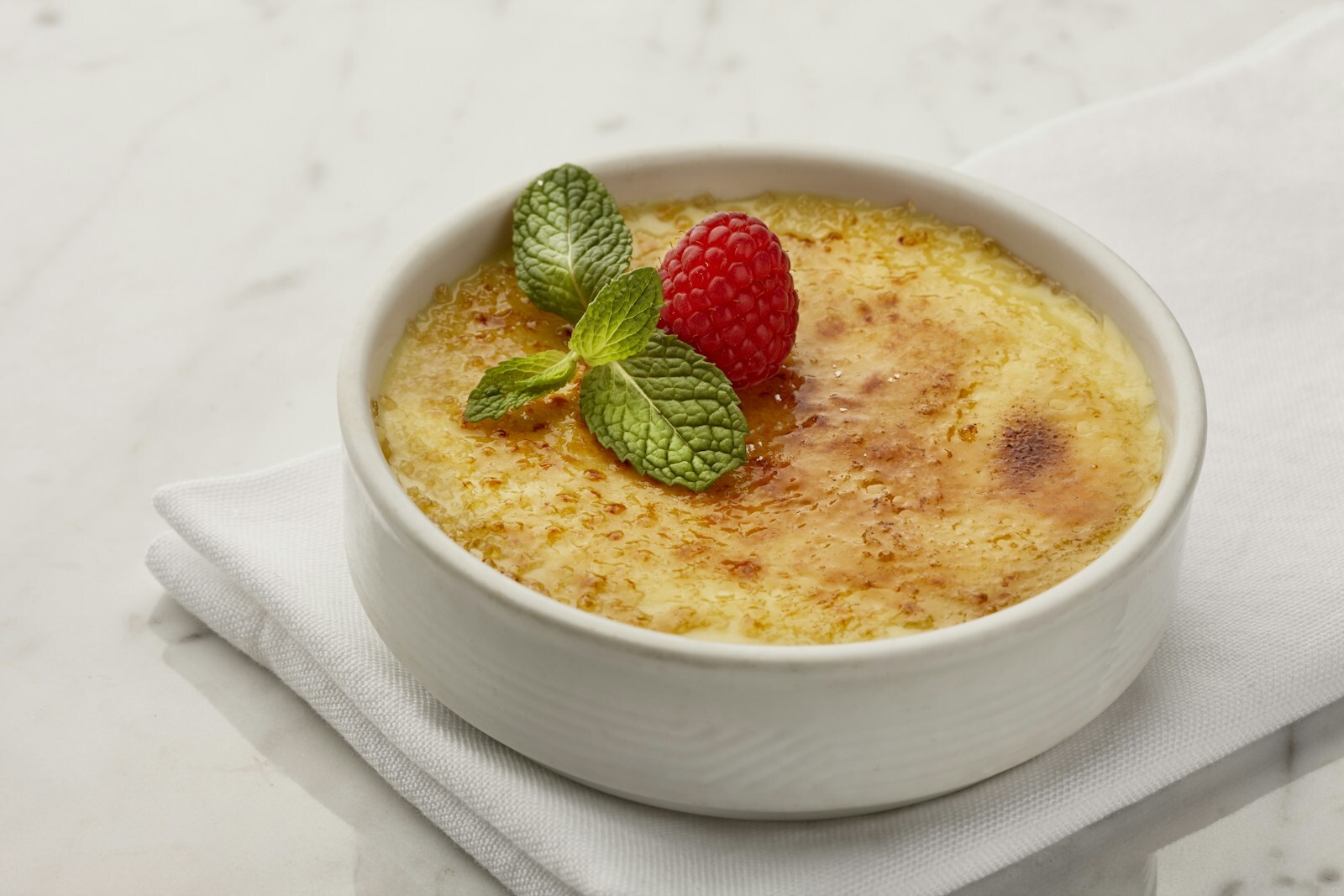
There is a sound to a perfectly torched creme brulee that almost qualifies as a kitchen miracle. You crack the surface with the back of a spoon and the caramel breaks with a clean glassy snap, splitting along fault lines like real glass. Underneath, the custard is silky and cold and almost shockingly smooth on the tongue. The contrast is the entire point: a thin layer of fragile hot sugar caramel suspended a millimeter above the cold vanilla-scented cream, the two textures meeting in a single bite. Done badly, creme brulee is a weeping bowl of curdled custard with a sticky burnt-sugar puddle on top. Done correctly, it is one of the most satisfying desserts in the French repertoire.
Creme brulee is older than its modern fame suggests. A recipe titled creme brulée appeared in François Massialot’s Cuisinier royal et bourgeois in 1691, and the technique of finishing a custard with caramelized sugar appears in English cookbooks of the seventeenth century (where it was called “burnt cream”) and in Catalan tradition (crema catalana, made with milk rather than cream, eggs rather than just yolks, and lemon and cinnamon for flavor). The modern version — cream and egg yolks only, vanilla-scented, finished with caramel torched on a cold custard — was popularized in the United States in the 1980s after the chef Sirio Maccioni put it on the menu at Le Cirque in New York. It has remained the most ordered dessert in fine dining ever since.
Stella Parks, the pastry chef and Serious Eats writer, called creme brulee “the most forgiving custard in classical French pastry” in a 2018 column, and she is correct: the proportions are wide, the technique is small, and the finishing step is a question of confidence rather than skill. What you cannot fudge is the temperature control. Custard is fundamentally a controlled emulsion of fat (cream) and protein (egg yolks) that needs to set at a specific temperature (about 82°C / 180°F) without overshooting (which curdles it). The rest of this article is the technique that makes that control consistent.
The Egg Yolk Ratio: Six Per 500 ml of Cream
The ratio of egg yolks to cream determines the final density. Too few yolks (4 per 500 ml) and the custard sets too softly and pools. Too many (8 or more) and it sets too firmly, more like a flan than a creme brulee, and the texture becomes eggy rather than creamy. Six yolks per 500 ml of heavy cream is the classical proportion and produces the textbook result: dense enough to hold a clean spoon mark, soft enough to feel cold and silky on the tongue. Whites are not used — they would set too firmly and add a chalky texture.
Use cream with at least 36% fat (regular heavy cream in US grocery stores). Half-and-half or whipping cream (30%) produces a thinner custard that breaks more easily. Avoid “ultra-pasteurized” cream when possible; its proteins are damaged by the high-temperature pasteurization and produce a slightly less stable custard. Look for “pasteurized” cream (not ultra) from organic dairies if your area carries it — the difference in finished texture is real.
Tempering: The Slow Stream That Saves Yolks
The single technical step that beginners get wrong is tempering. Egg yolks coagulate at about 70°C (158°F). The infused cream is around 80°C (175°F). If you pour hot cream directly into yolks, the heat shocks the proteins and produces a curdled, lumpy mixture that cannot be saved. The solution is tempering: pour the hot cream into the yolks in a slow, thin, steady stream while whisking constantly. The constant stirring distributes the heat instantly, raising the yolks’ temperature gradually without ever exposing any single spot to enough heat to coagulate.
The stream should be slow enough that the cream pours from the pan in a thin line rather than a gush. Whisk continuously throughout. If the yolks suddenly thicken or you see white streaks, you have moved too fast — strain immediately through a fine-mesh sieve and continue, accepting that the texture will be slightly less perfect. Strain the final mixture regardless. The fine-mesh strain removes any chalazae (egg-white strands attached to the yolk) and any small coagulated bits and produces the silky texture that defines a good creme brulee.
The Water Bath and Why It Matters
Custards bake in a bain-marie (water bath) because direct oven heat is too harsh. At 150°C (300°F) oven temperature, an unprotected custard would set at the edges within minutes while the center is still raw — and by the time the center sets, the edges have over-cooked and become rubbery. The water bath solves this by surrounding the ramekins with water that cannot exceed 100°C (212°F) at sea level. The custards bake gently and uniformly from all sides except the top, which receives direct radiant heat but does not over-set because of the moisture.
Use very hot tap water (about 65°C / 150°F) for the bath. Pour it into the baking dish after the dish is already in the oven — this avoids spilling water into the ramekins during transit. Fill until the water reaches halfway up the sides of the ramekins. Begin checking the custards at 30 minutes by gently shaking the baking dish — the edges should be set but the centers should still have a clear soft wobble in the middle. Pull them when the wobble is still visible; they continue setting from residual heat.
Creme Brulee vs Creme Caramel vs Pot de Creme: A Quick Map
| Dessert | Egg ratio | Caramel application |
|---|---|---|
| Crème Brûlée | Yolks only (6 per 500ml) | Torched on cold custard, served immediately |
| Crème Caramel (Flan) | Whole eggs + yolks (looser) | Caramel poured in ramekin first, custard on top, inverted to serve |
| Pot de Crème | Yolks only (denser, more) | No caramel – chocolate or other flavor |
| Crema Catalana | Whole eggs + cornstarch, milk not cream | Torched caramel, like creme brulee |
Ingredients
For the custard:
- 500 ml (2 cups) heavy cream, 36% fat or higher
- 1 vanilla bean, split (or 2 tsp pure vanilla extract)
- 6 large egg yolks, room temperature
- 75 g (6 tbsp) granulated sugar
- Pinch of fine sea salt
For the sugar top:
- 6 tablespoons (75 g) demerara or turbinado sugar (raw sugar with larger crystals)
Equipment:
- Six 4-oz ramekins (about 9 cm wide x 4 cm deep)
- Deep baking dish for water bath
- Kitchen torch (or broiler as fallback)
- Fine-mesh sieve
- Heavy-bottomed saucepan
Making It
- Preheat oven to 150 C (300 F). Place 6 ramekins in a deep baking dish.
- Infuse the cream. Heat cream + vanilla seeds + pod in heavy saucepan over medium-low until steam rises (80 C / 175 F). Do not boil. Remove from heat, cover, steep 15 min.
- Whisk yolks. In medium bowl, whisk egg yolks, sugar, and salt until pale and slightly thickened, 1 min.
- Temper. Remove vanilla pod. Pour warm cream into yolks in slow steady stream while whisking constantly.
- Strain. Pour mixture through fine-mesh sieve into clean pitcher.
- Fill ramekins. Divide custard among ramekins (about 1 cm from rim). Tap to release bubbles.
- Water bath bake. Place baking dish in oven. Pour very hot tap water in dish until halfway up ramekins. Bake 35-45 min until edges set but centers wobble.
- Cool and chill. Remove ramekins from water bath immediately. Cool to room temp on rack, then refrigerate uncovered at least 4 hours, ideally overnight.
- Torch. Just before serving, blot surface dry. Sprinkle 1 tbsp demerara sugar evenly. Torch in slow circles 5 cm above until deep amber. Let caramel set 1-2 min. Serve immediately.
Troubleshooting
Curdled custard during tempering: Poured cream too fast. Strain through fine mesh and continue — texture will be slightly less perfect but salvageable. Next time, pour slower. Custard does not set after the full bake: Oven temperature was too low or the water bath was too cool. Verify oven with a thermometer. Use very hot tap water for the bath, not warm. Custard set into a rubbery firmness: Overbaked. Pull at the wobble next time. Sugar top will not caramelize: Surface was wet from condensation. Blot with paper towel before sugaring. Use demerara or turbinado (raw sugar with large crystals) — regular granulated sugar caramelizes too fast and burns before the surface develops.
Flavor Variations Without Changing the Method
The cream infusion is the only step that changes for flavor variations. Instead of vanilla bean, try: 1 tablespoon orange zest + 1 teaspoon Grand Marnier (citrus); 2 cardamom pods crushed + 1 teaspoon rose water (Middle Eastern); 1 tablespoon Earl Grey tea leaves steeped 10 min then strained (tea); 3 sprigs lavender + 1 teaspoon honey (Provencal); 60 g good dark chocolate melted into the cream (chocolate); the seeds of 1 vanilla bean + 2 tablespoons lemon zest (citrus-vanilla). The rest of the method is identical. Each flavor variation produces a distinct dessert worth its own evening.
Storage and Make-Ahead
The custard keeps refrigerated up to 3 days, tightly covered with plastic wrap touching the surface. Do not freeze — ice crystals destroy the silky texture. The sugar top must be torched within 30 minutes of serving; any earlier and moisture from the custard begins to soften the caramel from below, turning it from crackling glass into sticky paste within 2 hours. For dinner parties: make custards the day before, refrigerate, then torch each ramekin just before serving. This is also how restaurants execute the dish — the torch is intentionally last so the diner experiences the contrast.
Frequently Asked Questions
Can I make creme brulee without a torch?
Yes, but the result is inferior. Broiler position the ramekins 5 cm under a hot broiler for 60-90 seconds, watching constantly. This warms the top layer of custard, partially defeating the cold-vs-hot contrast. A small butane kitchen torch costs about $20 and is worth buying.
What if I do not have vanilla beans?
Pure vanilla extract works (2 tsp stirred into warm cream just before tempering). Vanilla bean paste is next best (1 tbsp equivalent, with visible specks). Avoid imitation vanilla flavoring. For variations, infuse with orange zest, cardamom, Earl Grey, or rose water instead.
Why does my creme brulee weep liquid?
Two causes: overbaking (the proteins squeezed out water — pull at the wobble), or condensation while cooling (cool to room temp before refrigerating uncovered first hour, then plastic wrap touching surface). Small amounts of pooled liquid can be blotted with paper towel before torching.
How long can creme brulee be made ahead?
Custard (without sugar topping) keeps 3 days refrigerated, tightly covered. Sugar must be torched within 30 minutes of serving — moisture from the custard dissolves the caramel from below otherwise. For dinner parties, make custards day-before, torch just before plating.
Sources
- Serious Eats — The Best Classic Crème Brûlée — Stella Parks’ detailed breakdown of egg yolk ratios and water bath physics.
- NYT Cooking — Classic Crème Brûlée — The canonical American adaptation with vanilla bean technique.
- USDA FoodData Central — Cream and Eggs — Nutritional data.
Each 4-oz ramekin contains roughly 385 calories, 5 g protein, 31 g fat, 22 g carbohydrates, 0 g fiber.
Please note: Contains dairy and eggs. Not suitable for vegan, dairy-allergic, or egg-allergic diets. High in saturated fat — consume in moderation if managing cholesterol. Consult a dietitian for specific dietary needs.

Elena Vasquez
Elena learned to bake from her abuela on a family farm in the south of Spain - wood-fired ovens, breakfast bread before sunrise, and a tia who taught her pastry between long lunches with cousins. At CookingZone she develops desserts, pastry, breakfast, healthy recipes, and beverages - from protein-rich morning bowls to classic French patisserie and viral bakery hits. She still tests every dessert on the same crew of family and friends before it makes it onto the site.