Two quart jars sit on the same refrigerator shelf overnight. In the morning one pours out like water. Tip the other one sideways and nothing moves at all: the contents have set into a wobbling amber block that has to be spooned.
Both came out of a pot of chicken bones and water. The difference is gelatin, and gelatin is the only part of this argument that can be measured at home without equipment. Everything else people use to separate the two words, whether bones or meat, seasoned or unseasoned, four hours or twelve, is a description of process rather than of result.
Below: what converts and at what temperature, which bones carry the raw material and which do not, the overnight test that settles it, and where the health claims attached to the whole subject hold up and where they run past the evidence.
- The one measurable difference: whether it sets when cold
- What sets it: gelatin, converted from collagen in connective tissue
- Conversion needs: sustained heat above roughly 160F and several hours
- Best sources: chicken feet, wings, necks and backs; beef knuckle, shank and oxtail
- Worst sources: boneless breast meat, which gives flavor and no body
- Ratio that works: water covering the bones by about an inch, no more
- Safety step people skip: cooling the pot fast, in shallow containers, not overnight on the stove
Two labels, one measurable distinction
The conventional split says stock is made from bones, unseasoned, cooked long; broth is made from meat, seasoned, cooked shorter and drunk on its own. That is a fair description of two traditions and it is not a definition, because you can follow the stock method exactly and still produce something that never sets.
What matters in a kitchen is body. A liquid with body coats a spoon, thickens a pan sauce without flour, makes a risotto glossy and gives a braise a texture that clings to the meat. A thin liquid does none of that, however good it tastes.
Commercial labeling adds noise rather than clarity. Cartons marked stock and cartons marked broth both tend to pour like water, since neither is concentrated enough to gel. That is why a sauce built on a supermarket carton needs help that a homemade one does not.
Collagen, gelatin, and what a long simmer actually converts
Collagen is the structural protein in skin, tendon, cartilage and the connective sheets that hold muscle together. In its raw state it is a triple helix, tough and insoluble, which is what makes a raw chicken foot rubbery and a raw shank difficult to cut.
Heat and water together unwind that helix, and the loose strands become gelatin, which dissolves. On cooling, those strands trap water in a loose network and the liquid sets. This is the same chemistry as a sheet of gelatin in a dessert, arriving by a slower route.
The conversion is time and temperature together, not one or the other. Below about 160 degrees very little happens no matter how long you wait. Above it the reaction runs, faster as the temperature rises, which is why a pressure cooker gets there in ninety minutes and a bare simmer takes six hours.
Which bones carry the collagen
| Cut | Gelatin yield | Flavor | Notes |
|---|---|---|---|
| Chicken feet | very high | neutral | the cheapest way to make anything set |
| Chicken wings | high | good | skin, cartilage and meat in one package |
| Chicken backs and necks | high | strong | the standard base if you butcher your own |
| Chicken carcass, roasted | moderate | strong and roasted | flavor first, body second |
| Beef knuckle and shank | very high | mild | ask for them cut across the bone |
| Oxtail | very high | rich and beefy | expensive, worth it, gives both at once |
| Beef marrow bones | low | fatty, mild | flavor and fat, almost no gel |
| Pork trotters | very high | mild, slightly sweet | the basis of a milky pork broth |
| Boneless breast or loin | none | clean | makes broth, never stock |
Read the table and the pattern is joints. Anything that had to bend, absorb load or hold two bones together is full of the raw material, and anything that was pure muscle is not. Marrow bones are the common trap: they look like exactly what a stock needs and they contribute almost no gel.
The difference between stock and broth, measured in a jar
Take a half cup of whatever came out of your pot, put it in a small jar, and refrigerate it uncovered for six hours or overnight. Then tip the jar. This is the whole test.
If it holds its shape entirely and has to be spooned out, the gelatin concentration is high, somewhere above roughly two percent by weight, and you have a stock that will do everything a stock is supposed to do. If it is thick and slow but still pours, you are around one percent, which is a good result and fine for soup.
If it pours exactly like water, no amount of relabeling changes what it is. That is broth. It can taste excellent and it can be the right thing for a clear soup. It will not thicken a pan sauce, it will not give a risotto body, and reducing it concentrates the salt faster than it concentrates anything useful.
Time and temperature: the window that converts
| Method | Temperature | Chicken | Beef and pork | Result |
|---|---|---|---|---|
| Bare simmer, stovetop | 185 to 195F | 4 to 6 hours | 8 to 12 hours | clear, strong gel |
| Low oven, lid ajar | 200 to 225F oven | 5 to 6 hours | 10 to 14 hours | even heat, very little attention |
| Pressure cooker | above 240F | 90 minutes | 2 to 3 hours | strongest gel, cloudier |
| Slow cooker on low | 190 to 200F | 8 to 10 hours | 16 to 24 hours | good gel, weaker flavor |
| Hard boil | 212F, agitated | any | any | cloudy and greasy, gel still forms |
Past a point more time stops helping. Chicken bones are largely spent after about six hours on the stove and start giving up bitter, dusty flavors instead. Beef takes far longer because the connective tissue is denser and the pieces are bigger.
Leaving a pot going overnight is a common shortcut and a poor one. An unattended pot on a low burner drifts, and a stock that spends hours in the temperature range between warm and properly hot is doing bacteria a favor. Use the oven or a pressure cooker if you want a long cook without standing over it, and refrigerate anything you are not finishing in one session.
Roasting the bones changes flavor, not body

Roast bones at 425 degrees until they are deep brown, forty to sixty minutes, and the resulting liquid tastes darker, rounder and unmistakably roasted. Deglaze the roasting pan and put that in too, because a good share of the flavor is stuck to the metal.
What roasting does not do is increase the gel. The collagen conversion happens in water, and a dry oven mostly drives moisture off the surface. A brown stock and a white stock from the same bones set to roughly the same degree.
Choose by what the liquid is for. Roasted bones for braises, brown sauces and deep beef soups. Raw bones for anything where clarity and a clean flavor matter, including risotto, where a dark stock overwhelms the rice.
Water level, pot shape, and the ratio that matters
The most common reason a homemade stock does not set is dilution. Water covering the bones by an inch is enough. Filling the pot to the top gives you twice the volume at half the concentration, and no amount of simmering fixes that without hours of reduction later.
Pot shape decides the evaporation rate. A tall narrow pot loses very little and holds its level for hours. A wide one loses a lot, which concentrates the liquid but risks exposing the bones. If you top up, do it with hot water and only enough to keep the bones covered.
The bones themselves should be cut or broken where possible. A whole beef shank gives up less than the same shank sawn into two-inch pieces, because the exposed surface is where the extraction happens. Ask the butcher; they have the saw.
Skimming, clarity, and the boil that ruins it
Bring the pot up slowly from cold water and skim the gray foam that gathers in the first twenty minutes. That foam is coagulated protein, it tastes of nothing, and if it is stirred back in it will cloud the finished liquid.
After that, keep the surface at a bare tremble with a bubble breaking every second or two. A rolling boil agitates the liquid enough to emulsify the fat into it and to break solids into particles small enough to pass through any strainer. Cloudy stock is not spoiled and it tastes fine, but it will never be clear again.
Strain through a fine mesh sieve, then again through damp cheesecloth if clarity matters. Chill it and lift the solid fat cap off the top the next day, which is easier than skimming warm fat and gives you a jar of rendered fat worth keeping. Some broths are built on the opposite principle, where a hard boil is the point and the emulsified fat is what makes the liquid opaque and rich.
Where the nutrition claims hold and where they do not
Gelatin is protein, and a strong homemade stock supplies a useful amount of it, heavy in the amino acids glycine and proline. It is not a complete protein on its own, since it is low in one of the essential amino acids, so it complements a diet rather than standing in for other protein sources.
The mineral claims are weaker than the marketing suggests. Analyses of home-style bone broths have generally found modest amounts of calcium and magnesium, well short of what a glass of milk provides, because minerals bound in bone do not readily dissolve into water even over long cooking. A little acid helps at the margins and does not transform the numbers.
Claims about collagen intake improving joints and skin are an active research area with mixed and mostly modest findings, and none of it is settled enough to treat a pot of stock as a treatment for anything. What is not in doubt is that a well-made stock is a low-calorie, protein-carrying, deeply flavored liquid that makes vegetables and grains taste better, which is a good enough reason to keep some. Anyone managing sodium, kidney function or a specific medical condition should talk to their own clinician rather than to a recipe, and homemade has the advantage that you decide the salt.
Cooling a stockpot safely is the hard part
A gallon of hot liquid in a covered pot on a turned-off stove can sit in the temperature range where bacteria multiply for several hours, and that is the single riskiest thing about making stock at home. The guidance food safety agencies give is two-stage: get it from steaming down to about 70 degrees within two hours, then into the refrigerator and down to 40 degrees within another four.
Three methods get you there. Divide the liquid into shallow containers no more than two or three inches deep, which is the simplest and works. Set the pot in a sink of ice water and stir it, which cools a gallon in about half an hour. Or freeze water in a clean sealed bottle and stand it in the pot as a cooling wand.
Do not put a full hot stockpot straight into the refrigerator with the lid on. It warms everything around it and takes most of a day to cool through the middle. And do not leave the pot out overnight to cool on its own, however common the habit is. Reheat what you take out to a full rolling boil before using it, and discard anything that smells sour or has been sitting more than four days in the refrigerator.
Freezing, reducing, and how long each keeps
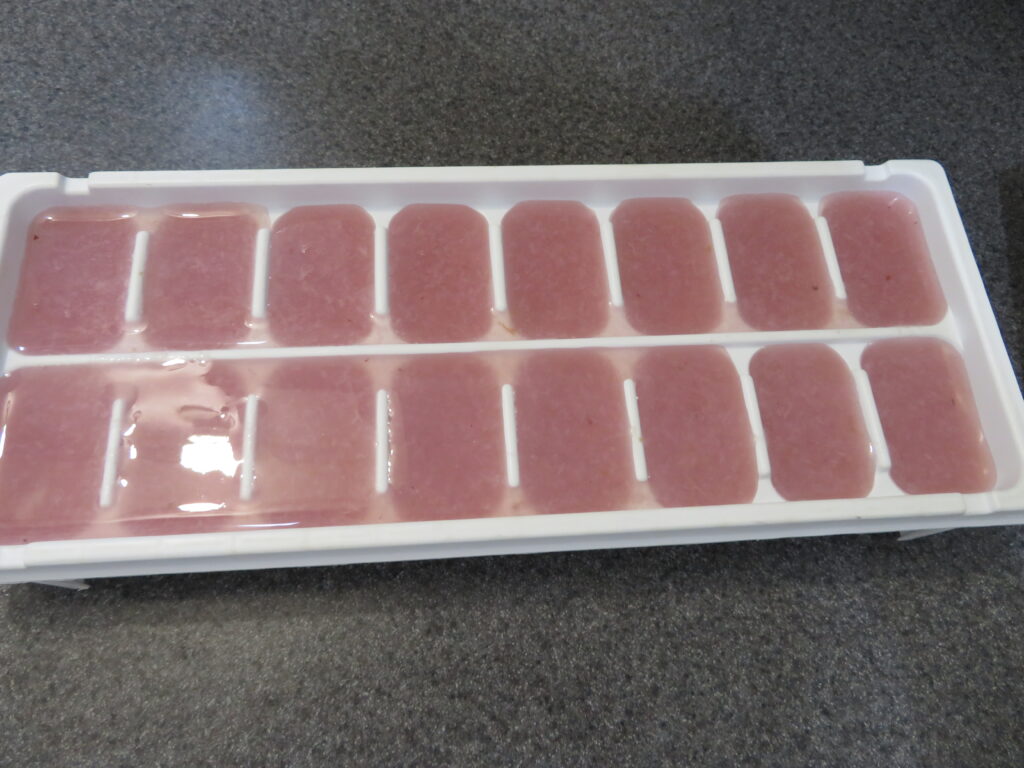
Refrigerated stock keeps three to four days, or a little longer if the fat cap is left intact as a seal. Frozen it holds four to six months before the flavor starts to flatten, though it stays safe well past that.
Freeze it in the portions you actually use. Two-cup containers for soup, half-cup portions for pan sauces, and a tray of cubes for the times a recipe wants two tablespoons. Leave headspace, because liquid expands and a full jar cracks.
Reducing before freezing saves a great deal of room. Take strained, unsalted stock down by three quarters over medium heat, cool it, and freeze it in an ice cube tray. Each cube reconstitutes into roughly half a cup. Only ever reduce unsalted stock, because salt concentrates along with everything else and a reduced salted stock is inedible. A pot of soup built from those cubes takes twenty minutes.
Make a jar, chill it overnight, tip it. Whatever the recipe called it and whatever the pot was doing for six hours, that one movement tells you what you actually have and what it is good for.
Frequently Asked Questions
My stock did not gel. Did I do something wrong?
Probably one of three things: too much water for the amount of bone, not enough joint material in the pot, or not enough time above the conversion temperature. Add chicken feet or a beef knuckle next time, cover the bones by only an inch, and give it the full window. The liquid you have is still perfectly good broth.
Does vinegar pull minerals out of the bones?
A splash of acid does slightly increase mineral extraction and it helps break down connective tissue at the margins, so it does no harm. The effect on the finished mineral content is small. Use a tablespoon per gallon if you like, and do not expect it to change the result dramatically.
Can I reuse the bones for a second batch?
You can, and the second batch will be thin. Chicken bones are largely spent after one long cook. Beef bones have more left in them, and a second pot makes a serviceable light stock for cooking grains or thinning a sauce. Do not expect it to gel.
Is bone broth different from stock?
In practice it is a long stock, usually cooked twelve hours or more and often seasoned for drinking. The name is newer than the method. Judge it the same way as anything else: chill a jar and see whether it sets.
Should I salt the pot?
No, or barely. An unsalted stock can be reduced, used in a braise that will reduce further, or seasoned at the end for whatever dish it lands in. Salt it early and every one of those options gets harder. Season the finished dish, not the raw material.