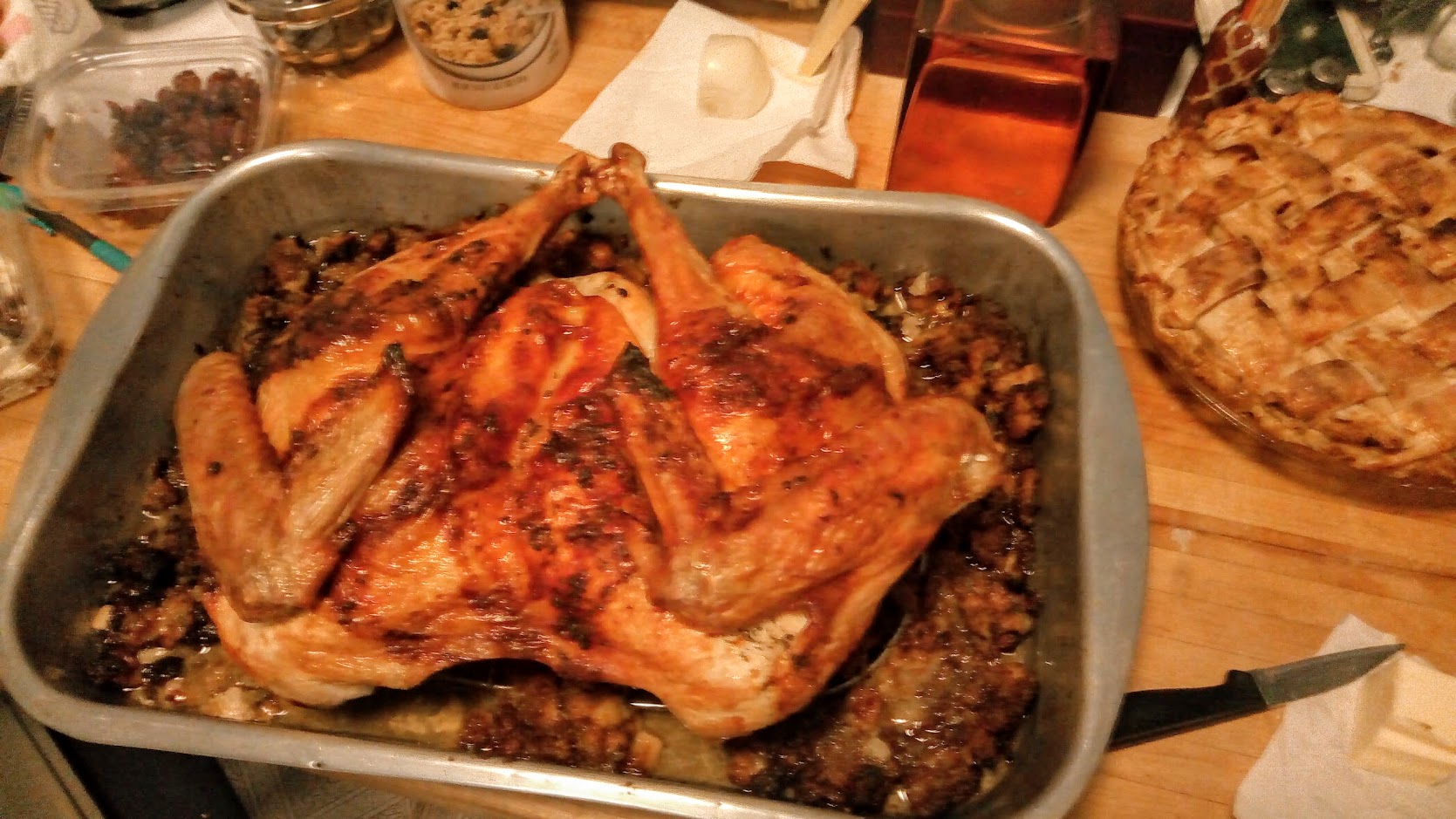
Two fourteen-pound birds went into the same oven on the same afternoon. One sat whole on a roasting rack the way a turkey always has. The other had its backbone removed and lay flattened, skin side up, taking up nearly the whole rack by itself.
The flattened bird’s breast hit 160F a full hour before the whole one did. That is not a small difference on a day when oven time is the tightest resource in the house, and it comes from a straightforward change in geometry rather than any trick of temperature or technique.
What it costs is the thing spatchcocking is usually left out of the conversation for: the bird that carries a turkey dinner’s visual centerpiece does not exist anymore once the backbone is out and the shape is flattened. Whether that trade is worth making depends on what the table actually needs that day.
- Time saved: roughly an hour faster to 160F in the breast on a 14-pound bird
- Why: a flattened bird has more surface area exposed to direct heat and a shorter distance from surface to center
- Temperature spread: breast and thigh finish closer together spatchcocked than they do whole
- What is lost: the traditional whole-bird presentation and tableside carving moment
- Best fit: weeknight-adjacent Thanksgiving prep, smaller ovens, crowded oven schedules
- Food safety: both methods must reach 165F in the thickest part of the thigh
- Carving: a spatchcocked bird carves faster since it is already flat and boneless-backed
Spatchcock turkey vs whole: the two-bird test
| Metric | Whole, trussed | Spatchcocked, flat |
|---|---|---|
| Oven temperature | 325F | 325F |
| Time to 160F, breast | about 3 hours 45 minutes | about 2 hours 45 minutes |
| Breast-to-thigh spread at pull | 10 to 12 degrees | 4 to 6 degrees |
| Skin, breast | good, some pale patches near the legs | evenly browned across the whole bird |
| Presentation at the table | whole, classic centerpiece | flat, carved before serving |
Both birds were dry-brined the same way, roasted at the same oven temperature, and pulled at the same target internal temperature. The clock was the only thing measured differently between them, and it was not close.
Why removing the backbone changes the cooking time this much
A whole turkey is a thick, roughly cylindrical mass, and heat has to travel from the outside surface all the way to the geometric center of the thigh, the slowest point to cook in the entire bird, before the whole thing is safely done. That distance is the main thing controlling total roasting time.
Removing the backbone and pressing the bird flat collapses that distance dramatically. Every part of the meat sits closer to a hot surface, whether that is the oven’s ambient heat above or the pan below, and the legs, which normally tuck underneath and cook more slowly, now lie flat and exposed at the same level as the breast.
The flattened shape also increases the bird’s total surface area relative to its mass, which is the same principle that makes a thin steak cook faster than a thick roast of the same total weight. More exposed surface means faster, more even heat transfer throughout.
What spatchcocking does to the temperature spread
A whole, trussed turkey is notorious for finishing its breast and thigh meat at noticeably different rates, since the legs are naturally insulated by their position against the body and by the cavity’s trapped air, while the breast sits more exposed and often finishes first, or occasionally overcooks while the thigh catches up.
A spatchcocked bird largely erases that gap. With the legs pressed flat and exposed at the same level as the breast, both cook at a much closer rate, and the temperature spread between the two at pull time narrows from something like ten or twelve degrees down to four to six.
That narrower spread means less of the usual tradeoff between a perfectly cooked breast and a slightly underdone thigh, or the reverse: a fully rendered thigh and a breast pulled a few degrees past ideal to get there. It is one of the more underrated benefits of the method, separate from the raw time savings.
How to spatchcock a turkey, step by step
- Set the thawed turkey breast-side down on a large cutting board. Pat the back dry so the shears do not slip.
- Using sturdy kitchen shears, cut along one side of the backbone from tail to neck. Repeat on the other side to remove the backbone entirely.
- Save the backbone for stock. It is exactly the kind of connective-tissue-rich part that makes good gelatin-rich stock, the same way trimmings do for a well-roasted whole chicken.
- Flip the bird breast-side up and press down firmly on the breastbone with both palms. A firm, sharp push should crack it flat; this is the step that makes the bird lie evenly.
- Tuck the wing tips underneath the bird. They burn easily if left exposed and unsupported.
- Season and dry-brine as usual, now working with a flat, more accessible surface. The flattened shape actually makes it easier to salt evenly under the skin.
- Roast on a rimmed sheet pan with a rack, skin side up. A flat bird needs a wide pan rather than a narrow roasting pan built for a whole turkey’s shape.
The presentation tradeoff nobody mentions
A whole roasted turkey carried to the table intact is a specific piece of Thanksgiving theater: the moment it lands on the table before anyone has touched a knife is part of the meal for a lot of families, and a spatchcocked bird cannot recreate that moment because the shape itself is no longer whole.
A spatchcocked turkey is, functionally, pre-carved before it even reaches the table, since the flattened shape makes it easiest to slice in the kitchen rather than presented and then carved in front of guests. For a household that treats the carving moment as part of the occasion, this is a real loss, not a minor styling detail.
It is also a genuinely reasonable trade for a smaller gathering, or for a cook managing a tight oven schedule with several other dishes competing for space and time, where an hour of saved oven time solves a bigger practical problem than the loss of tableside presentation creates.
Does spatchcocking change how the skin crisps?
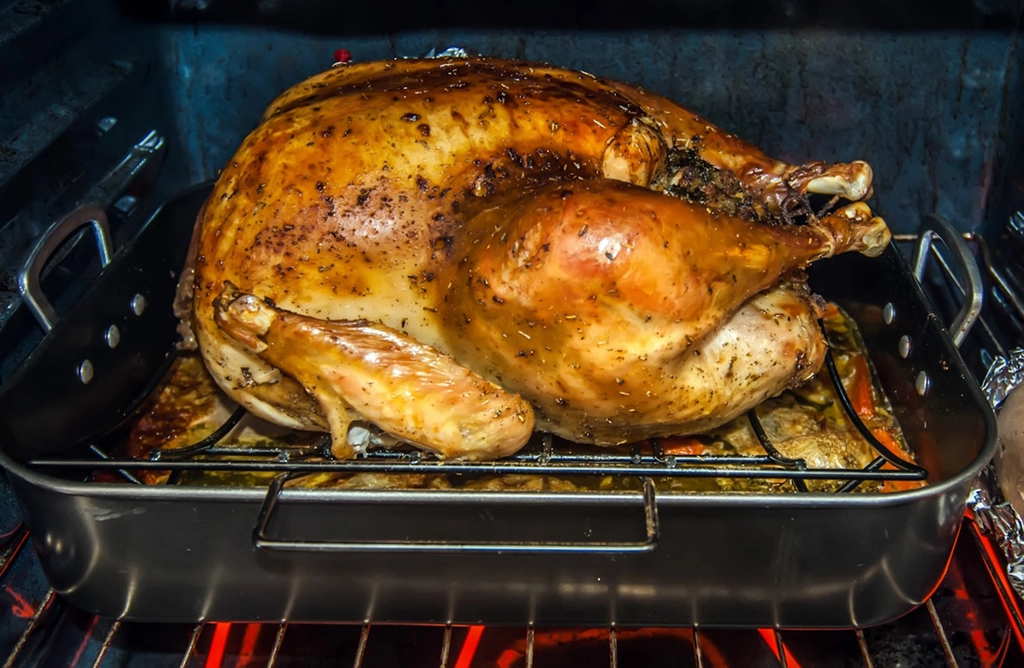
Yes, and mostly for the better. With the whole bird flattened and fully exposed to the oven’s heat rather than partially tucked against itself, the skin browns more evenly across the entire surface, without the pale, less-crisp patches that tend to show up where a whole bird’s legs meet its body.
The increased surface area that speeds up cooking also means more total skin surface is directly exposed to dry heat at once, which tends to produce a crisper result overall, assuming the skin started properly dried before roasting, the same step that matters for any roast.
The one place spatchcocking can work against browning is the very edges of the flattened breast and thigh, which sit closer to a wide pan’s cooler perimeter than the more centrally located parts of a whole bird would. Rotating the pan partway through the roast addresses this without adding real complexity to the method.
Does the size of the bird change which method wins?
The time savings scale with the bird’s original thickness, which means a smaller turkey, in the range of ten to twelve pounds, shows a smaller absolute time difference between whole and spatchcocked than a larger eighteen-to-twenty-pound bird does, since a smaller bird was already closer to fully cooked in less time regardless of shape.
A very large turkey, on the other hand, sees the biggest benefit from spatchcocking, both in time saved and in the reduced temperature spread between breast and thigh, since a large whole bird has the longest distance for heat to travel to its geometric center and the most room for uneven cooking to develop, the same size-driven logic covered in general roasting guidance for any large cut.
For a household consistently cooking birds on the larger end, spatchcocking is worth more consideration purely on the numbers than for a household that tends toward smaller turkeys, where the whole-bird method’s time cost is already more modest.
Food safety: what does not change between the two methods
Regardless of shape, a turkey is not safe to serve until the thickest part of the thigh reads 165F on an instant-read thermometer, checked away from the bone, which conducts heat differently than the surrounding meat and can give a falsely high reading if the probe touches it.
A spatchcocked bird’s flatter shape makes probe placement easier in practice, since the thigh sits fully exposed rather than tucked against the body cavity, but the target temperature itself does not shift based on the bird’s shape. Carryover cooking still applies the same way to both, adding a few degrees after the bird leaves the oven.
Raw turkey handling rules apply identically either way: wash hands and any surface the raw bird touched thoroughly, never rinse the raw bird in the sink, and keep the cutting board used to remove the backbone away from any ready-to-eat food until it has been washed with hot soapy water.
Carving a spatchcocked bird versus a whole one
A spatchcocked turkey, already flattened and with its backbone removed, carves noticeably faster than a whole roasted bird, since much of the anatomical navigation that carving a whole turkey requires has already been eliminated by the initial prep. There is no cavity to work around and no trussing string to remove first.
The tradeoff is that this carving generally happens in the kitchen, off camera, rather than as the tableside event a whole roasted bird can be. For a gathering built around that moment, doing at least a partial carve at the table with the already-flattened pieces is a middle option that preserves some of the ceremony without giving up the time savings earned in the oven.
Either way, resting the bird for fifteen to twenty minutes before carving still matters, and a spatchcocked turkey, being thinner overall, cools somewhat faster during that rest than a whole bird does, which is worth factoring into the timing of a meal built around a specific serving time.
What a smaller kitchen or a single oven gains from the time savings
An hour of freed oven time on Thanksgiving morning is not a small thing in a kitchen already juggling a casserole, dinner rolls, and a pie all wanting the same appliance at overlapping points in the day. Spatchcocking effectively hands that hour back to whatever else needs it, without asking for a second oven or a compromise on any other dish’s timing.
For a household with only one oven and a menu built around several dishes needing real oven time, that hour is often the difference between a schedule that runs smoothly and one that requires juggling temperatures and rack positions under real time pressure. It is a genuine scheduling advantage, separate from anything about flavor or presentation.
A wide sheet pan, the kind a spatchcocked bird needs, also stores more easily than a tall, narrow roasting pan built for a whole turkey’s shape, which matters for a kitchen with limited storage between one holiday and the next.
An hour of oven time is a real number on a day with no spare hours to give, and a flattened bird earns that hour honestly. Whether the centerpiece moment is worth more than the hour is the only question left to answer, and it is a household’s to decide, not a technique’s.
Frequently Asked Questions
Can I spatchcock a frozen turkey?
No, the turkey needs to be fully thawed first. A partially frozen bird is too rigid to press flat safely, and the backbone is much harder to cut through when the meat and joints are not fully pliable.
Do I need special kitchen shears to spatchcock a turkey?
A sturdy pair of kitchen shears rated for poultry works fine; a heavy chef’s knife can also do the job but requires more control and carries more risk of slipping. Dedicated poultry shears are inexpensive and make the cut noticeably easier.
Does spatchcocking work for stuffing the bird?
No, a spatchcocked turkey has no cavity to stuff, since the backbone removal and flattening eliminate the enclosed space a whole bird has. Stuffing needs to be baked separately in its own dish if this method is used.
Will a spatchcocked turkey fit in a standard oven better than a whole one?
It depends on the oven’s width rather than its depth. A spatchcocked bird is wider and flatter than a whole turkey, so it needs a rimmed sheet pan large enough to hold the flattened shape, which can actually be a tighter fit in a narrow oven than a tall roasting pan holding a whole bird.
How much oven time does spatchcocking actually save on a smaller bird?
Less than on a large bird, generally thirty to forty-five minutes rather than a full hour, since a smaller turkey already had less distance for heat to travel to its center even in its whole, unflattened shape.