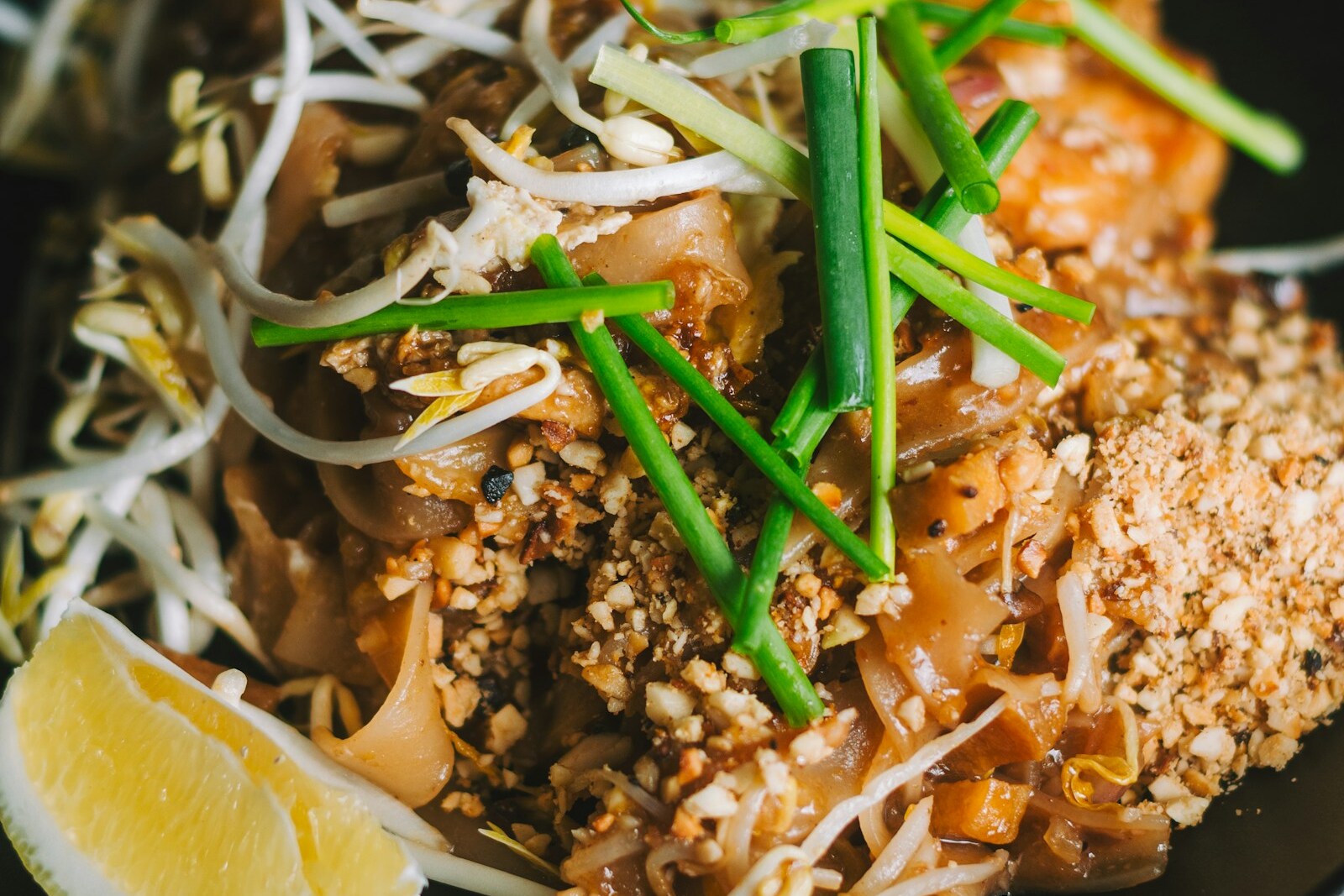
The first real pad thai you eat in Bangkok rearranges everything you thought you knew about the dish. The pad thai you have ordered in the US for fifteen years is a sweet, ketchup-toned, slightly limp noodle dish that fills a plate but does not announce itself. The Bangkok version is sharper. The noodles still have a faint bite, the tamarind sourness cuts through every bite, the fish sauce sits as a salty bass note under the palm-sugar sweetness, and crushed roasted peanuts give the whole thing a slightly caramelized crunch. It is the most popular Thai dish in the world and one of the most consistently mistranslated.
Pad thai is not an ancient dish. It was invented — or, more accurately, codified and promoted — in the late 1930s and 1940s by Prime Minister Plaek Phibunsongkhram, who needed a national rice-noodle dish that could substitute for white rice during wartime shortages. He sponsored a recipe competition and the winning entry, an adaptation of Chinese-Thai stir-fried noodles, became pad thai. The dish was distributed nationally via government cooking demonstrations and street-cart subsidies. By the 1960s it was a Bangkok staple. By the 2000s it was the international face of Thai food.
The Bangkok food writer Leela Punyaratabandhu and the chef Andy Ricker (Pok Pok) have spent the past fifteen years dragging international pad thai back toward its actual Thai form. Ricker’s Pok Pok cookbook, published 2013, and Punyaratabandhu’s Bangkok, published 2017, are the two definitive English-language records of how the dish is meant to taste. This recipe takes its bearings from those two sources, with technique notes for a home wok cook who does not have access to a 200,000 BTU jet burner. The rest of this article is what every variable does to the final result.
The Four-Flavor Balance
Pad thai is built on the Thai principle of rot chat — the four-flavor balance of sweet, sour, salty, and umami in roughly equal weight. The sauce achieves this with three ingredients: tamarind (sour), palm sugar (sweet), and fish sauce (salty/umami). Each is potent. Each is fairly approximate. The skill of pad thai cooking is tasting the sauce before it goes in the wok and adjusting until all four flavors register clearly when you taste a single drop. A sauce that tastes mostly sweet is wrong. A sauce that tastes mostly sour is wrong. The right answer is a sauce that does not taste like any one thing.
The default proportions in this recipe — 3 tablespoons tamarind, 3 tablespoons palm sugar, 2.5 tablespoons fish sauce — are a starting point calibrated for a fairly sour tamarind and a moderately sweet palm sugar. Brands vary wildly. Adjust freely: more tamarind if the sauce tastes too sweet, more sugar if too sharp, more fish sauce if the umami is thin. Taste with a clean spoon, not your finger. Adjust before the sauce enters the wok — mid-fry corrections are difficult.
Noodle Soak: Warm Water, Never Hot
Dried flat rice noodles (sen lek, the 5-millimeter wide variety) must be soaked, not boiled. Boiling cooks them through and leaves them mushy by the time they hit the wok. Soaking in warm tap water (about 110°F / 43°C) for 25 to 30 minutes hydrates them enough that they bend without breaking but still have firmness in the center. They finish cooking in the wok during the final toss. Hot water, even briefly, overshoots this window: by the time you drain, the noodles are partially gelatinized and will turn to mush on contact with hot oil.
Look for sen lek noodles labeled as “Thai rice noodles” or “banh pho” at Asian markets. The 5-millimeter width is standard for pad thai; narrower (3-millimeter) is for noodle soups, wider (10-millimeter) is for pad see ew. The brand matters less than the freshness of the package — older dried noodles take longer to hydrate and may need 35 to 40 minutes of soaking. Test by bending a noodle: pliable with no white crack at the center means done.
Why You Cannot Cook Four Portions at Once
Every Thai cooking teacher will tell you the same thing: pad thai is a one-or-two-portion dish. The reason is heat. A home wok over a residential gas burner can sustain frying temperature for about 200 grams of noodles plus protein. Add a third portion and the wok cools, condensation builds, and the noodles steam rather than fry. The result is wet, soft noodles instead of the slightly chewy, lightly caramelized strands you want. Bangkok street vendors with jet burners producing 100,000+ BTU still cook one or two portions at a time.
If you are feeding four, cook two batches consecutively. The first batch goes on a warm plate covered loosely with foil while you fry the second. Each batch takes under ten minutes from wok-hot to plate. The slight loss of synchronicity is worth it for properly fried noodles. The alternative — doubling the recipe in a household pan — produces a uniformly disappointing result every time.
Pad Thai vs Pad See Ew vs Drunken Noodles: A Quick Map
| Dish | Noodle | Sauce profile |
|---|---|---|
| Pad Thai | Sen lek (5mm flat rice) | Tamarind, palm sugar, fish sauce – four-flavor balance |
| Pad See Ew | Sen yai (wide flat rice) | Dark soy, oyster sauce, sugar – sweet-savory |
| Pad Kee Mao (drunken) | Sen yai (wide flat rice) | Garlic, chili, holy basil, fish sauce – hot, herbal |
Ingredients
For the sauce:
- 3 tablespoons (45 ml) tamarind paste
- 3 tablespoons (45 g) palm sugar, grated (or light brown sugar)
- 2.5 tablespoons (37 ml) fish sauce
For the stir-fry:
- 180 g (6.3 oz) dried flat rice noodles (5 mm wide / sen lek)
- 2 tablespoons (30 ml) neutral oil (peanut or vegetable)
- 2 large shallots, finely chopped
- 3 garlic cloves, finely chopped
- 200 g (7 oz) firm tofu, pressed and cubed
- 2 large eggs, lightly beaten
- 8 medium shrimp, peeled (optional)
- 2 cups (about 100 g) bean sprouts
- 4 garlic chives or 6 green onions, cut in 2-inch lengths
To finish:
- 1/3 cup (45 g) roasted unsalted peanuts, roughly crushed
- 2 tablespoons (15 g) dried shrimp powder (optional)
- 1 lime, cut into wedges
- Thai chili flakes, for serving
Making It
- Soak noodles. Cover dried noodles with warm tap water for 25-30 minutes until pliable. Drain.
- Mix sauce. Whisk tamarind, palm sugar, and fish sauce until sugar dissolves. Taste — should hit four flavors in balance. Adjust.
- Prep mise en place. Have everything within reach of the wok. Pad thai is fast.
- Heat the wok. Carbon steel wok over high heat until smoking. Add oil and swirl. Add shallots and garlic; stir-fry 20 seconds.
- Add tofu. Stir-fry 90 seconds until edges are golden. Add shrimp if using; stir-fry 90 seconds until pink.
- Scramble eggs. Push protein aside. Pour eggs into empty side, let set 15 seconds, then scramble loosely.
- Add noodles + sauce. Add drained noodles. Pour sauce over. Toss with two spatulas 90 seconds. Add splash of water if dry.
- Add chives + sprouts. Toss 30 seconds. Bean sprouts should stay crunchy.
- Plate. Divide between two warm plates. Top with crushed peanuts. Serve with lime and chili flakes.
Common Mistakes
The most common mistake is over-cooking the noodles. Soak in warm, not hot, water and drain while still firm. The noodles finish in the wok. The second mistake is using ketchup or tomato paste in the sauce. American-Chinese versions sometimes include both; authentic pad thai uses tamarind for the red-brown color and sour profile. Ketchup makes the dish taste cloying and Americanized. The third mistake is cooking too many portions at once. Stick to two portions maximum in a home wok.
What to Serve With Pad Thai
A plate of pad thai is a meal on its own. For a wider Thai table, add a clear som tum salad (green papaya, lime, chili) to cut the richness, a small tom yum kung soup for a hot-sour counterpoint, and Thai iced tea or fresh-squeezed lime soda to drink. For something from our family, our Korean fried chicken with double-fry technique shares the wok-and-glaze sensibility on a different continent, and our Korean bibimbap rice bowl rounds out a broader Asian rotation.
Storage and Make-Ahead
Pad thai does not refrigerate well. The noodles absorb sauce overnight and turn from al dente to mushy. Eat the day it is made. Components, however, can be prepped ahead: the sauce keeps in the refrigerator for a week and improves with time as the tamarind mellows. Soaked noodles can sit drained at room temperature for 30 minutes before the wok. Crushed peanuts, dried shrimp powder, and chopped chives can be prepped a day ahead. Cook the dish in 10 minutes when you are ready to eat.
Frequently Asked Questions
Why are my pad thai noodles mushy?
Mushy noodles come from two causes: soaking in hot water (use warm tap water, never hot) and not letting them finish in the wok (drain while still firm, let the wok do the final cook). If your noodles are overcooked before they hit the wok, no stir-fry can save them.
Where can I buy tamarind paste?
Look for jarred tamarind paste from Thai Kitchen, Tamicon, or Por Kwan at Asian markets or specialty groceries. For best results, find tamarind from a Thai or Indian store — the flavor is brighter and more authentic than mainstream brands. Block tamarind requires more work but produces the best result.
Why palm sugar instead of white sugar?
Palm sugar has caramel-vanilla notes that white sugar lacks, and it balances tamarind sourness in a way pure sweetness cannot. Light brown sugar is the closest substitute. Avoid white sugar entirely — the dish will taste flat.
Can I make pad thai for more than 2 people at once?
No. Pad thai is a one-or-two-portion wok dish. More than two portions overwhelms home wok heat capacity and produces steamed, soft noodles instead of crisp fried ones. Cook batches consecutively when feeding more.
Sources
- Serious Eats — The Best Pad Thai — Detailed sauce balance breakdown from Bangkok-style preparation.
- NYT Cooking — Pad Thai by Leela Punyaratabandhu — The Bangkok food writer’s authoritative home-kitchen adaptation.
- USDA FoodData Central — Rice Noodles and Peanuts — Nutritional data.
Each serving (1 of 2) contains roughly 685 calories, 32 g protein, 22 g fat, 82 g carbohydrates, 4 g fiber.
Please note: Contains fish (fish sauce, dried shrimp), shellfish (if shrimp added), peanuts, soy (in tofu), and eggs. Pad thai is high in sodium and not suitable for sodium-restricted diets, severe shellfish/peanut allergies. Consult a dietitian for specific dietary needs.