A pie made with fresh puree came out of the oven looking correct and sliced two hours later into something closer to a pudding with a crust under it. The filling wept. There was a shallow moat of pale liquid in the bottom of the pan by the next morning.
The recipe was not at fault and neither was the oven. A 15-ounce can of pumpkin and 15 ounces of fresh roasted puree are not the same ingredient. The fresh version carries substantially more free water, and a custard has a fixed capacity for water before the egg network stops holding it.
The fix is not complicated and it is not fast. Roast rather than boil, drain overnight, weigh what is left, and then adjust the recipe to the weight rather than to the cup. Below is that sequence, with the numbers from a five-pound sugar pumpkin.
- Buy: sugar or pie pumpkin, 3 to 5 pounds, heavy for its size
- Roast: halved, cut side down, 400F, 45 to 60 minutes
- Drain: 8 to 12 hours in cheesecloth in the refrigerator
- Loss on draining: 20 to 35 percent of the puree weight, as water
- Target: 425 g of drained puree stands in for one 15-ounce can
- Yield: a 4-pound pumpkin gives roughly 500 to 650 g drained
- Keep in mind: pumpkin pie is a low-acid custard and belongs in the refrigerator
Why fresh puree loosens a pie
A custard sets because egg proteins unfold with heat and link into a mesh that traps liquid. That mesh has a limit. Past a certain ratio of water to egg, the mesh forms but cannot hold everything, and the excess drains out over the following hours in a process bakers call syneresis and everyone else calls weeping.
Canned pumpkin has already been cooked hard, and a good deal of its water left during processing. Fresh roasted flesh has lost some water to evaporation but is still carrying most of what was in the fruit, and pumpkin flesh is around ninety percent water to begin with.
The difference is easy to see without any equipment. Spoon a tablespoon of each onto a paper towel and wait five minutes. The canned sample sits there. The fresh sample puts out a visible wet ring.
Sugar pumpkin, not the one from the porch
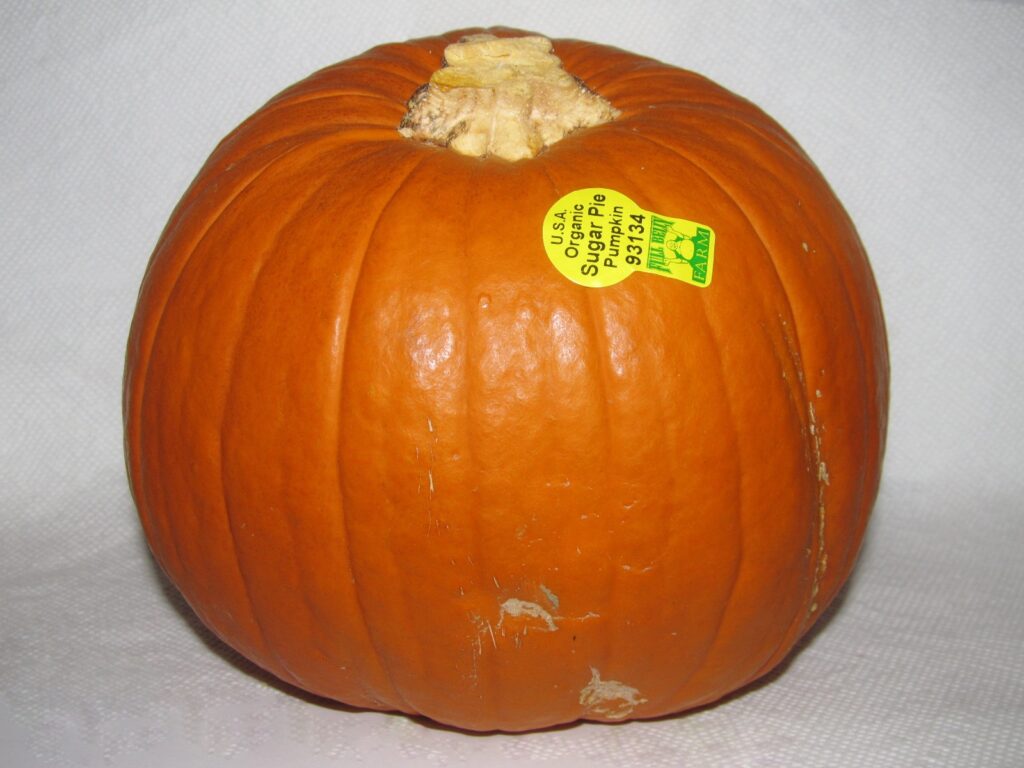
Large carving pumpkins are bred for size, wall thickness and a flat bottom. Their flesh is stringy, pale and watery, and it tastes faintly of squash and mostly of nothing. A pie made from one is a great deal of work for a mediocre result.
What you want is labeled sugar pumpkin, pie pumpkin, or sometimes just baking pumpkin, and it runs three to five pounds. The flesh is denser, deeper orange and noticeably sweeter. Kabocha, red kuri and butternut all make better pie than a carving pumpkin does, and butternut in particular is drier and more reliable.
Pick one that feels heavy for its size with a hard, dull skin and an intact stem. A glossy skin means it was picked early. A soft spot anywhere on it, especially near the stem or the blossom end, means put it back.
Roast, do not boil, do not steam
Boiling adds water to something that already has too much, and steaming is only marginally better. Roasting drives water off and browns some of the sugars at the cut surface, which is where the flavor difference between fresh and canned actually lives.
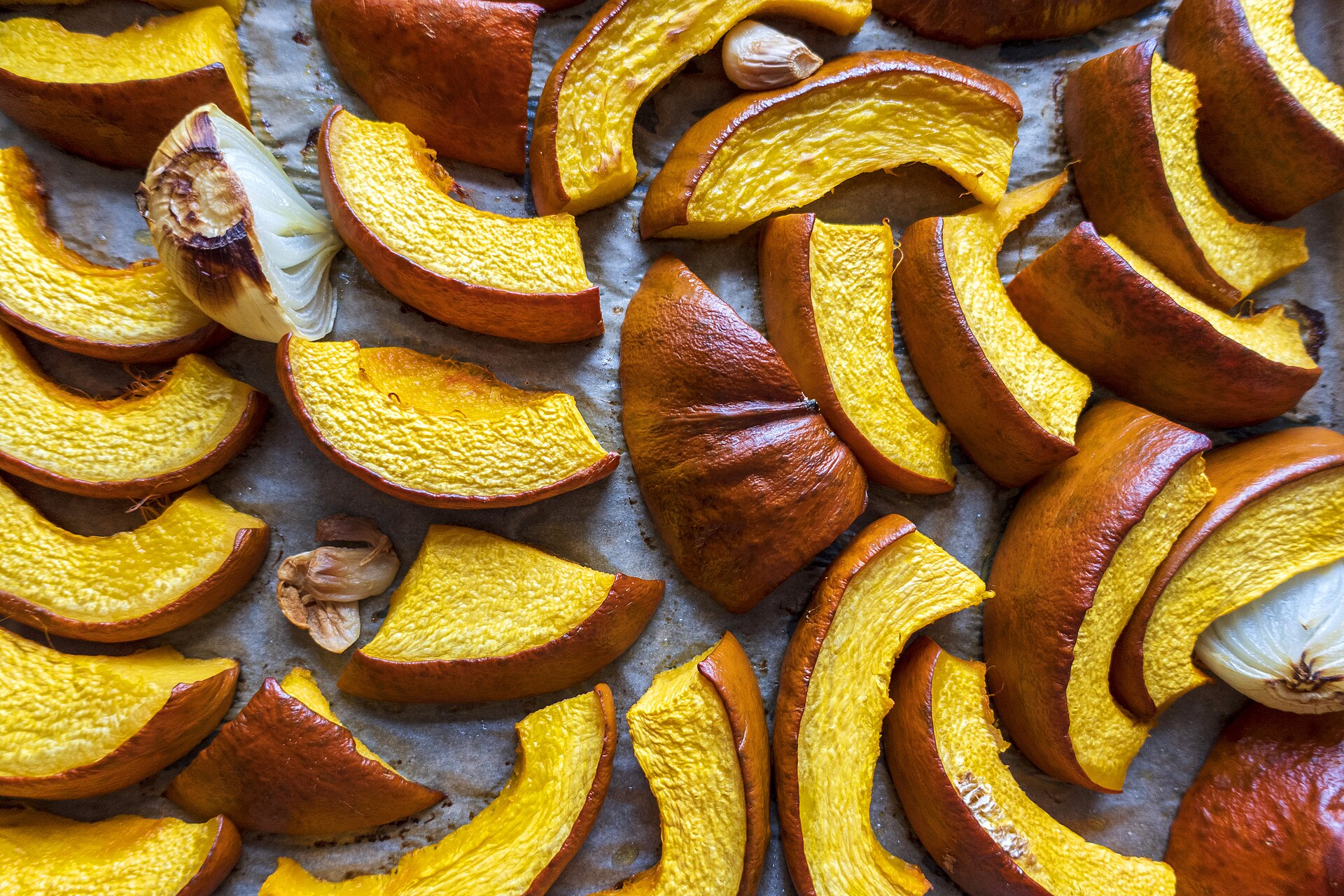
Cut side down on a lined sheet pan is the position that matters. The trapped steam softens the flesh while the exposed skin dries, and the sugars that leak out caramelize against the pan rather than diluting into a pool. Do not add water to the pan. Do not cover it with foil.
Four hundred degrees for forty-five minutes to an hour, depending on size, until a knife slides through the thickest part of the wall with no resistance. Slightly overdone is better than slightly under, since undercooked flesh purees grainy and holds onto its water.
Homemade pumpkin puree, step by step
- Wash the outside and dry it. The knife is going to drag whatever is on the skin through the flesh.
- Halve it through the stem end with a heavy knife. Set the pumpkin on a folded towel so it cannot roll. This is the part of the procedure that sends people to the emergency room.
- Scrape out the seeds and the loose fibers with a metal spoon. An ice cream scoop is better than a spoon. Set the seeds aside rather than throwing them out.
- Place the halves cut side down on a parchment-lined sheet pan. No oil, no water, no cover.
- Roast at 400F for 45 to 60 minutes. The skin will collapse and darken in patches. That is the signal, not a problem.
- Cool until you can handle it, then scoop the flesh from the skin. It should come away in sheets. Anything that clings is underdone.
- Puree until completely smooth. A food processor takes about ninety seconds, a blender needs a spatula and patience, and a food mill gives the finest texture and removes any remaining fiber.
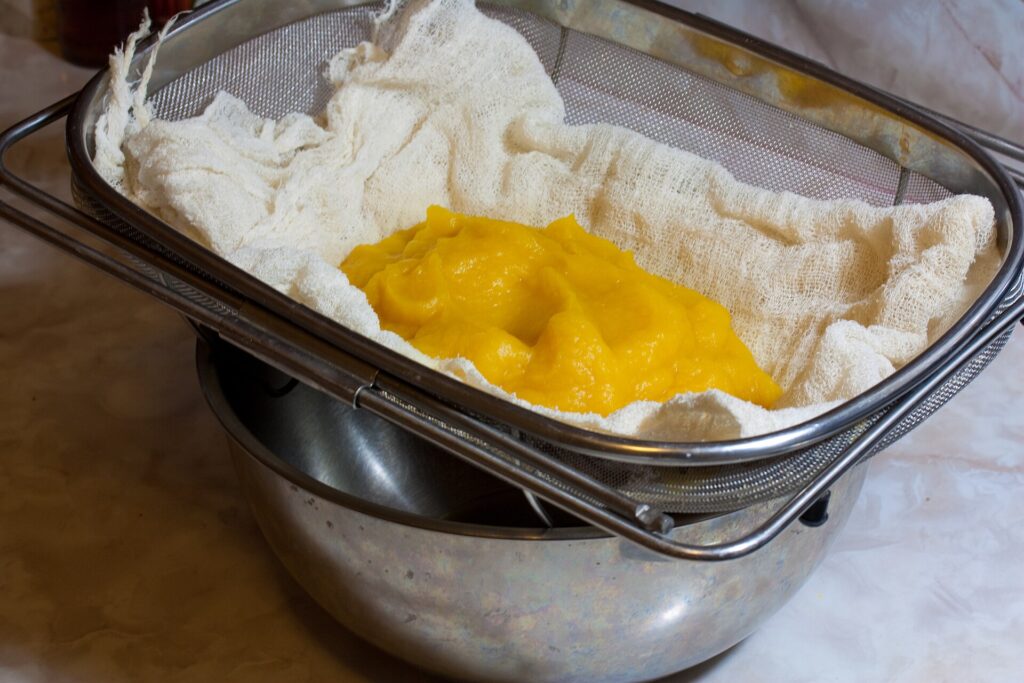
- Line a sieve with four layers of cheesecloth and set it over a bowl. A clean cotton dish towel works. Coffee filters clog.
- Scrape the puree in, fold the cloth over, and refrigerate 8 to 12 hours. Weight it with a small plate and a can if you want to push it further.
- Weigh what is left and pour off what drained. The liquid is worth keeping for a soup. The weight is the number the recipe now runs on.
The overnight drain, measured
This is where the fresh-versus-canned problem gets solved, and it is the step most recipes leave out. Draining is passive, takes no skill, and removes exactly the thing that ruins the pie.
| Stage | Weight from a 4 lb pumpkin | What it is good for |
|---|---|---|
| Whole, as bought | 1810 g | – |
| Seeds and fiber removed | 1520 g | – |
| Roasted, skin off | 860 g | soups, risotto, mash |
| Pureed, undrained | 860 g | soups, curries, quick breads |
| Drained 4 hours | 700 g | muffins, pancakes, gnocchi |
| Drained 12 hours | 590 g | pie, cheesecake, custards |
Roughly a third of the weight of the puree left as water over twelve hours, and the puree that remained was visibly stiffer, darker and more concentrated in flavor. Four hours removes about half as much and is enough for anything with flour in it.
The drained liquid is not waste. It is faintly sweet, tastes of pumpkin, and belongs in a soup, a braise or the cooking water for rice. Refrigerate it and use it within a couple of days.
Target weight: what a can actually holds
A standard can of pumpkin in an American supermarket is 15 ounces, or 425 grams, and virtually every pie recipe in circulation is written around one can. That is your target number and it is more reliable than any cup measure.
Volume is where the substitution goes wrong. A cup of loosely spooned fresh puree and a cup of dense canned puree can differ by fifty grams, and two cups of the wrong one is a hundred grams of unexpected water in a filling that holds about four hundred grams of it.
So: weigh the drained puree, and if you are short, drain a smaller amount for longer rather than making up the difference with wetter puree. If you are over by more than twenty grams, hold the extra back for something else.
Adjusting a canned recipe for fresh puree
Once the puree is at 425 grams and properly drained, most recipes need only small changes. If you have skipped the drain, or drained only briefly, the adjustments below get you most of the way there.
| If the puree is | Reduce the dairy by | Add | Bake |
|---|---|---|---|
| Drained 12 hours | nothing | nothing | as written |
| Drained 4 hours | 2 tablespoons | nothing | as written |
| Undrained | 60 to 80 ml | 1 extra egg yolk | 10 minutes longer |
| Undrained and thin | 80 ml | 1 yolk and 1 tbsp cornstarch | 10 to 15 longer |
The extra yolk is doing real work. Yolk brings both emulsifiers and additional protein, and it firms a custard without the rubbery edge that a whole extra egg gives you. Cornstarch is the blunter instrument and it dulls the flavor slightly, so it goes in last.
A filling that has been cooked down in a saucepan for ten minutes before it meets the eggs is the professional version of all this. It concentrates the puree, blooms the spices in fat, and gets you a filling that sets cleanly with no arithmetic at all.
What canned pumpkin actually is
Most canned pumpkin in the United States is not the round orange field pumpkin. It is a tan-skinned, dense-fleshed variety in the same species as butternut squash, selected precisely because it purees smooth and carries less water. Labeling rules allow it, and the result is better than what the name suggests.
That is worth knowing because it explains why fresh field pumpkin never quite tastes like the can. It is not a processing difference alone. It is a different plant, chosen for exactly this job.
It also means butternut squash is the closest fresh equivalent, and a butternut roasted and pureed the same way lands nearer the canned texture than any pumpkin will. If a pie is the goal and a sugar pumpkin is not available, reach for butternut without apology.
The custard, and how to tell when it is done
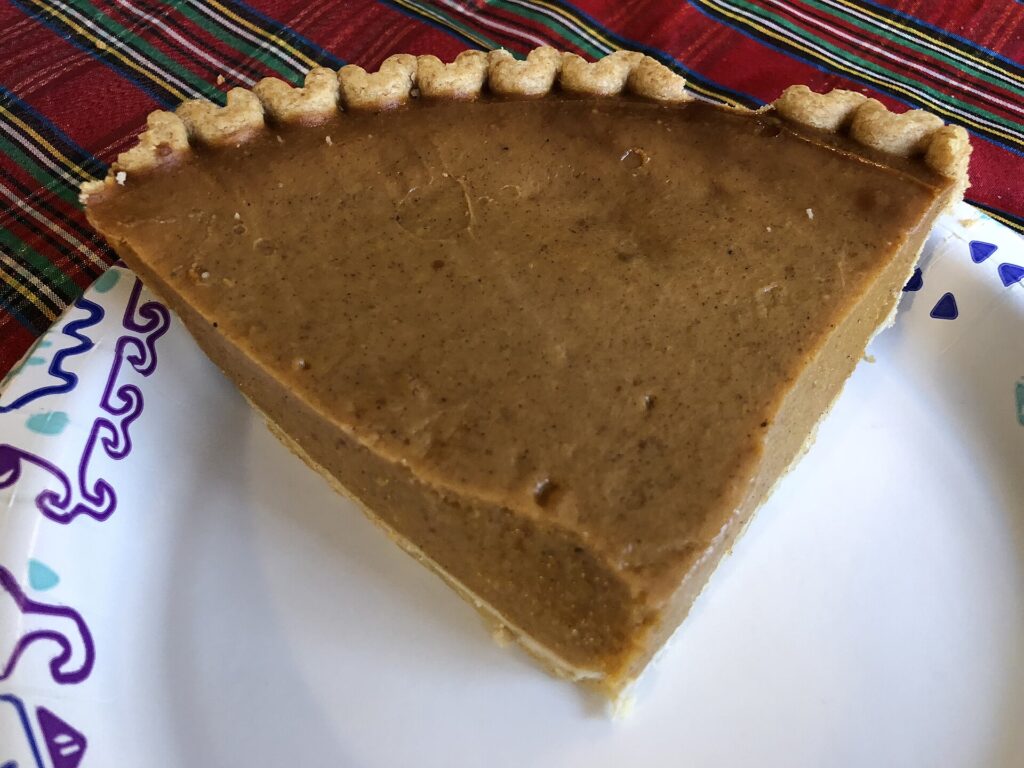
A pumpkin pie is a baked custard and it follows custard rules. The center should be set but still wobble as one piece when the pan is nudged, and the edges should be puffed but not cracked. A pie baked until the center is firm is a pie that will crack as it cools.
An instant-read thermometer in the center at an inch of depth is the honest test. Somewhere around 175F is where the custard has set and has not yet begun to curdle, and past about 185F the proteins tighten and squeeze water out, which produces both the crack and the weeping.
Cool it on a rack for two hours and then refrigerate. The set continues as it cools, so a pie that looks slightly loose at the two-hour mark is usually correct by the time it is cold. Slicing warm is how a perfectly good pie gets blamed for being runny.
Storage, freezing and the safety line
Fresh puree keeps in the refrigerator for about five days and freezes for a year with no meaningful loss. Freeze it in 425-gram portions, flat in bags, and note the weight on the bag. Thawed puree releases more liquid, so drain it again briefly and expect to lose another twenty grams.
Do not water-bath can pumpkin puree, and do not pressure can it as puree either. Pumpkin is low in acid and mashed or pureed pumpkin is too dense for heat to penetrate reliably to the center of the jar, which is the exact condition that allows botulism spores to survive processing. Home canning guidance from every food preservation extension service says the same thing: cubes in liquid, pressure canned, and puree only in the freezer.
The finished pie has the same low-acid, egg-and-dairy character and belongs in the refrigerator rather than on the counter. Two hours at room temperature is the working limit after it has cooled, and it keeps three to four days covered and cold.
Where fresh actually beats the can
Flavor, once it is drained. Roasted fresh puree tastes brighter and more like the vegetable, and it has an edge of caramelization the can cannot have. In a pie that is heavily spiced the difference narrows, and in a lightly spiced custard it is obvious.
It also gets you the rest of the pumpkin. Seeds, skins, the fibrous strands and the trimmings are all usable, and a five-pound pumpkin that yields a pie also yields a tray of seeds and a pot of stock. Cooking with less waste is easier when the raw material arrives whole.
Where the can wins is Tuesday. It is consistent, it is already the right texture, and it costs a fraction of the time. Roast fresh when the pumpkin is good and the afternoon is free, and keep two cans in the cupboard for when it is not. A fruit pie forgives a wet filling in a way a custard never will.
Frequently Asked Questions
Can I skip the draining if I cook the filling down first?
Yes, and it is the better route if you have twenty minutes. Simmer the puree with the sugar and spices in a wide saucepan, stirring, until it thickens and pulls away from the sides, then cool it before whisking in the eggs and dairy. You are removing the same water with heat instead of time.
How much pumpkin do I need to buy for one pie?
A four-pound sugar pumpkin drained for twelve hours gives around 590 grams, which is one 425-gram pie with a good deal left over. A three-pound pumpkin is closer to the exact amount. Buy the larger one and put the surplus in the freezer.
Is the stringy flesh around the seeds usable?
Not in a puree, since it never breaks down smooth and it holds a lot of water. It is worth simmering with the skins and trimmings for a light stock. If it makes it into the food processor, push the finished puree through a sieve.
Why did my pie crack across the middle?
It was baked past the point where the custard set. The crack is the protein network contracting and tearing after it squeezed out its water. Pull the pie when the center still moves as a unit, and let it finish setting on the counter.
Can I use fresh puree in quick breads and muffins the same way?
Yes, and there you need much less draining, since flour and chemical leavening tolerate the extra water without collapsing. Four hours in the sieve, or none at all if you cut a tablespoon or two of liquid from the recipe. Custards and cheesecakes are the fussy ones.