A fourteen-pound turkey goes into the refrigerator three days before the meal, salted and sitting on a rack, with nothing covering it. Anyone who opens that refrigerator door in the meantime sees a raw, exposed bird sitting there for what looks like an uncomfortably long time, and the instinct to wrap it in plastic is strong. Resisting that instinct is most of the technique.
Dry brining works by drawing moisture out of the meat with salt, dissolving that salt into a concentrated surface brine, and then letting the meat slowly reabsorb it over the following days, carrying the seasoning deep into the muscle rather than leaving it on the surface. A wet brine does something similar faster, but it also waterlogs the skin, which is why a wet-brined turkey rarely crisps as well as a dry-brined one.
What follows is the actual salt weight for a bird that size, what happens day by day in the refrigerator, why leaving it uncovered is the step that makes the skin work, and the handling that keeps three days of raw turkey in the fridge safe rather than risky.
- Salt for a 14-pound turkey: about 1.5 tablespoons of kosher salt per 5 pounds, roughly 4 tablespoons total
- Timeline: apply salt 3 days out, uncovered, refrigerated the entire time
- Uncovered matters: open air dries the skin surface, which is what crisps in the oven
- Fridge temperature: must stay at or below 40F for the full 3 days
- Never rinse raw turkey. It splashes bacteria around the sink and does nothing useful
- Result versus wet brine: drier, crisper skin; more concentrated flavor; no added water weight
Why three days uncovered instead of a wet brine
A wet brine, the kind behind a buttermilk-brined chicken or a turkey submerged in salted water for a day or so, seasons the meat and adds moisture through osmosis, but that added moisture sits mostly in the skin and the outer layers of meat, and skin that starts out wetter than normal has a harder time crisping in the oven regardless of how well the bird is dried before roasting.
Dry brining skips the added water entirely. Salt applied directly to the skin draws the turkey’s own moisture out first, dissolves into it, and that concentrated salty liquid is then slowly drawn back in over the following days by the same osmotic process working in reverse, carrying seasoning into the meat without adding any extra water weight to the skin.
The tradeoff for that better skin is time. A wet brine can be done same-day or overnight. Dry brining wants three days minimum for a turkey-sized bird to fully seat the seasoning through thick muscle, which is exactly why it needs to start well before Thanksgiving morning rather than the night before.
The salt weight for a 14-pound bird, and how to scale it
| Bird weight | Kosher salt (Diamond Crystal) | Approx. total |
|---|---|---|
| 10 lb | 3 tbsp | about 1.5 oz |
| 14 lb | 4 tbsp | about 2 oz |
| 18 lb | 5 tbsp | about 2.5 oz |
| 22 lb | 6 tbsp | about 3 oz |
Salt brands vary considerably in density, and this matters more than most seasoning advice acknowledges. Diamond Crystal kosher salt is roughly half the density by volume of Morton kosher salt, so a recipe written for one and measured by the tablespoon in the other can end up nearly twice as salty as intended. Weighing the salt on a kitchen scale removes the ambiguity entirely, and roughly a tablespoon per five pounds of bird by weight, not necessarily by volume, is the safer way to think about the ratio.
The salt goes everywhere: under the breast skin where fingers can reach, over the legs and thighs, inside the cavity, and lightly over the back. An even distribution matters more than a heavy hand in any one spot, since a patch of double-salted skin will taste noticeably different from the rest of the bird once cooked.
What dry brining actually does over three days
On day one, salt sitting on the surface draws moisture out through osmosis, and the skin often looks wet or beaded within the first few hours as this happens. That drawn-out liquid dissolves the salt crystals into a concentrated brine sitting directly on the surface of the meat.
Over day two, that concentrated surface brine begins moving back into the meat, this time carrying the dissolved salt with it, seasoning the muscle from the outside in. This reabsorption is slower than the initial moisture loss, which is part of why the process needs more than a single overnight rest to complete.
By day three, most of the surface liquid has been reabsorbed, the skin has had time to air-dry in the refrigerator’s low humidity, and the salt has penetrated meaningfully into the muscle rather than sitting only at the surface. This is also when the skin itself starts to feel noticeably drier and slightly tacky to the touch, which is exactly the texture that produces good crisping in the oven.
Dry brine turkey, step by step
- Make sure the turkey is fully thawed. A partially frozen bird salts unevenly and the timeline below assumes it starts fully thawed.
- Pat the entire bird dry with paper towels, inside and out. Starting dry gives the salt direct contact with the skin rather than a layer of surface moisture.
- Weigh out the salt for the bird’s size. Use the ratio of about 1 tablespoon of kosher salt per 5 pounds, adjusted for your specific salt brand’s density if measuring by volume.
- Loosen the skin over the breast with your fingers and salt directly on the meat underneath. This is the single most important spot, since breast meat dries out fastest in the oven and benefits most from direct seasoning.
- Salt the legs, thighs, and back, and a light amount inside the cavity. Distribute evenly rather than concentrating in one area.
- Set the turkey on a rack over a rimmed sheet pan, breast side up, uncovered. The rack keeps air circulating underneath, which matters as much as the exposure on top.
- Refrigerate uncovered for 3 days, at 40F or below the entire time. Resist the urge to wrap it; open air is doing real work here.
- On cooking day, take it straight to the oven. No rinsing, no additional salting, no wet brine step layered on top.
Uncovered is not optional: why open air matters
The refrigerator’s dry, cold air pulls surface moisture off the skin continuously over the three days, and that gradual drying is what sets up good browning and crisping later in the oven. A wet skin going into a hot oven spends its first stretch of cooking time just evaporating that surface water, delaying the Maillard browning that produces color and crackle.
Covering the bird with plastic wrap or foil traps humidity against the skin and largely undoes the drying half of what dry brining accomplishes, even though the salt would still season the meat underneath. The two effects, seasoning and surface drying, both come from the same three days, and covering the bird only interferes with the second one.
A rimmed sheet pan and a rack are the only equipment this requires, keeping the bird elevated so air moves underneath as well as over the top, and catching any drips so the refrigerator itself stays clean through the three days.
The moisture readings that explain the wet-brine tradeoff
A wet-brined turkey typically weighs measurably more after brining than before, since it has absorbed water along with the salt, and that extra water is part of why wet-brined meat is often described as juicier straight out of the oven. It is also, quite literally, partly water rather than concentrated turkey flavor.
A dry-brined turkey loses a small amount of weight during the process, since the initial moisture drawn out by the salt does not all get reabsorbed, and what stays behind in the pan is mostly water rather than flavor. The meat itself ends up seasoned throughout without carrying the same added water weight.
In practical terms this means a dry-brined turkey’s juiciness comes more from careful roasting, correct temperature, and proper resting than from the brine itself, while a wet-brined turkey has some built-in moisture insurance even against a slightly overcooked result. Neither approach is universally better; they solve the moisture question differently, and the skin outcome is where dry brining has the clearer advantage.
Handling raw turkey safely for three days in the fridge
A raw turkey sitting in the refrigerator for three days needs the same handling care as any raw poultry, just extended over a longer window. The refrigerator itself must hold at or below 40F consistently, which is worth confirming with an appliance thermometer rather than trusting the dial, especially in a fridge that will be opened frequently over a busy few days.
Do not rinse the raw turkey at any point, including right before it goes into the oven. Rinsing raw poultry does not remove bacteria in any meaningful way and instead splashes contaminated water across the sink, counters, and nearby surfaces, which is a well-documented source of cross-contamination in home kitchens. Cooking the bird to a safe internal temperature is what addresses the bacteria; washing it does not.
Keep the sheet pan holding the turkey away from other refrigerator contents, ideally on the bottom shelf so any drips cannot fall onto food stored below it, and wash hands, the sink, and any surface the raw bird or its pan touched with hot soapy water immediately after handling. A raw turkey carries the same salmonella risk as any raw poultry, uncovered or not, and the three-day dry brine window does not change what safe handling requires.
What to do the day of, after three days of dry brining
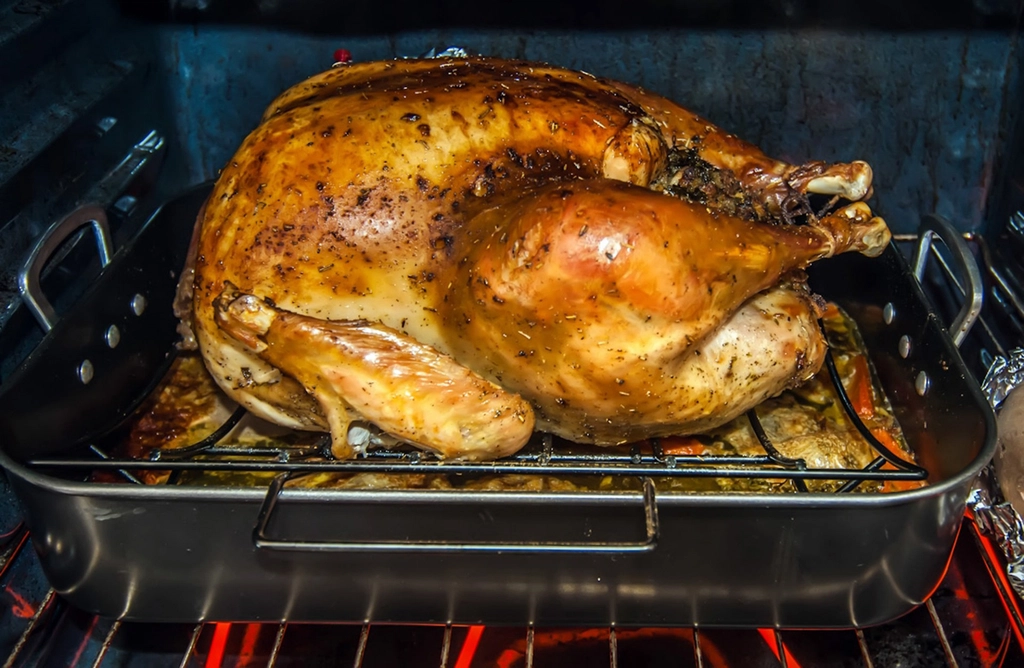
The turkey goes straight from the refrigerator to the roasting pan with no additional prep beyond bringing it closer to room temperature for the last hour before cooking, which helps it roast more evenly. No further salt is needed, and no rinsing or wiping down changes anything except removing seasoning that took three days to build.
The skin at this point should feel noticeably drier than a fresh, unsalted turkey’s skin, almost slightly tacky rather than wet, which is the sign the process worked, the same dry-skin starting point that makes baked chicken wings crisp without frying. A light coating of oil or softened butter just before roasting helps with browning but is not required for the technique to succeed.
Roasting proceeds exactly as it would for any turkey, watching internal temperature rather than the clock the same way a properly roasted whole chicken does, and resting the finished bird for the usual amount of time before carving. Dry brining changes the seasoning and the skin’s starting condition; it does not change the roasting method itself.
Common mistakes that ruin a dry brine
Salting a partially frozen bird. Salt cannot penetrate ice, and a still-frozen center means an unevenly seasoned turkey no matter how long it sits afterward.
Using table salt at the same volume as kosher salt. Table salt is much denser by volume, and measuring it the same way as kosher salt produces a dramatically over-salted bird.
Covering it “just in case.” This traps moisture against the skin and undoes the drying half of the process, even though the seasoning half still works.
Starting too late. A single overnight dry brine still improves flavor somewhat but does not fully season a turkey-sized bird the way three full days does; the difference is noticeable in a side-by-side comparison.
Adding a wet brine or an injected marinade on top. Combining methods adds water back into the skin and largely cancels the crisping benefit that dry brining was meant to provide.
Frozen bird, short timeline: what to do with less than three days
A turkey still partially frozen with only a day or two before cooking needs its thaw time prioritized over its brine time, since salting frozen meat accomplishes very little. Thawing in the refrigerator takes roughly 24 hours for every 4 to 5 pounds, which for a fourteen-pound bird is close to three days on its own, leaving no room for a proper dry brine afterward on a tight schedule.
A cold-water thaw, in a sealed bag with water changed every 30 minutes, thaws the same bird in a matter of hours rather than days, freeing up time for even a single overnight dry brine, which still delivers a meaningful improvement over no brine at all, even if it falls short of the full three-day result.
If the timeline genuinely does not allow for any dry brine, salting generously just before roasting, including under the skin, is still worthwhile and better than skipping seasoning altogether, even though it will not carry the seasoning as deep into the meat as a proper multi-day brine would.
Three days, a scale, and an open shelf in the refrigerator are the whole method. The bird looks alarming sitting there uncovered for that long, and that exposure is precisely what makes the skin work once it hits the oven.
Frequently Asked Questions
Can I dry brine for longer than three days?
Up to about four days generally continues to improve seasoning depth without much downside, as long as the refrigerator stays reliably at or below 40F the entire time. Beyond that, the returns diminish and the skin can begin to feel overly dried in a way that some cooks find too firm.
Do I need a specific rack and pan setup, or can I use a plate?
A rack elevating the bird above the pan surface is worth using because it lets air circulate underneath as well as over the top, drying the skin more evenly. A flat plate leaves the bottom of the bird sitting in whatever liquid collects, which slows drying on that side.
Will dry brining make the turkey too salty?
Not at the ratios given here, roughly a tablespoon of kosher salt per five pounds, which is calibrated to season the meat rather than cure it. The common mistake that does cause an oversalted result is substituting table salt at the same volume measurement rather than adjusting for its higher density.
Can I dry brine a turkey breast the same way as a whole bird?
Yes, using the same salt ratio scaled to the breast’s weight, though a boneless or smaller cut needs less total time, often one to two days rather than three, since the salt has less mass to penetrate.
Is it safe to stuff a dry-brined turkey?
The dry brine itself does not change stuffing safety. Any stuffing cooked inside the bird needs to reach a safe internal temperature along with the meat, which typically takes longer than an unstuffed bird and is worth checking with a thermometer placed in the center of the stuffing itself, not just the turkey meat.