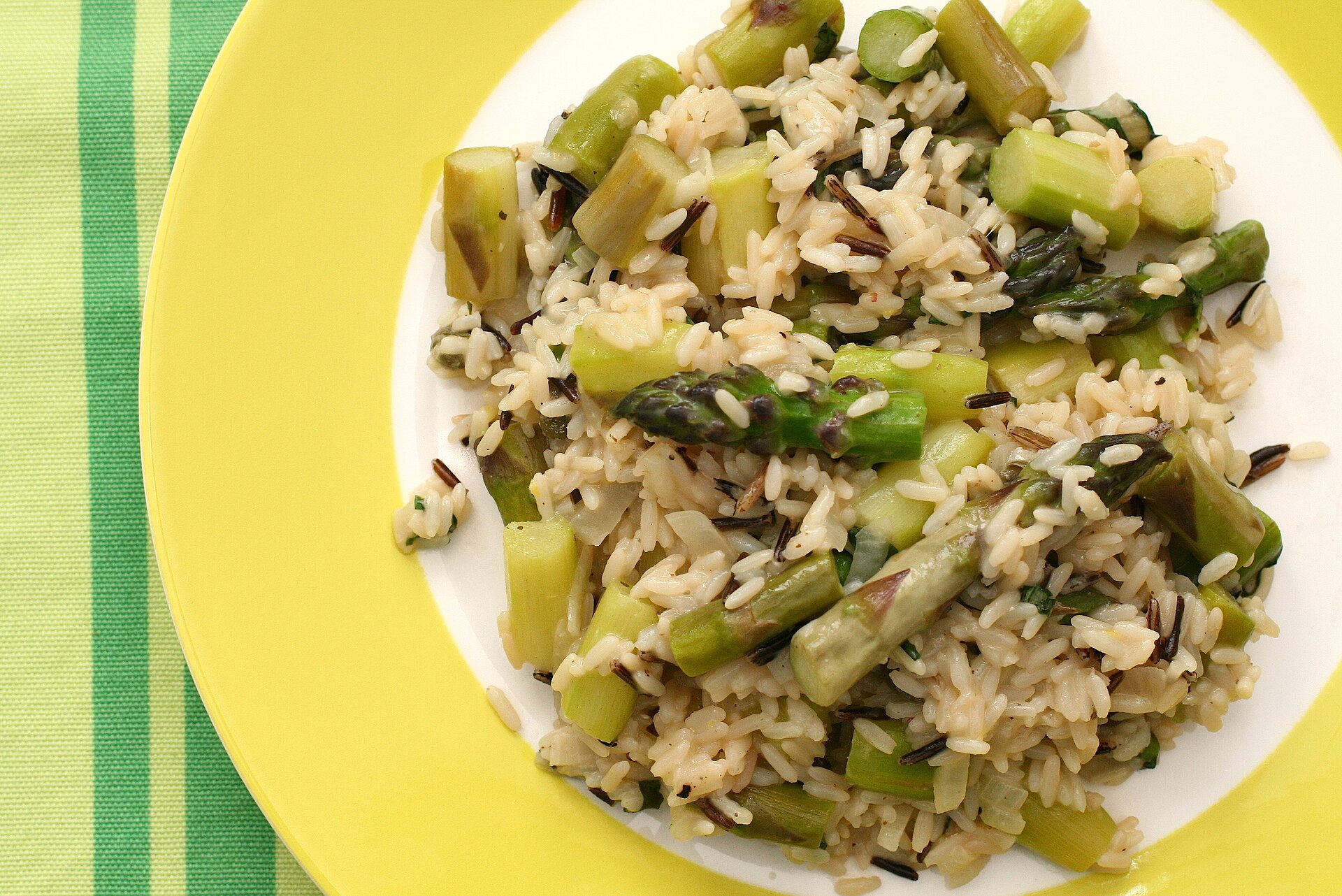
There is a particular moment in late March when asparagus first appears at the farmers market – thin, pale-green, with tightly closed tips. The arrival is unmistakably the start of spring cooking. Within a few weeks, the asparagus becomes thicker, deeper green, more abundant. The whole season lasts about 8 weeks. Italian risotto with asparagus is the canonical way to celebrate the vegetable – the slow-cooked Italian rice provides a creamy background that lets the asparagus flavor sing.
Risotto is technically a method, not a recipe. Italian rice (Carnaroli, Arborio, or Vialone Nano) is toasted briefly in butter, deglazed with white wine, then fed warm stock one ladle at a time while constantly stirring. The constant stirring causes the rice grains to release starch, which thickens the liquid into a creamy emulsion. The result is a luxurious savory dish that takes 30 minutes of attention.
This article is the spring asparagus version – the canonical Italian preparation – with the asparagus tips reserved and added at the end so they stay bright green and crisp-tender. The rest covers exactly why each step matters and how to time the dish for a perfect al dente finish.
Carnaroli Rice: The Chef’s Choice
Carnaroli is the gold standard for risotto. The longer grain (5-7 mm) has higher amylose content than Arborio (the most widely available variety). The result: rice that holds its shape during 20 minutes of stirring while releasing steady amounts of starch to create the creamy emulsion. Arborio works well and is more available at American supermarkets. Vialone Nano is the Veneto choice for seafood risottos. Whatever you choose, look for the Italian DOC or IGP designation on the package – this guarantees authentic rice variety.
Brands: Acquerello (aged Carnaroli, very expensive, but worth it for special occasions); Riso Gallo (mass-market Italian rice, reliable); De Cecco Arborio (the most-stocked at American groceries). Avoid: any rice marketed simply as “risotto rice” without variety designation – usually generic long-grain that does not produce proper risotto.
The Stock and Why It Must Be Warm
Stock provides 80% of the risotto’s flavor. Homemade chicken stock is best – the gelatin produces extra body. Vegetable stock works for vegetarians. Beef stock is too heavy for asparagus risotto. Whatever stock you use, keep it simmering in a separate pot during cooking. Cold stock added to hot rice drops the temperature, slowing the cooking and disrupting the starch release.
Quality matters – this is not the place for bouillon cubes. Better Than Bouillon Roasted Chicken Base or Bonewerks chicken stock concentrate are acceptable shortcuts. Salt the stock lightly – the risotto will absorb it and concentrate, so a heavy salt at the start produces an oversalted final dish.
The Asparagus Tips: Blanched Separately
Asparagus has two textures in risotto. The stalks (the bottom 2/3 of the spear) are diced and cooked into the rice from the beginning, contributing flavor throughout the cooking. The tips are reserved, blanched separately for 60 seconds, then stirred into the finished risotto. This preserves their bright green color and crisp-tender texture while the stalks have integrated into the rice.
Skipping the blanch step produces dull olive-colored tips and limp texture – bad both visually and texturally. The 60-second blanch + ice bath is non-negotiable. The blanching water also reveals the difference between fresh and stale asparagus – fresh asparagus turns electric green within seconds; stale asparagus stays gray-green.
Stirring and The 18-22 Minute Window
The constant stirring is non-negotiable. The friction of stirring causes the rice grains to release amylose starch, which suspends in the liquid and creates the creamy texture. Lazy stirring produces lumpy risotto with separated liquid. Use a flat wooden spoon and stir in a circular motion every 20-30 seconds.
The total cooking time is 18 to 22 minutes from the moment the rice goes into the pan. At 18 minutes, taste – the rice should be just al dente with slight bite. At 22 minutes, taste again – if still chewy, add another ladle and continue. The wide range accounts for rice variety, pan size, and heat level. Pull off heat when the rice is creamy and the grains have a slight bite at the center.
Finishing: Butter and Cheese Off Heat
The final step (mantecatura in Italian) is critical. Off heat, stir in additional butter and freshly grated Parmigiano-Reggiano. The butter emulsifies into the starchy liquid, creating the glossy finish. The cheese adds umami depth and additional creaminess. Cover for 2 minutes to let the dish rest and finish setting.
Do NOT do this over heat – the butter breaks and the cheese separates into oily clumps. Off heat only. The two-minute rest is when the rice fully absorbs the final liquid and reaches the proper al dente texture.
Ingredients
- 500 g (1 lb) fresh asparagus, tough ends snapped off
- 1.5 liters (6 cups) warm chicken or vegetable stock
- 60 g (4 tbsp) unsalted butter
- 1 small yellow onion, very finely chopped
- 320 g (1 1/2 cups) Carnaroli or Arborio rice
- 250 ml (1 cup) dry white wine
- 100 g (3.5 oz) freshly grated Parmigiano-Reggiano
- Salt and freshly ground black pepper
- Lemon zest
- Fresh chives, chopped
Making It
- Prep asparagus. Cut tips off, reserve. Cut remaining stalks into 1 cm pieces.
- Blanch tips. 60 sec in salted boiling water. Ice bath. Drain.
- Keep stock warm. In separate pot, gently simmering.
- Saute onion + stalks. 2 tbsp butter in heavy wide pan. Onion 5 min. Add chopped stalks 2 min.
- Toast rice. Add rice. Stir constantly 90 sec – grains glossy with butter.
- Deglaze with wine. Stir until absorbed.
- Add stock one ladle at time. ~200 ml each. Stir continuously. Wait for absorption before next. 18-22 min total.
- Finish off heat. Stir in remaining 2 tbsp butter, Parmigiano, and asparagus tips.
- Rest 2 min covered. Adjust salt. Plate. Top with lemon zest and chives. Serve immediately.
Frequently Asked Questions
Carnaroli vs Arborio vs Vialone Nano?
Carnaroli is chef’s choice (longer grain, better hold). Arborio most available (slightly more starch-forward). Vialone Nano for seafood. Avoid generic long-grain.
Why warm the stock?
Cold stock drops the temperature and disrupts cooking. Keep stock simmering separately. Always add WARM.
How thick should finished risotto be?
All’onda – with the wave. Tilt the plate, risotto flows in slow wave motion. Too thick: pile. Too thin: runs. Rice should be just al dente.
Can I make risotto ahead?
Partially – par-cook to 75% done, spread on sheet, refrigerate. Finish 5-7 min from cold. Eat within 5 min of completion.
Sources
- Serious Eats — The Best Risotto — J. Kenji López-Alt’s technique walkthrough.
- Bon Appétit — Asparagus Risotto — Spring vegetable adaptation.
- USDA FoodData Central — Nutritional data.
Each serving contains roughly 485 calories, 15 g protein, 18 g fat, 58 g carbs, 3 g fiber.
Please note: Contains dairy (butter, Parmigiano), gluten-free (rice). Not suitable for dairy allergies. Vegetarian if using vegetable stock. Consult a dietitian.