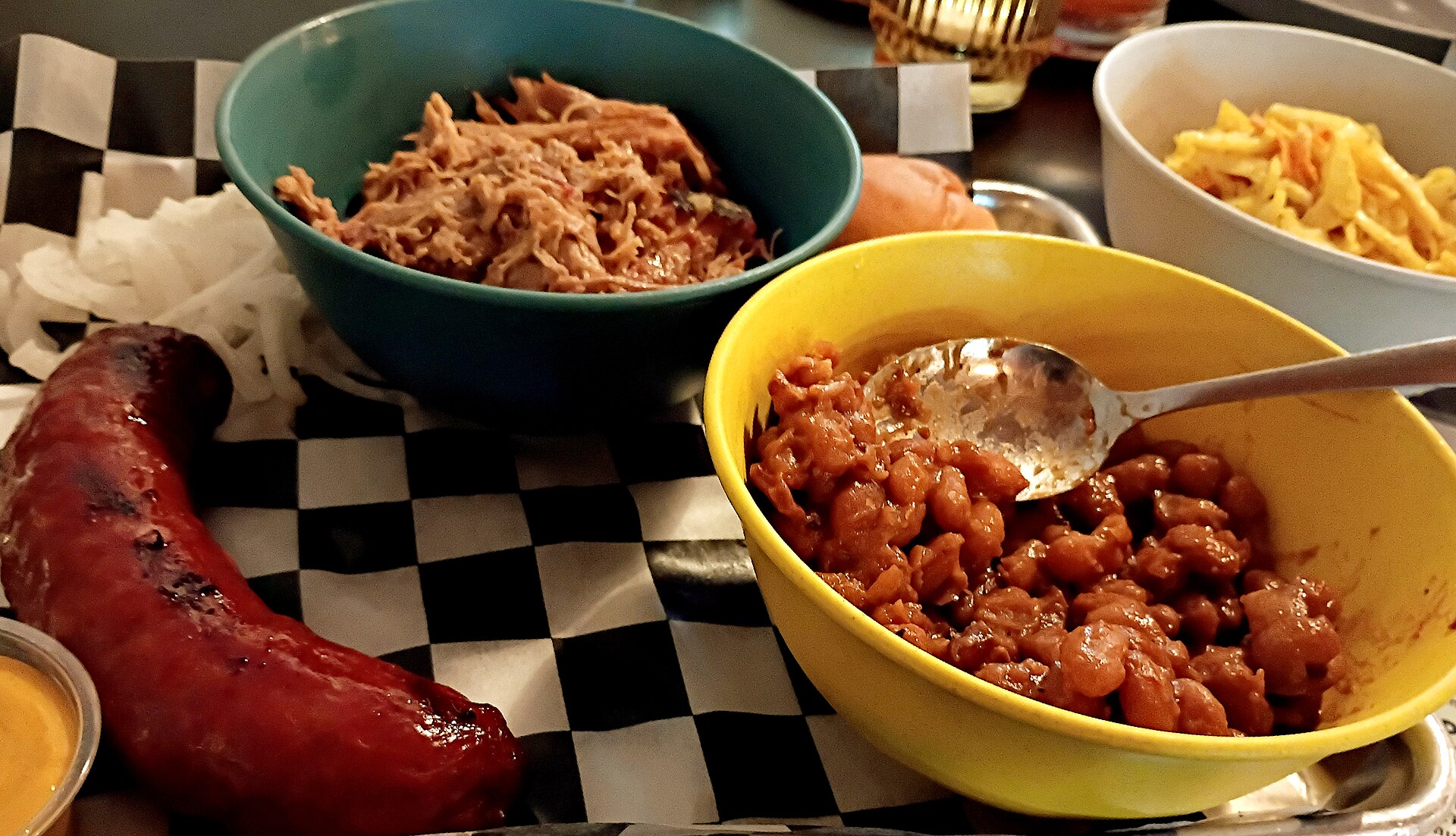
An eight-pound bone-in Boston butt went on at six in the morning, cooker holding 250 degrees, probe seated in the thickest muscle and clear of the bone. At half past ten it read 154. At noon it read 159. At two in the afternoon it read 161, and the fire had not drifted more than five degrees the entire time. Four hours of fuel bought seven degrees.
Nothing was broken. The shoulder had reached the point where water leaving its surface carries heat away as fast as the cooker delivers it, and until that balance tips, the number on the probe stays where it is. Cooks meeting it for the first time add charcoal, open the vents, or decide the thermometer has failed. All three make the finished shoulder worse.
Below is the whole clock for an eight-pound shoulder at 250 degrees: where the plateau starts, how long it runs, what wrapping does to both the timeline and the bark, and what the meat gives up when you try to force the number with heat.
| Cut | 8-pound bone-in pork shoulder, fat cap trimmed to a quarter inch |
|---|---|
| Cooker | 250 degrees at the grate, indirect, water pan in place |
| Plateau | somewhere between 150 and 170 degrees internal |
| How long it holds | 2 to 6 hours, 4 is typical |
| Total cook | 12 to 14 hours unwrapped, 9 to 11 wrapped |
| Pull at | 200 to 205 degrees, confirmed by feel rather than by number |
| Rest | 1 hour minimum, 3 to 4 hours in a dry cooler |
| Yield | about 4 1/2 pounds of pulled meat |
What the probe reads, hour by hour
A cold shoulder out of the refrigerator starts around 38 degrees and climbs fast. The first hundred degrees take roughly four hours at 250, and the rate barely slows: heat moves into cold meat easily because the gap between cooker and center is large, and almost nothing is evaporating yet.
Somewhere past 140 the curve bends. The surface has dried enough that evaporation is running at full rate, the temperature gap has narrowed, and the climb slows from about 25 degrees an hour to five, then to two, then to nothing. That flat line is the part that catches people out, because it arrives at the exact moment the meat looks finished from the outside.
After the plateau breaks, the last 35 degrees go quickly, usually in an hour and a half. Three phases, and only the middle one is unpredictable, which is why an hour and a half per pound works as a planning figure.
The smoked pork shoulder stall is evaporative cooling, not collagen
For years the plateau was explained as energy being consumed by collagen breaking down into gelatin. That explanation is tidy and wrong. The heat involved in that conversion is a rounding error next to what is actually happening, which is that the shoulder is working as a very large wet-bulb thermometer.
Turning a pound of water into vapor takes on the order of 970 BTU, which is an enormous amount of energy compared with what it takes to warm a pound of meat by a degree. A shoulder in a moving stream of hot dry air sheds moisture continuously, and every gram that leaves as steam takes its share of heat with it. When the cooker is supplying roughly 250 degrees of driving force and the surface is giving back an equivalent amount through evaporation, the net into the meat approaches zero.
The proof is easy to run at home. Wrap the shoulder tightly enough that vapor cannot leave and the plateau ends within twenty minutes. Nothing about the collagen changed. Only the evaporation stopped.
Why the number lands near 160 and not 145 or 175
The temperature at which the plateau parks is the wet-bulb temperature inside your particular cooker, and that depends on how humid the air moving over the meat is. A dry, drafty offset with wide-open vents produces a low wet bulb, so the meat stalls closer to 150 and sits there a long time. A bullet smoker with a full water pan runs humid, the wet bulb climbs, and the same shoulder may not stall until 168.
Airflow is the second half of it. Fast air strips the saturated layer off the surface and replaces it with dry air, which raises the evaporation rate. Slow air lets a humid boundary layer sit against the meat and slows everything down. Two people cooking identical shoulders at the same dial setting can report plateaus twenty degrees apart and both be telling the truth.
The useful consequence is that your cooker has its own plateau temperature and it repeats. Write down where the shoulder parked, and the next cook is a scheduling problem rather than a mystery.
How long the plateau actually lasts
Two hours at the short end, six at the long end, four in the middle for an eight-pound bone-in shoulder in a humid cooker at 250. Larger cuts do not stall proportionally longer, because what matters is exposed surface area relative to mass, and a bigger roast has relatively less of it.
Spritzing extends it, and it is the most common self-inflicted delay. Every spray of apple juice or cider vinegar puts water back on a surface that had finally started to dry, and the cooker has to evaporate that off before the meat moves again. Spritzing does real work for color and for a softer bark. It also costs time.
Opening the lid costs time twice over, once from the temperature drop and once from the burst of dry air across the surface. A shoulder does not need to be looked at between hour four and hour eight. A brisket behaves the same way on a longer clock, which is why the same argument comes up every time somebody cooks one for the first time.
Foil, pink butcher paper, or nothing at all
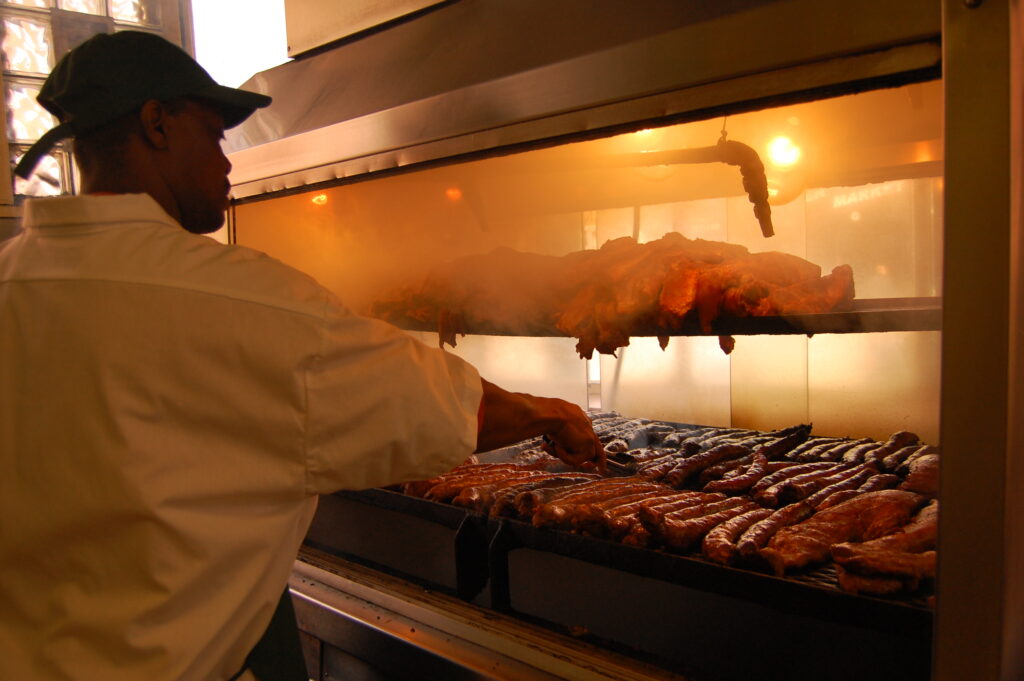
Wrapping is a decision about what you value, not a technique with a right answer. Foil ends evaporation, so the plateau breaks almost at once and the meat finishes as a braise in its own juices. Butcher paper is porous, so vapor still escapes, only slower. Bare meat evaporates at full rate for the whole cook.
| Method | Time saved | Bark | Best for |
|---|---|---|---|
| Heavy foil, sealed | 2 to 3 hours | softens, goes damp and loses crunch | a hard deadline, or pulled pork going into sauce |
| Unwaxed pink butcher paper | 1 to 1 1/2 hours | mostly holds, slight softening | the usual compromise |
| Foil boat, top open | 45 to 60 minutes | holds well on top, protects the underside | fatty shoulders that scorch on the pan side |
| Unwrapped | none | thickest, driest, most crackle | a cook with nowhere to be |
Timing matters more than material. Wrap before the bark has set and it never sets, because the surface stays wet from then on. Wait until the color is where you want it, which usually means six to eight hours in and around 160 to 165 internal.
What pushing through with heat costs you
Raising the cooker to 300 or 325 does break the plateau. More energy goes in than evaporation can carry away, and the number climbs. The question is what you get at the other end.
Muscle fibers contract more sharply at higher pit temperatures and the liquid they squeeze out has to go somewhere. The outer inch of a shoulder run hot dries closer to jerky than to bark, and the meat pulls stringy instead of falling into strands. A shoulder that finishes at roughly 60 percent of its raw weight at 250 lands lower when it is pushed, and every point of that is moisture you were going to eat.
There is a fair version of the hot cook. Run 275 to 285, wrap in foil at the plateau, accept a soft bark, and finish in nine hours with meat that is genuinely good. What does not work is 325 with no wrap, which produces a dark, dry exterior wrapped around meat that has not had time to convert its connective tissue. The reverse sear works on the opposite principle, gentle heat first and violence at the end, and a shoulder is the same idea stretched over twelve hours.
The second climb, from 170 to 203
Once the surface has either dried into a proper bark or been sealed inside a wrap, evaporation drops off and the temperature moves again. Expect roughly 25 degrees an hour through this stretch, faster inside foil, slower in paper.
This is where the connective tissue does its real work. Collagen begins unwinding around 160 and converts to gelatin at a rate that depends on both temperature and time, which is why a shoulder held at 195 for an hour is not the same as one that touched 195 and came off. The gelatin is what makes pulled pork feel moist in the mouth even though the meat has lost a third of its weight.
Watch the probe rather than the clock here, and take the reading in three or four places. A shoulder is two muscles with a fat seam and a bone between them, and they do not finish at the same moment.
203 is a texture, not a temperature
The useful endpoint is between 195 and 207, and where a given shoulder lands inside that window depends on the animal, the trim, and how long it spent in the sixties and seventies. A thermometer tells you when to start checking. It does not tell you when to stop.
The test is resistance. Slide a thin probe or a bamboo skewer into the thickest part and pay attention to what it feels like going in. When it is ready it goes in with no push at all, the way a skewer goes into a jar of room-temperature butter, and it comes out just as easily. If there is any grab, give it another twenty minutes and try again somewhere else.
The blade bone is the second confirmation. Grip it and twist. On a finished shoulder it turns freely and lifts out clean with a small amount of gelatin clinging to it. On one that needs more time it is still anchored. A slow cooker gets to the same endpoint by a different road, without the bark and without the plateau, because nothing evaporates inside a sealed crock.
The rest, and why an hour is the floor
A shoulder pulled at 203 and torn apart five minutes later floods the board. Give it an hour on the counter, still wrapped, and the same shoulder holds most of that liquid. Carryover on a piece of meat this size runs three to six degrees, so pulling at 200 and resting is a reasonable plan if you are nervous about overshooting.
For a longer hold, wrap the shoulder in a towel and put it in a dry cooler with nothing else in it. An eight-pound shoulder stays above 140 degrees for four hours that way, sometimes longer, which turns a cook that finished early into an advantage rather than a problem. Keep a probe in it and check that it is still above 140 before serving.
Pull it warm rather than hot, by hand or with two forks. Save the liquid that collects in the wrap, skim the fat, and put the rest back into the meat. It is the most concentrated thing on the table.
A full clock for an eight-pound shoulder
| Elapsed | Internal | What is happening | What to do |
|---|---|---|---|
| 0:00 | 38 degrees | cold meat, smoke sticking to a damp surface | fat cap up, probe seated |
| 2:00 | 115 degrees | fast climb, surface drying | nothing |
| 4:00 | 150 degrees | bark color setting, climb slowing | nothing |
| 5:30 | 158 degrees | plateau begins | confirm the cooker is holding |
| 7:00 | 160 degrees | flat | decide whether to wrap |
| 9:30 | 163 degrees | still flat, bark fully set | wrap now if wrapping |
| 10:30 | 175 degrees | plateau broken | probe two more spots |
| 12:00 | 198 degrees | connective tissue converting | start the feel test |
| 12:45 | 203 degrees | no resistance, bone turns | off the cooker, still wrapped |
| 13:45 | above 140 | juices redistributing | pull, add back skimmed liquid |
Wrapped at the seven-hour mark, the same shoulder finishes closer to hour ten. Unwrapped in a dry cooker, it can run to fourteen. Build a three-hour buffer into any schedule that ends with people sitting down at a specific time, because the cooler will hold it and the guests will not.
Six ways the timeline goes wrong
The probe is in fat or touching bone. Both read ahead of the muscle around them. Seat the tip in the thickest meat you can find and check the depth with your fingers before the lid goes down.
The dome gauge is not the grate temperature. A kettle dome can read 25 to 40 degrees higher than the air where the meat actually sits. Put a second probe at grate level and cook by that number.
Wrapping too early. Foil at 145 produces a pale, soft exterior that never recovers, however long the cook runs afterward. Bark forms once.
Spritzing on a schedule. Every twenty minutes is a habit, not a technique. Twice in the whole cook, if at all, and never in the hour before you wrap.
Cooking to a time. Two shoulders of identical weight can finish two hours apart. The clock tells you when to start paying attention.
No buffer. A shoulder that finishes early rests happily in a cooler. One that finishes late has no equivalent rescue, and turning the heat up at hour eleven undoes most of what the first ten built.
The plateau is not an obstacle to defeat. It is the shoulder telling you its surface is doing what a barbecue surface is supposed to do, and the only question it asks is whether you would rather have the bark or the two hours.
Frequently Asked Questions
Is the stall a sign that something has gone wrong?
No. A cook that never plateaus is the unusual one, and it usually means the cooker is running much hotter than the gauge suggests or the meat was wrapped before you noticed. A flat probe reading for three hours at 160 is the normal behavior of wet meat in hot dry air.
Can I avoid it entirely?
Only by preventing evaporation, which means wrapping from the start or cooking in a sealed vessel. Both work and both cost you the bark. A shoulder cooked covered in a low oven finishes in about eight hours with no plateau at all and no crust worth the name.
Does a bigger shoulder stall longer?
Not by much. Surface area drives the plateau and it does not scale with weight as fast as volume does. A twelve-pound shoulder takes longer overall, but its flat section runs about the same length. Humidity and airflow move that number far more than weight does.
Should I cook to temperature or to feel?
Use temperature to know when to start testing and feel to decide when to stop. Around 195 the probe should start meeting less resistance every twenty minutes. When it slides in and out with none at all, the shoulder is done, whether that happens at 197 or at 206.
Is cooking pork this slowly safe?
For an intact whole muscle, yes, provided the cooker genuinely holds 225 degrees or more so the surface moves through the risk range within a few hours. Pathogens on a whole cut sit on the outside, and the outside of a shoulder gets hot early. Federal guidance sets 145 degrees plus a three-minute rest as the safe minimum for whole cuts of pork, and a shoulder passes that long before it reaches the texture you want. Injected, brined, or blade-tenderized pork is a different case, since the surface has been carried inward, and it should not be cooked below 250.