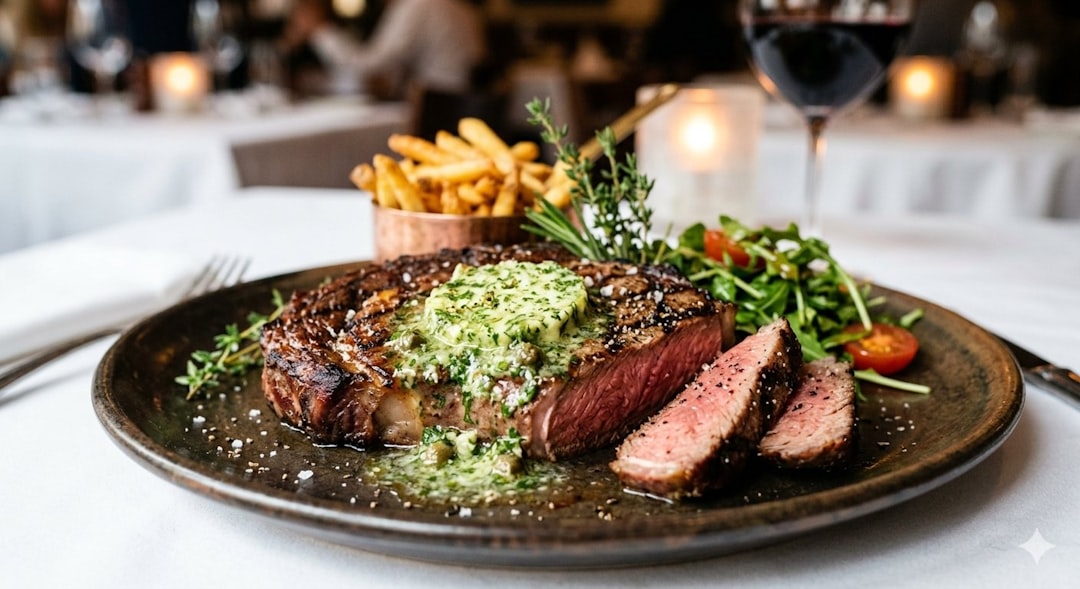
The tomahawk on a wooden board, bone pointing up like a Stone Age weapon, deep mahogany crust gleaming, herb-garlic butter melting in slow rivulets down the meat – this is Father’s Day theater at its highest. The 1.2 kg bone-in ribeye took 24 hours of dry-brining, 45 minutes in a 250 F oven, and 4 minutes in screaming-hot cast iron. Everyone at the table reacts the same way when you bring it out.
This is the reverse-sear technique applied to the steakhouse premium cut. Slow oven first (to internal 48 C / medium-rare base), then explosive sear in cast iron, then compound butter on top while the meat rests. The whole cook takes about an hour of active work but produces a result that beats any $200 steakhouse experience. The rest covers exactly why each step matters.
Quick Read — At a Glance
| Yield | 2-3 servings |
| Total time | 25 hours (24h brine + 1h cook) |
| Difficulty | Intermediate |
| Texture | Edge-to-edge medium-rare, crispy bark, melting butter |
| Critical | Internal temperature 54 C max – tomahawks are easy to overcook |
The Cut and Source
Tomahawk ribeye is the showy bone-in version of ribeye with the rib bone left long (25 cm / 10 inches) and frenched clean. 1.2-1.5 kg for 2-3 servings. Source: quality butcher (call 3 days ahead), Costco business (best value), Snake River Farms (online premium, $80-150 each). USDA Prime grade preferred; Choice acceptable.
The bone makes the steak look impressive but does little for flavor (the meat is the same as a regular ribeye). The visual theater alone justifies the cost on a special occasion like Father’s Day.
Compound Butter Strategy
Compound butter is softened butter + aromatics formed into a log and chilled. The classic herb compound for steak: 115 g butter + 3 garlic cloves + 2 tbsp fresh herbs (parsley, thyme, rosemary) + 1 tsp flaky salt + black pepper. Mix until uniform, form into 3 cm log on plastic wrap, refrigerate at least 2 hours.
Slice into 1 cm discs and place on hot steak after the sear. The butter melts into the meat fibers, basting from above. Theater plus flavor: as you cut, the butter pools in the crevices.
Ingredients
- 1 bone-in tomahawk ribeye (1.2-1.5 kg / 2.6-3.3 lb)
- 2 tbsp kosher salt (for 24h dry-brine)
- 2 tbsp neutral oil (grapeseed)
- Compound butter:
- 115 g (8 tbsp) softened unsalted butter
- 3 garlic cloves, minced
- 2 tbsp fresh herbs (parsley, thyme, rosemary)
- 1 tsp flaky sea salt
- Freshly cracked black pepper
Making It
- Dry-brine 24h. Salt all over. Wire rack uncovered in fridge.
- Compound butter. Mix butter+garlic+herbs+salt. Log on plastic wrap. Refrigerate 2+ hours.
- Temper 1 hour. Steak out of fridge before cooking. Preheat oven 120 C (250 F).
- Oven phase. On rack over sheet pan, bake to internal 48 C – about 45 min.
- Cast iron 5 min preheat. Highest heat. Should smoke when oil added.
- Sear. 60 sec per side. Hold bone-side briefly to sear edges. Internal hits 54 C.
- Compound butter top. 2 thick discs on the hot steak.
- Rest 10 min. Slice off bone, then against grain. Serve on board with juices.
Frequently Asked Questions
Why tomahawk?
Bone-in ribeye with long rib bone (25 cm) frenched clean. Stone-Age weapon look. Bone insulates and adds flavor. Father’s Day theater – audible reaction from guests.
Where to source?
Quality butcher (call 3 days ahead), Costco business, Snake River Farms online ($80-150). Plan 1.2-1.5 kg for 2-3 people.
Reverse-sear or pan-sear?
Reverse-sear unambiguously better for thick cuts. Slow oven to 48 C, then high-heat sear. Eliminates gray band of overcooked meat.
What is compound butter?
Softened butter + aromatics formed into log, chilled. Slice discs on hot steak – melts into meat fibers from above.
Sources
- Serious Eats — Reverse Sear Steak — Kenji Lopez-Alt method.
- Snake River Farms — Premium American Wagyu tomahawk source.
- USDA FoodData Central — Nutritional data.
Each serving contains roughly 785 calories, 62 g protein, 58 g fat.
Please note: Contains beef and dairy. Very high in saturated fat. Not suitable for low-fat or low-sodium diets. Consult a dietitian.