A table of six does not need a fourteen-pound turkey, and cooking one anyway is how a household ends up eating turkey sandwiches for the better part of a week afterward, whether anyone actually wants them or not.
A bone-in turkey breast, roasted on its own, feeds six generously, cooks in under an hour and a half rather than most of a morning, and produces a fraction of the leftovers a whole bird leaves behind. It is not a smaller version of Thanksgiving; it is the correctly sized version for a smaller table.
What follows is the weight to buy, a dry brine scaled down from a whole-bird ratio, the roasting temperature that gets there without drying out, and the one thing a breast-only roast requires extra attention on: getting enough drippings for gravy from a bird with no legs or back contributing their share.
- Weight to buy: a 6 to 7 pound bone-in, skin-on turkey breast for six people
- Dry brine: same ratio as a whole bird, about 1 tablespoon kosher salt per 5 pounds
- Roast temperature: 325F, roughly 20 minutes per pound
- Target: 160F in the thickest part, accounting for carryover to 165F
- Time saved: roughly two and a half hours less oven time than a whole 14-pound bird
- Drippings shortfall: a breast alone renders less fat and juice than a whole bird
- Fix: roast on a bed of vegetables and add stock partway through to build a base
Roast turkey breast, scaled for six
| Breast weight | Serves | Roast time at 325F | Rest |
|---|---|---|---|
| 4 to 5 lb | 4 | 65 to 80 minutes | 15 minutes |
| 6 to 7 lb | 6 | 90 to 105 minutes | 15 to 20 minutes |
| 8 to 9 lb | 8 | 110 to 130 minutes | 20 minutes |
These times are a starting estimate rather than a guarantee, since oven accuracy and the breast’s exact shape both affect the actual cook time. A thermometer, not a clock, is the real signal that the roast is done.
Why a whole bird is the wrong size for a table of six
A fourteen-pound turkey is proportioned for a table of ten to twelve, and cooking one for six people means roughly half the bird becomes leftovers by design, not by accident. A week of turkey sandwiches, turkey soup, and turkey hash is a real tradition for some households, but for others it is simply more turkey than anyone wants to see again before December.
A breast-only roast sized to the actual table avoids that problem at the source. Rather than cooking a full bird and hoping the leftovers get used, the portion size is matched from the start, which also means less food waste overall if the household genuinely does not want a week of repurposed turkey afterward.
It also solves a practical space problem for a smaller kitchen or a smaller oven: a whole turkey needs a large roasting pan and often a specific rack configuration, while a bone-in breast fits easily in a standard baking dish with plenty of room to spare.
Weight selection: how much breast a table of six actually needs
A bone-in turkey breast yields somewhat less usable meat per pound than the stated weight suggests, since bone and skin make up a real portion of the total, similar to how a whole turkey’s stated weight includes far more than just the breast and thigh meat that actually gets served.
A 6 to 7 pound bone-in breast comfortably serves six people with a reasonable portion size and a modest amount of leftovers, rather than the substantial surplus a whole bird would leave. Scaling up to 8 or 9 pounds adds two more servings without meaningfully changing the method, just the total roasting time.
Boneless breast roasts, often tied into a compact shape, cook faster and slice more uniformly than a bone-in breast, but they also dry out more easily since the bone that normally insulates the meat and slows heat penetration is not present. A bone-in breast is the more forgiving choice for a first attempt at this smaller-scale approach.
The dry brine, scaled down from a whole bird
The same salt ratio used for a whole turkey, roughly a tablespoon of kosher salt per five pounds, applies directly to a breast-only roast, scaled to the breast’s actual weight rather than to what a whole bird of similar total weight would need. A 6-pound breast takes a little over a tablespoon of kosher salt, applied under the skin and over the surface.
Because the breast is a smaller, more compact cut than a whole bird, the dry brine needs less total time to fully season it, generally one to two days rather than the three days recommended for a whole turkey, since the salt has considerably less mass and distance to penetrate.
The same technique applies: loosen the skin gently over the meat, distribute the salt evenly underneath and over the top, and refrigerate uncovered on a rack so the surface dries out along with absorbing the salt, exactly the mechanism that produces good crisp skin on a properly roasted whole chicken at a similar scale.
Roasting temperature and how to keep the breast from drying out
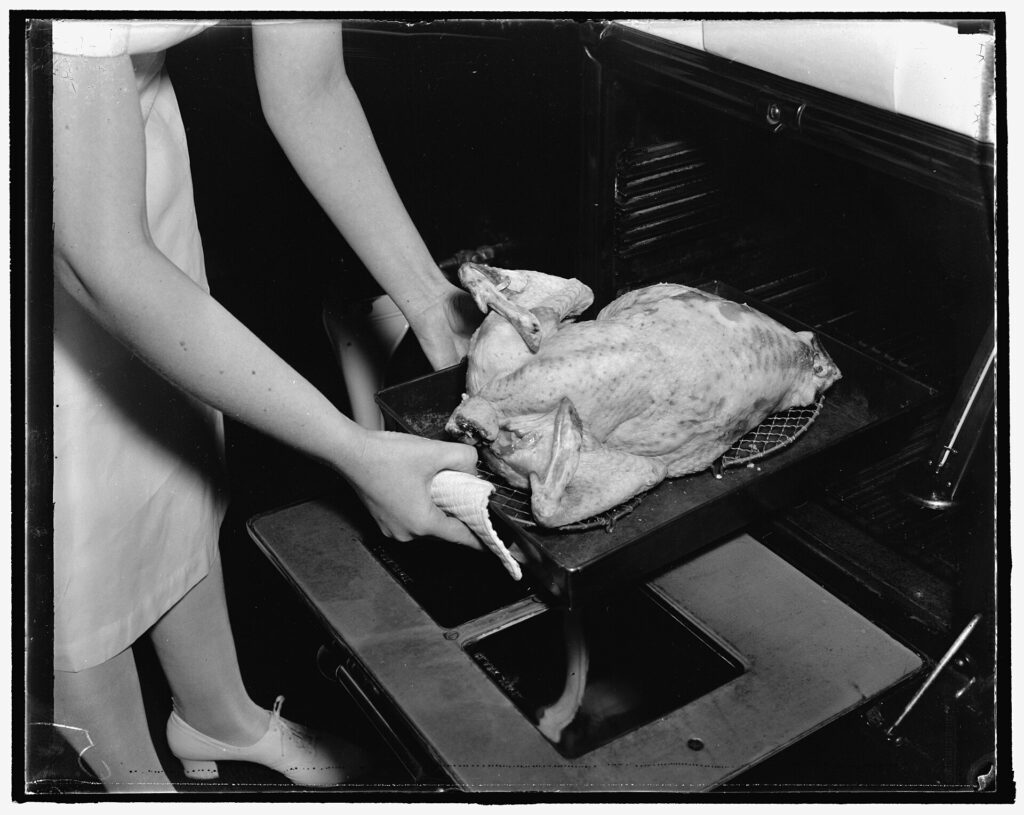
A bone-in breast roasted at 325F, the same moderate temperature recommended for a whole turkey, takes roughly twenty minutes per pound to reach a safe finished temperature, though this varies with the exact shape and thickness of the specific piece being cooked.
Breast meat has considerably less fat than thigh meat and dries out more easily if overcooked even slightly, which makes an accurate thermometer more important here than almost anywhere else in Thanksgiving cooking. Pulling the breast at 160F in the thickest part, rather than waiting for it to read a full 165F in the oven, uses carryover cooking to finish the last few degrees gently during the rest rather than in direct oven heat.
Tenting the breast loosely with foil for the first half of the roast, then removing it for the second half to allow browning, is a simple technique that protects the exposed, more delicate breast meat from overcooking on the surface before the interior catches up, without sacrificing the crisp skin the second half of the roast is responsible for developing.
The gravy problem: not enough drippings from a breast alone
A whole turkey renders fat and juice from its legs, thighs, back, and cavity in addition to the breast, and that combined output is what typically fills a roasting pan with enough drippings to build a proper gravy. A breast roasted on its own renders considerably less total liquid, simply because there is less total meat, skin, and bone contributing to the pan.
Roasting the breast on a bed of aromatic vegetables, onion, carrot, and celery, rather than directly on a bare rack, gives those vegetables a chance to caramelize in the rendered fat and adds their own flavor and moisture to the pan, partially compensating for the smaller volume of drippings a breast alone produces.
Adding a cup of stock to the pan partway through the roast, rather than relying solely on what the breast itself renders, builds a base that, combined with whatever drippings do collect, gives enough liquid to make a properly flavored gravy without needing to stretch a thin amount of pure pan drippings further than they can reasonably go.
Roast turkey breast, step by step
- Dry brine the breast one to two days ahead. Salt under the skin and over the surface, then refrigerate uncovered on a rack.
- Bring the breast closer to room temperature for about an hour before roasting. This helps it cook more evenly than starting fully cold from the refrigerator.
- Arrange chopped onion, carrot, and celery in the bottom of a roasting pan. Set the breast on top, skin side up.
- Roast at 325F, tented loosely with foil for the first half of the cook. Remove the foil for the second half to allow the skin to brown.
- Add a cup of stock to the pan partway through, once some fat has started to render. This builds the base for gravy alongside the vegetables.
- Pull the breast at 160F in the thickest part and rest it for 15 to 20 minutes before carving. Carryover will bring it the rest of the way to a safe finished temperature.
- Strain the pan contents, skim the fat, and use the remaining liquid as the gravy base. Combine with a simple roux for a properly thickened result.
Getting enough drippings for gravy: the vegetable-bed method
Vegetables roasting directly in the pan beneath the turkey breast catch the fat and juice as it renders, rather than letting it pool thinly across a bare pan surface where it can scorch before there is enough of it to matter. Once strained out at the end, those same vegetables have absorbed and concentrated much of what the breast rendered, adding real flavor back into the gravy base beyond just the liquid volume itself.
This method works because it treats the shortfall in drippings as a volume problem with a straightforward fix, rather than accepting a thin gravy as an unavoidable tradeoff of cooking a smaller cut. A cup of added stock plus what the vegetables and breast together render is generally enough for a gravy serving six people generously.
Straining the pan contents through a fine mesh sieve before building the gravy removes the solid vegetable pieces while keeping their concentrated flavor in the liquid that passes through, the same principle behind clarifying any pan-based sauce built from roasted aromatics.
Carving a breast-only roast versus a whole bird
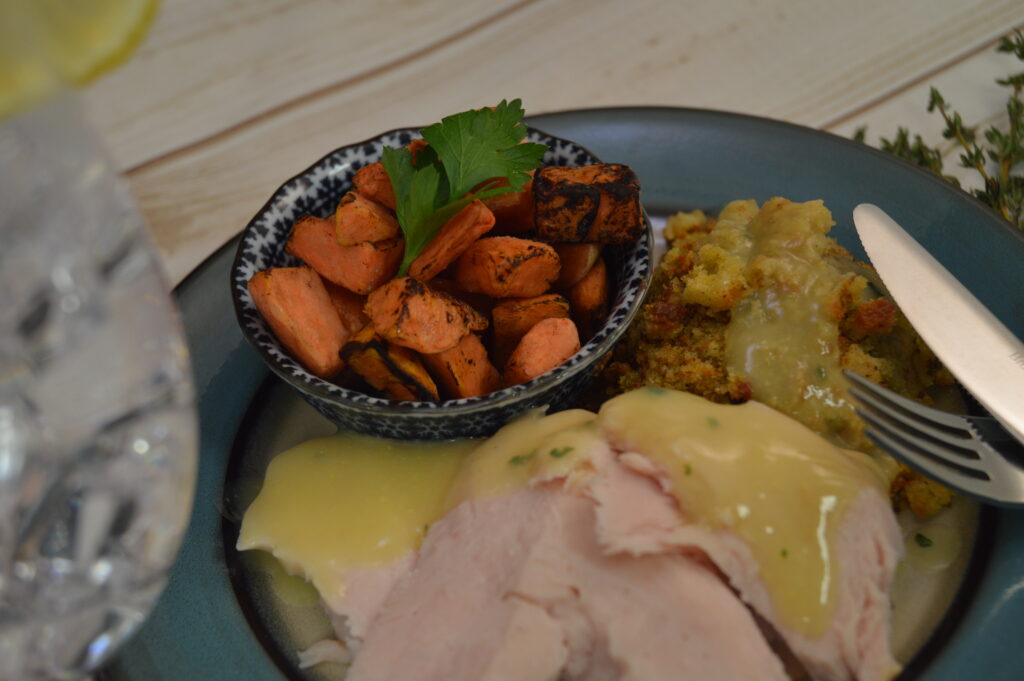
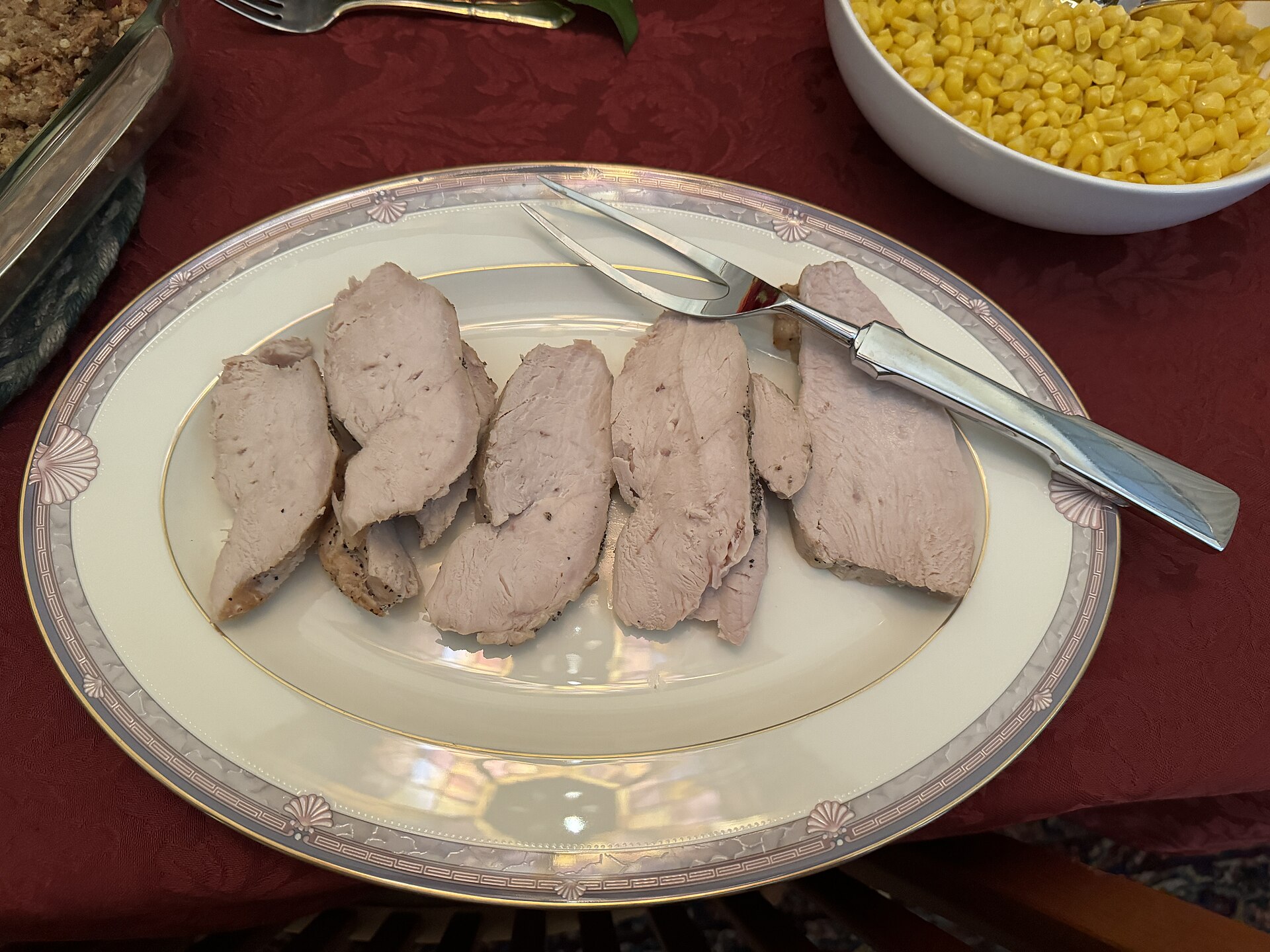
A bone-in breast carves considerably more simply than a whole turkey, since there is no leg, thigh, or wing joint to navigate, just a single large muscle to slice against the grain once it has rested. This is a genuine advantage for anyone who finds carving a whole turkey intimidating or time-consuming.
Slicing across the breast in even, moderately thin pieces, working from one side toward the bone, gives clean, presentable slices without needing specialized carving skill. The bone itself, once the meat is removed, is worth saving for a smaller batch of stock, following the same long, gentle simmer behind any well-built bone broth, which turns poultry bones into a useful base regardless of the animal.
For a household that wants some of the visual tradition of a whole roasted bird at the table, even a breast-only roast can be presented whole and sliced tableside before serving, rather than pre-carved in the kitchen, preserving some of that moment despite the smaller scale.
Scaling this method further, up or down
The same approach scales cleanly beyond six people by simply moving up the weight chart above, and beyond roughly nine or ten pounds of breast, the shape starts to behave enough like a small whole bird that a slightly longer, gentler roast, closer to 300F, helps the exterior avoid overbrowning before the thicker center finishes.
Scaling down for a table of two or three works just as well with the smallest breast sizes available, sometimes a split, half-breast portion rather than a full one, though the dry brine ratio and roasting temperature stay consistent regardless of exactly how small the final portion gets.
What does not change at any scale is the underlying logic: match the cut to the table, use the same salt ratio and roasting temperature that work for a whole bird, and compensate deliberately for the smaller volume of drippings a breast-only roast will always produce compared to a whole turkey of similar total weight.
A table of six gets a properly sized roast, a full gravy, and a refrigerator that is not still working through turkey a week later. The method is not a smaller version of Thanksgiving; it is the version actually built for the table it is serving.
Frequently Asked Questions
Can I use a boneless turkey breast instead of bone-in for this method?
Yes, though it cooks faster and dries out more easily, so check the internal temperature earlier than the times given here and consider a shorter roast at the same 325F setting, watching closely once it approaches the target temperature.
Do I still need to worry about raw poultry safety with just a breast?
Yes, the same rules apply as with a whole turkey: never rinse the raw breast in the sink, wash hands and surfaces thoroughly after handling it, and confirm it reaches a safe internal temperature with a thermometer rather than by appearance alone.
How much stock should I start with if I want extra for gravy beyond the pan drippings?
A cup added directly to the pan during roasting, plus an additional cup or two of separately prepared stock stirred in while building the gravy, generally gives enough total volume for a properly thickened gravy serving six without stretching a thin base too far.
Will a breast-only roast still have crispy skin like a whole turkey?
Yes, following the same dry-brine-and-uncovered-rest principle produces crisp skin on a breast just as reliably as on a whole bird, since the mechanism, a dry surface meeting hot oven air, is identical regardless of which part of the turkey is being roasted.
What should I do with the leftover meat from a 6 to 7 pound breast?
A breast this size leaves a modest, manageable amount of leftovers rather than the surplus a whole bird produces. It works well sliced cold for sandwiches over the following two or three days, refrigerated and used within that window for food safety.