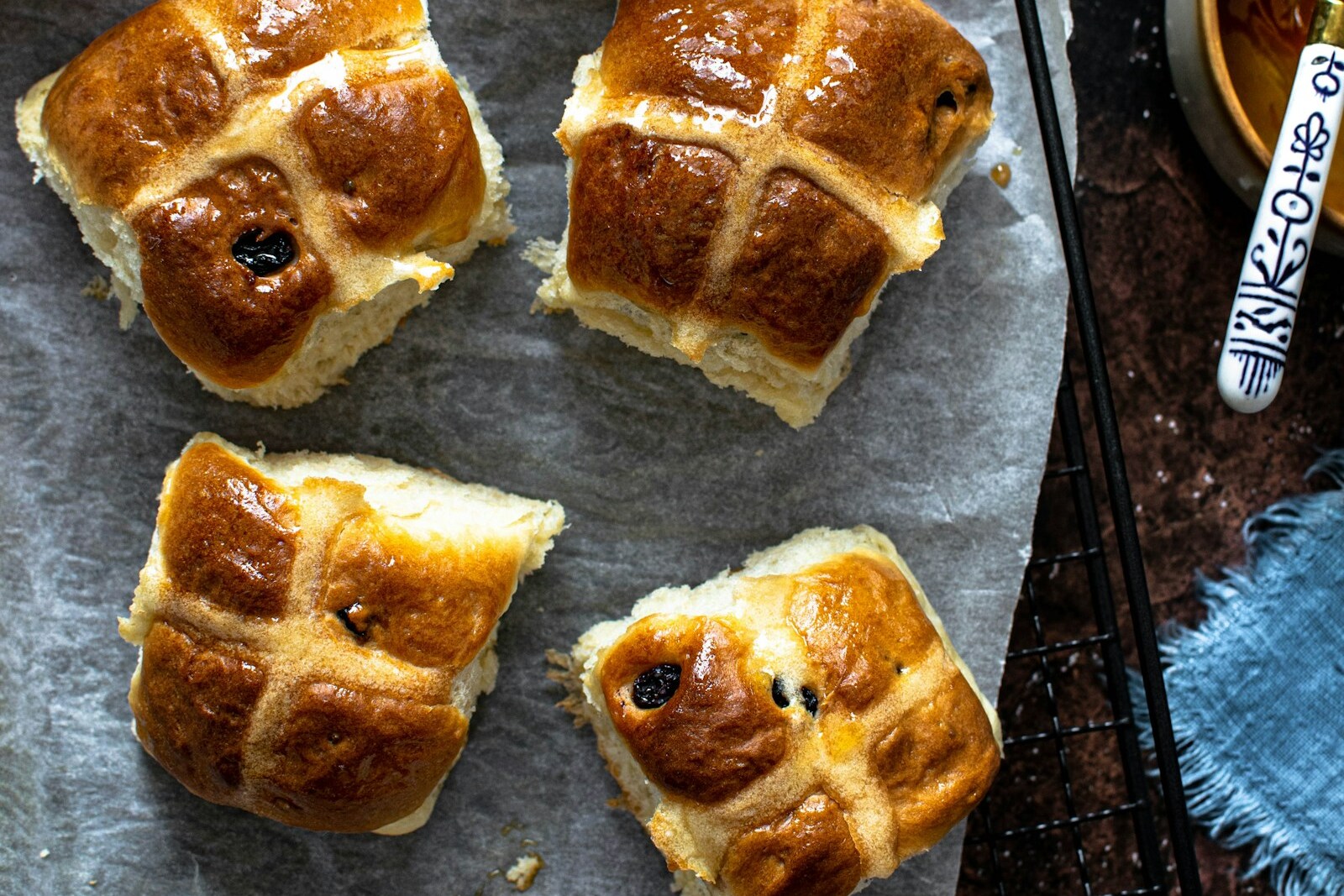
There is a particular smell that fills a British kitchen on Good Friday morning – cinnamon, allspice, nutmeg, and yeast all rising from a warm oven, with the candied peel and orange zest cutting through. The hot cross buns come out deeply golden, marked with their distinctive white pastry crosses, and get brushed with apricot glaze while still hot enough that the jam melts into the surface. Within twenty minutes, the whole pan is gone, slathered with cold butter, paired with strong tea.
Hot cross buns are an Easter tradition that goes back at least to the 14th century in England. A monk at St Albans Abbey is credited with the standardized recipe in 1361, marking the buns with a cross to commemorate Good Friday. The buns spread through Anglican Easter tradition, became a staple of British bakeries, and now appear at every major supermarket and Tesco from Lent through Easter. The American adaptation arrived with British immigrants and has been a holiday-bakery item in upscale American markets since the 1980s.
This article is the traditional British recipe with the flour-paste cross (not icing), apricot glaze finish, and the spice blend that defines the bun. The rest covers exactly why each ingredient matters, the timing for Easter morning service, and the small details that separate average buns from bakery-quality.
The Spice Blend
The canonical spice mix is cinnamon-dominant with allspice and nutmeg providing depth. 2:1:0.5 ratio (2 tsp cinnamon, 1 tsp allspice, 1/2 tsp nutmeg) for 500 g of flour. The spices go into the dry mix – blending them into the flour ensures even distribution. Some traditional recipes add ground cloves (1/4 tsp) for additional warmth. Avoid adding ginger – ginger fights with the orange peel and produces a confused flavor.
Buy fresh spices. Ground spices lose flavor within 6 months of opening; many home cooks have 3-year-old spice jars that contribute almost nothing. The bakery-quality hot cross buns you remember from childhood used fresh spices. Replace your ground cinnamon, allspice, and nutmeg before making these if they are old.
The Fruit and Peel
Currants (Zante currants – tiny dark dried grapes, sometimes labeled “dried currants”) are the traditional fruit. Smaller than raisins, more intense flavor, more delicate texture. Mixed candied peel (orange + lemon rind candied in sugar syrup) adds the citrus brightness that defines the bun. Together they produce the distinctive bun fruit profile.
Substitutions: raisins instead of currants (acceptable, slightly different texture); candied orange peel alone (more intense, fewer pieces); skipping candied peel and using fresh zest only (less authentic but works). Brand: Paradise Mixed Fruit Peel for traditional, Sun-Maid for currants.
The Cross: Flour-Water Paste
The cross is made from a thick paste of flour, water, and a touch of sugar – piped onto the risen buns just before baking. During baking, the paste sets into a soft white cross that contrasts beautifully with the golden bun. This is the traditional British method. Icing crosses (added after baking) are an American adaptation that produces sweeter buns but is not authentic.
To make the paste: 60 g flour + 60 ml water + 1 tbsp sugar, whisked smooth. Transfer to a piping bag with a small round tip. Pipe a horizontal then vertical line across each bun, forming a cross. The paste should hold its shape – if it spreads, it is too thin (add 1 tbsp more flour).
Ingredients
- 500 g (4 cups) bread flour
- 60 g (1/4 cup + 1 tbsp) granulated sugar
- 2 tsp fine sea salt
- 2 tsp ground cinnamon
- 1 tsp ground allspice
- 1/2 tsp ground nutmeg
- 2 tsp instant yeast
- 250 ml (1 cup) warm whole milk (40 C / 105 F)
- 60 g (4 tbsp) butter, melted
- 1 large egg
- 100 g (3/4 cup) dried currants
- 50 g (1/3 cup) mixed candied peel
- Zest of 1 orange
- For the cross: 60 g flour + 60 ml water + 1 tbsp sugar
- For glaze: 2 tbsp apricot jam + 1 tbsp water
Making It
- Mix dry. Whisk flour, sugar, salt, spices, yeast in large bowl.
- Add wet. Warm milk, melted butter, egg. Mix to shaggy dough.
- Knead. 10 min by hand or 5 in stand mixer until smooth and elastic.
- Add fruit. Currants, candied peel, orange zest. Knead briefly to distribute.
- First rise. Cover, 1 hour until doubled.
- Shape. Divide into 12 balls. Place in greased 9×13 pan, sides touching.
- Second rise. Cover, 30-45 min until puffy.
- Cross. Mix flour+water+sugar paste. Pipe crosses on risen buns.
- Bake. 200 C (400 F) for 18-22 min until deeply golden.
- Glaze. Brush warm buns with warmed apricot jam mixed with water. Cool on rack.
Frequently Asked Questions
What is the cross supposed to be?
Flour-water paste piped onto risen buns before baking. Sets into soft white cross during baking. Symbolism: Christian cross commemorating Good Friday crucifixion. Traditional British method – icing crosses added after baking are American adaptation.
What is candied peel?
Citrus rind candied in sugar syrup. Sold as mixed fruit peel. Look near baking section. Substitute: chopped candied orange peel or raisins.
Why tough buns?
Too much flour during kneading, insufficient kneading, or over-baking. Dough should be tacky not dry. Knead 10 min by hand. Watch deep golden color (max 22 min).
Can I make ahead?
Yes – best same day. Day 2 reheat at 150 C 5 min. Freeze 3 months. Easter morning: make Saturday, reheat.
Sources
- BBC Good Food — Hot Cross Buns — The British canonical version.
- King Arthur Baking — Hot Cross Buns — American baker adaptation.
- USDA FoodData Central — Nutritional data.
Each bun contains roughly 265 calories, 6 g protein, 7 g fat, 45 g carbs.
Please note: Contains gluten, dairy, eggs. Not suitable for these allergies. Consult a dietitian for specific needs.

Elena Vasquez
Elena learned to bake from her abuela on a family farm in the south of Spain - wood-fired ovens, breakfast bread before sunrise, and a tia who taught her pastry between long lunches with cousins. At CookingZone she develops desserts, pastry, breakfast, healthy recipes, and beverages - from protein-rich morning bowls to classic French patisserie and viral bakery hits. She still tests every dessert on the same crew of family and friends before it makes it onto the site.