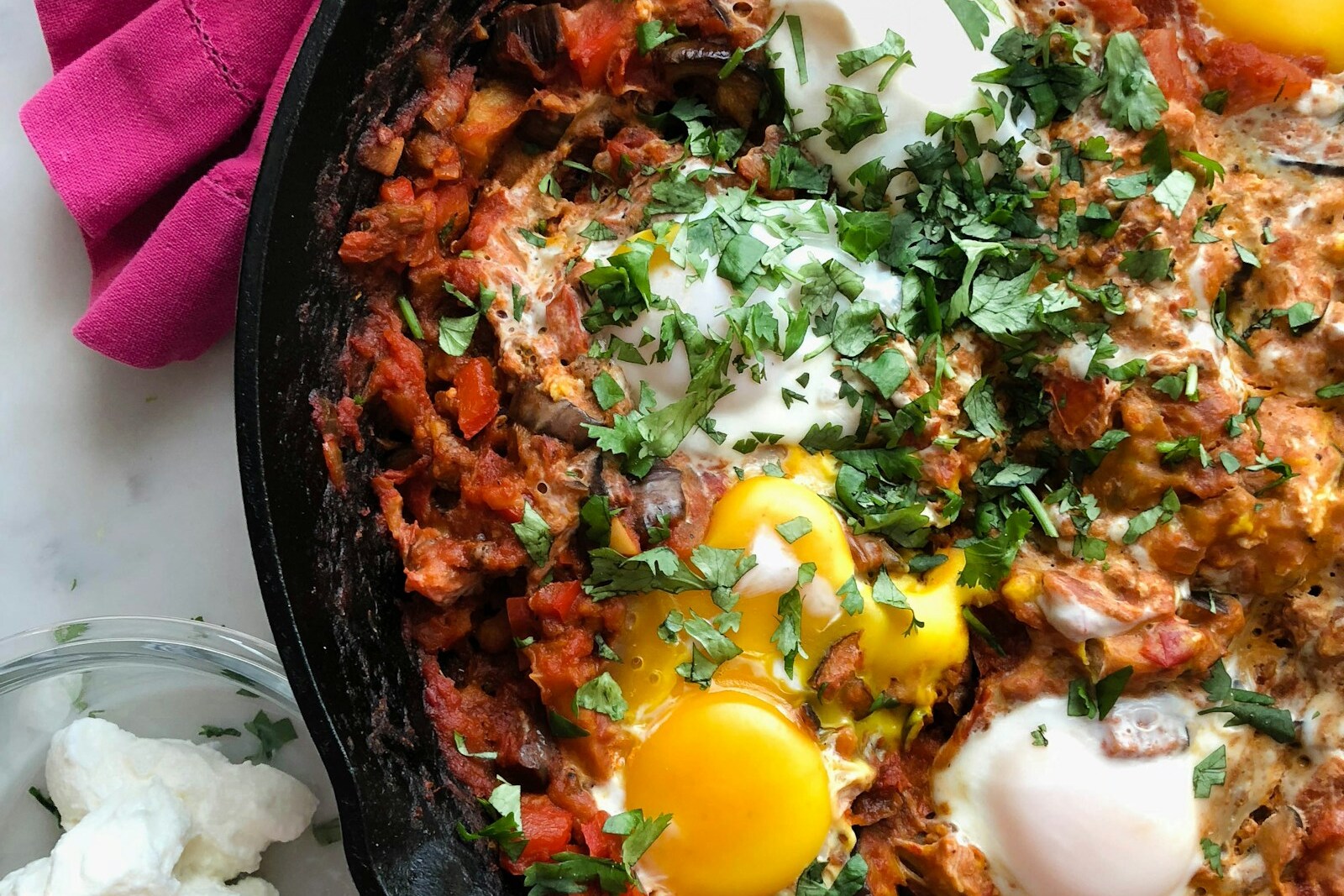
There is a particular pleasure to a skillet of shakshuka arriving at the table still bubbling. The sauce is dark red, almost terra-cotta, flecked with bits of softened onion and roasted pepper and a fine dust of smoked paprika across the top. Six eggs nestle in distinct wells, the whites set, the yolks still wobbling. Crumbled feta and torn cilantro scatter across the surface. Crusty bread is already on the table, ready to be torn and dragged through both yolks and sauce. The dish requires almost nothing — pantry tomatoes, pantry spices, a few eggs — and yet it remains one of the most satisfying meals you can put on a table.
Shakshuka is older than most people who eat it today realize. The word itself is North African, possibly Berber, possibly Arabic, meaning roughly “to shake” or “mixture.” The dish in some form has existed across the Maghreb — Tunisia, Libya, Morocco, Algeria — for centuries, with each country developing variations: Tunisia adds harissa for fierce heat; Libya often includes lamb; Morocco sometimes adds preserved lemon. The version most internationally known today, with its slightly sweet bell-pepper base and smoked paprika, is closest to the Tunisian-Israeli tradition. The dish reached global fame through Israeli cuisine in the 2010s when chefs like Yotam Ottolenghi (Plenty, 2010) and Michael Solomonov (Zahav, 2015) wrote about it for international audiences.
Yotam Ottolenghi’s shakshuka recipe in Plenty, published 2010, is the version most international home cooks first encountered. Michael Solomonov’s Philadelphia restaurant Zahav has served a version since 2008. Both chefs credit the Mizrahi Jewish communities of Israel — Tunisian, Moroccan, Libyan immigrants — for the dish’s Israeli formalization. The recipe in this article follows their adapted technique with notes on the variations across North Africa, because shakshuka’s greatest virtue is that it is genuinely simple: a thick spiced tomato-pepper sauce with eggs poached on top, eaten with bread. Everything else is local flavor.
The Tomato Question: Canned, Not Fresh
Shakshuka is one of the rare dishes where canned tomatoes are better than fresh, year-round. The reason is concentration: canned whole peeled tomatoes (especially DOP-certified San Marzano from Italy or Bianco DiNapoli from California) are picked at peak ripeness and processed within hours, capturing sugar levels and umami concentration that supermarket fresh tomatoes outside of August through September simply cannot match. The dish wants the sauce to be intensely tomato-flavored, slightly sweet, and slightly tart — canned tomatoes deliver this reliably.
Crush the tomatoes by hand directly into the pan rather than blending or using crushed tomatoes from the can. The irregular chunks break down during the simmer but leave some texture in the finished sauce. Use the entire 28-ounce can with its juices — the juice contains flavor that you would lose by draining. If using fresh tomatoes (only worth it in summer, with very ripe vine tomatoes), peel them first by scoring an X on the bottom, blanching 30 seconds in boiling water, then sliding the skins off. Then proceed as with canned.
Spices: Bloom Them in Oil
The spice blend defines regional variations. The base for the Israeli-Tunisian version: smoked paprika (sweet, not hot), cumin, and sometimes ground caraway seeds. Aleppo pepper or other moderate chili flakes provide the heat. The Moroccan version adds ras el hanout. The Libyan version adds preserved lemon. The Tunisian version adds aggressive harissa and sometimes mergeuz sausage. For a starting point, the Israeli-Tunisian spice profile in this recipe is broadly accessible and produces a balanced dish.
All spices must be bloomed in oil before liquid is added. After the onions and peppers have softened, the spices are added directly to the hot oil with the garlic and cooked for sixty seconds before the tomato paste and tomatoes. This step releases the aromatic compounds in the spices that are otherwise trapped in dry powder form — the flavor difference between bloomed and unbloomed spices in the finished dish is dramatic. Smoked paprika in particular needs the oil bloom to develop its full character.
The Egg Poach: Covered, Low Heat, Short Time
The eggs are the technical critical step. They should sit in distinct wells of sauce (the sauce comes halfway up each egg, not covering them), and they should poach gently from both the steam above (lid trapping heat) and the heat below (sauce conducting heat from the pan). The temperature must be medium-low — aggressive simmering causes the whites to set too fast and the yolks to overcook before the whites finish. Five to eight minutes is the window depending on your stove and egg temperature. Check at five minutes by tilting the pan slightly — the whites should jiggle gently when tilted but not flow like raw egg.
Pull the pan from heat the moment the whites look mostly set. Residual heat in the cast iron and sauce continues to cook the eggs after removal — if you wait until they look fully done, they will be overcooked at the table. For runny yolks: pull when whites are slightly translucent on top. For just-set yolks (closer to soft-boiled): pull when whites are completely opaque but yolks still wobble. For hard yolks: continue another 2 minutes, but this defeats the purpose of shakshuka.
Shakshuka Variations: A Quick Map
| Region | Distinguishing additions | Heat level |
|---|---|---|
| Tunisian (original) | Harissa paste, caraway, sometimes merguez | Hot |
| Israeli (popularized) | Smoked paprika, cumin, feta on top | Mild to medium |
| Moroccan | Ras el hanout, preserved lemon, olives | Mild |
| Libyan | Lamb, lots of chili, preserved lemon | Hot |
| Modern fusion | Spinach, mushrooms, white beans (vegan) | Variable |
Ingredients
For the sauce:
- 3 tablespoons (45 ml) extra-virgin olive oil
- 1 large yellow onion, finely chopped
- 1 large red bell pepper, finely chopped
- 1 large yellow bell pepper, finely chopped
- 4 garlic cloves, finely chopped
- 1 teaspoon ground cumin
- 1 1/2 teaspoons sweet smoked paprika
- 1/2 teaspoon ground caraway seeds (optional)
- 1/4 teaspoon Aleppo or red pepper flakes
- 1 tablespoon tomato paste
- 1 can (28 oz / 800 g) whole peeled tomatoes, hand-crushed
- 1 teaspoon fine sea salt, plus more to taste
- Freshly ground black pepper
- 1 teaspoon sugar (if tomatoes are tart)
To finish:
- 6 large eggs
- 100 g (3.5 oz) feta cheese, crumbled (optional)
- 1/4 cup fresh cilantro and flat-leaf parsley, chopped
- Crusty bread or pita, for serving
- Plain Greek yogurt, for serving
Making It
- Saute base. Heat oil in 12-inch cast iron over medium. Add onion and both bell peppers. Cook 10-12 min, stirring, until soft and edges caramelized.
- Bloom spices. Add garlic, cumin, paprika, caraway, Aleppo flakes. Cook 1 min stirring constantly until fragrant.
- Add tomato paste. Stir in tomato paste, cook 2 min until darkens.
- Add tomatoes. Add hand-crushed tomatoes with juices. Add salt, pepper, sugar if using. Bring to gentle simmer.
- Simmer thick. Reduce to medium-low. Simmer uncovered 15-20 min until loose stew consistency. Adjust salt.
- Add eggs. Make 6 wells with back of spoon. Crack egg into each well. Sauce should come halfway up eggs, not cover. Pinch salt on whites.
- Cover and poach. Cover skillet. Cook medium-low 5-8 min checking often. Whites set, yolks runny. Begin checking at 5 min.
- Garnish and serve. Scatter feta crumbles, cilantro, parsley. Serve immediately in the skillet with bread and yogurt.
Common Mistakes
The most common mistake is rushing the sauté base. Soft, slightly caramelized onions and peppers are the flavor foundation; if you reduce the 10 to 12 minute sauté to 5 minutes, the sauce will taste raw and one-dimensional. Take the full time. The second mistake is under-simmering the sauce. The eggs need to nestle in a thick spoonable base, not float in soup. Test consistency with a spoon — the track should close slowly, not immediately. The third mistake is overcooking the eggs. Pull at 5 to 7 minutes, residual heat finishes them.
What to Serve With Shakshuka
Shakshuka is traditionally a breakfast or brunch dish in Israel and North Africa, eaten with warm pita or challah for sopping up sauce and yolk. For a fuller Israeli breakfast (a complete cultural production known as Israeli breakfast), add labneh, hummus, Israeli salad (chopped cucumber-tomato-parsley with lemon), olives, and strong Turkish coffee. For dinner, accompany with our Cantonese congee with century egg for a comfort-food rotation. For something dessert-friendly, our classic French crème brûlée rounds out a substantial meal.
Storage and Make-Ahead
The shakshuka sauce alone is a make-ahead dream — it keeps refrigerated 5 days and improves slightly as the spices integrate. Reheat gently in the skillet before adding eggs. Adding eggs is the only step that does not refrigerate well; do this when serving. The full assembled dish (sauce plus eggs) does not refrigerate — the yolks set up rubbery during reheat. For meal prep: make a large batch of sauce on Sunday, refrigerate, and reheat-plus-egg portions throughout the week. Each serving takes 10 minutes to assemble fresh.
Frequently Asked Questions
Is shakshuka Israeli or North African?
Both. Shakshuka originated in the Maghreb (Tunisia, Libya, Morocco) and traveled to Israel with Mizrahi and Maghrebi Jewish immigrants after 1948. Chefs like Yotam Ottolenghi and Michael Solomonov popularized the Israeli version globally in the 2000s and 2010s. Both origins are accurate — North African by birth, Israeli by global adoption.
Why simmer the sauce so long before adding eggs?
The 15-20 minute simmer concentrates the tomato sauce from watery to thick and glossy. Without enough simmer, eggs poach in liquid rather than nestling in sauce. Test by drawing a spoon through — the track should close slowly, not immediately.
How do I get the perfect runny yolk?
Cover the skillet, reduce heat to medium-low, check at 5 min. Whites set from above (steam) and below (sauce). Pull from heat when whites are mostly set but yolks still wobble — residual heat continues cooking. Cold-from-fridge eggs take longer than room-temp ones.
What if I cannot eat eggs or want a vegan version?
The sauce base is fully vegan. Substitute eggs with silken tofu mounds (warm gently in covered pan 5 min), sautéed mushrooms, or white beans (cannellini, drained, added in last 5 min of simmer). Tel Aviv cafes serve vegan shakshuka under the name “shakshuka veganit.”
Sources
- Serious Eats — Shakshuka — Yotam Ottolenghi-style adaptation with sauce-simmer technique.
- NYT Cooking — Shakshuka with Feta — The canonical Israeli-style recipe.
- USDA FoodData Central — Eggs and Tomatoes — Nutritional data.
Each serving contains roughly 320 calories, 15 g protein, 20 g fat, 22 g carbohydrates, 5 g fiber.
Please note: Contains eggs and (if feta added) dairy. Not suitable for egg or dairy allergies. Vegan substitution noted in FAQ. Consult a dietitian for specific dietary needs.

Tom Nakamura
Tom learned to cook from his obaachan during summers in Japan - pickling daikon at the kitchen table, watching her stir miso into broth without ever measuring. Later, family trips with cousins took him through markets in Bangkok, Shanghai, and Hanoi, and the food stuck with him. His writing focuses on making authentic Asian techniques accessible to home cooks without diluting the technique or the culture that defines them. He handles Chinese, Japanese, Korean, Thai, Vietnamese, Indian, and Middle Eastern recipes at the publication.