Two jars sit on the counter with the same thing in them: six tablespoons of olive oil, two tablespoons of red wine vinegar, a good pinch of salt. The first one gets shaken for fifteen seconds. The second gets a teaspoon of smooth Dijon whisked into the vinegar before any oil goes near it.
Set both down and watch. The shaken jar turns cloudy, holds that cloud for about a minute, and then a clean line appears near the bottom and climbs. Inside five minutes it has gone back to two layers with a thin murky band between them. The second jar is still opaque an hour later, still pours as one thing, and only shows a faint line by the time dinner is cleared.
The difference is one teaspoon of a condiment that costs almost nothing. Why it works comes down to how small the droplets are and what is standing between them, and the order the bowl gets filled in turns out to matter more than how hard anything is whisked.
- Working ratio: 3 parts oil to 1 part acid by volume, adjusted by how sharp the vinegar is
- The stabilizer: 1 teaspoon of smooth Dijon per 1/2 cup of finished dressing, roughly 5 grams
- Hold time with it: several hours on a counter, longer if it was blended
- Hold time without it: 60 to 120 seconds before the line starts forming
- Yield: about 3/4 cup, which dresses 8 to 10 cups of leaves
- Equipment: a bowl and a whisk, which beats a blender for a table dressing
- Easiest thing to get wrong: salt added at the end instead of dissolved in the vinegar first
Two jars, one variable
The shaken jar separates from the bottom up. Vinegar is denser than oil, so the droplets you just created start sinking, bumping into each other, merging into bigger droplets, and sinking faster once they do. That accelerating merge is why the second minute looks so much worse than the first.
The mustard jar separates too. Everything separates eventually. It just does it slowly enough that the dressing survives the trip from bowl to table, gets spooned over leaves as one liquid, and coats them evenly instead of leaving oil slicks on some and raw vinegar on others.
Oil and water are not fighting, they are just separating
Oil and vinegar are described as enemies, which makes the problem sound chemical when it is mostly mechanical. Water molecules hold onto each other through hydrogen bonding. Oil molecules have nothing to offer that arrangement, so water excludes them, and the two liquids settle into the shape with the least contact area between them: two flat layers with one boundary.
Shaking is a way of forcing contact area. You tear the oil into millions of droplets suspended in the vinegar, and for a moment the surface between the two phases is enormous. That state is not stable. Every droplet is under pressure to shrink its own surface, and the cheapest way to do that is to find another droplet and merge. This is a vinaigrette at its most basic, and left alone it undoes itself.
So two things happen at once. Droplets merge, and the merged droplets rise or sink faster because size drives that speed. Nothing in a plain oil-and-vinegar mixture opposes either process, and the energy you put in with the whisk leaves the moment you stop.
What an emulsifier in vinaigrette actually does
An emulsifier is a molecule with a split personality. One end is comfortable in water, one end is comfortable in fat, and it cannot be fully happy in either, so it goes and stands on the boundary between them. Millions of them do this at once, and the interface stops being a bare surface and becomes a crowded one.
That crowding does two useful things. It lowers the interfacial tension, so it costs less energy to make small droplets in the first place, which is why a mustard-first dressing whisks up thicker with the same effort. And it wraps each droplet in a coat that physically gets in the way when two droplets try to touch.
With mustard there is a third effect that matters more than either. The seed brings a charge to the droplet surface, so droplets repel each other slightly instead of drifting together, and it brings soluble fiber that thickens the vinegar around them. Thicker liquid means slower travel, and droplets that travel slowly meet less often.
Droplet size is the whole game
The speed at which a droplet rises or sinks scales with the square of its radius. Cut the diameter in half and it moves at roughly a quarter of the speed. Cut it to a tenth and it moves at about a hundredth. Nothing else in the equation gives that kind of return.
A lazy shake makes droplets you can see, coarse enough that the mixture looks streaky rather than creamy, and those separate in a minute. A brisk whisk against the side of a bowl, with the oil going in slowly, makes droplets fine enough that the dressing turns pale and opaque. Opacity is the useful signal: it means the droplets are now small enough to scatter light.
An immersion blender goes further, into a range where the dressing behaves like thin mayonnaise and holds overnight. The tool changes the answer as much as the ingredient does.
Mustard punches well above its quantity
Five grams of Dijon in a half cup of dressing is roughly one part in twenty by weight, and most of that five grams is water, vinegar and salt. The active fraction is smaller still, which makes the effect look disproportionate until you look at what is in the seed.
Mustard seed coats carry a mucilage, a soluble fiber that swells in water into something slippery and slightly viscous. Ground into a paste and suspended in vinegar, it coats oil droplets and thickens the liquid between them. The seed also contributes proteins that sit at the interface the way proteins do everywhere else in cooking.
Smooth Dijon works better than whole grain, and the reason is surface area: in whole grain most of the seed is still intact, so most of the mucilage is still locked inside it. Whole grain earns its place for texture, but use it alongside a teaspoon of the smooth kind rather than instead of it.
The other emulsifiers already in your refrigerator
| Ingredient | Per 1/2 cup of dressing | How well it holds | What it costs you |
|---|---|---|---|
| Smooth Dijon mustard | 1 teaspoon | hours on the counter | a sharp, warming note that suits most leaves |
| Whole-grain mustard | 2 teaspoons | weaker, an hour at best | texture and seeds, which is often the point |
| Egg yolk | half a yolk | the strongest of the group | richness, opacity, and a raw-egg question |
| Mayonnaise | 1 tablespoon | very stable, it is already an emulsion | turns the dressing creamy and pale |
| Honey or maple syrup | 1 teaspoon | modest, mostly by thickening | sweetness you have to balance with more acid |
| Tahini or white miso | 2 teaspoons | good, and it thickens noticeably | an assertive flavor that takes over |
| Aquafaba, the liquid from canned beans | 1 tablespoon | surprisingly good | almost nothing, which is its whole appeal |
Egg yolk is the benchmark because of its lecithin, about as efficient an emulsifier as a kitchen has access to, and it is why a yolk dressing crosses the line into something closer to a sauce. If you use raw yolk, use eggs you would eat soft-boiled, and skip it for anyone pregnant, elderly or immune-compromised.
Aquafaba is the surprise. The proteins and starches that leach out of chickpeas during canning behave like a weak egg white, and a tablespoon holds a vinaigrette respectably without adding flavor.
Ratios, and the times three to one is wrong
Three parts oil to one part acid is the number everyone learns, and it is a good default for red wine vinegar on sturdy leaves. It is not a law. The right ratio depends on how aggressive the acid is and what the dressing has to stand up to.
Distilled white vinegar and undiluted lemon juice want four to one, sometimes five. Rice vinegar, sherry, aged balsamic and most citrus want two or two and a half to one, because a three-to-one dressing built on soft acid reads as oily. Anything going onto grains or fruit wants more acid than the same dressing on bitter greens.
Salt goes in first, into the vinegar, and gets stirred until you cannot feel grains against the bottom of the bowl. Salt dissolves in the water phase and not in the oil, so salt added at the end sits as crystals in a fat suspension and reads as gritty and under-seasoned at the same time. A Caesar dressing takes the same order of operations, with anchovy and yolk doing the work the mustard does here.
The order that decides the outcome
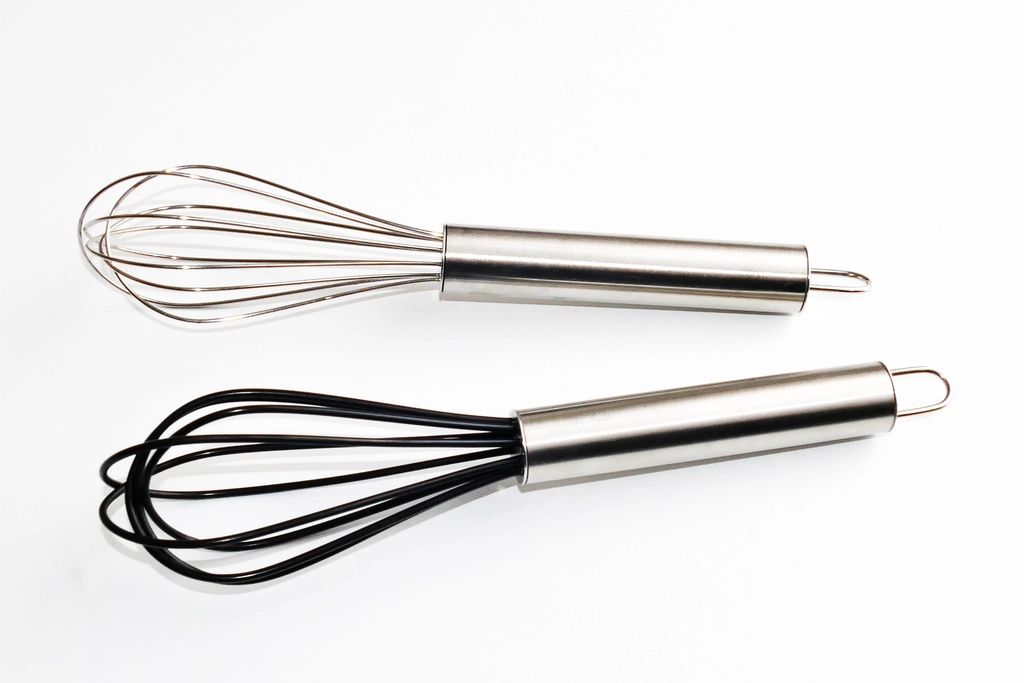
- Acid and salt into the bowl. Two tablespoons of vinegar, a quarter teaspoon of fine salt. Stir for ten seconds until the salt is gone.
- Mustard next, whisked to smooth. One teaspoon. It should disperse completely into the vinegar with no visible streaks. Any aromatics, such as a minced shallot or a grated clove of garlic, go in here so the acid can soften them.
- Start the oil in drops, not a stream. The first tablespoon is the one that sets the emulsion. Add it slowly while whisking, and watch the color turn from clear to pale.
- Then pour the rest in a thin steady stream. Once the base has thickened it will take oil much faster. Six tablespoons should go in over about thirty seconds.
- Stop when it coats the whisk. The dressing should hang on the wires for a moment before dropping. If it runs off like water, it needs more whisking rather than more mustard.
- Taste on a leaf, not a spoon. Straight vinaigrette always tastes too sharp. Dip a piece of lettuce and judge it there, then adjust with salt or a few drops of oil.
Two details carry most of the weight: the salt dissolving before the oil, and the first tablespoon going in slowly. Skip either and the dressing still works, it just holds for minutes instead of hours.
Whisk, jar, blender, immersion blender
| Method | Time | Roughly how long it holds | Where it fits |
|---|---|---|---|
| Jar, shaken, no emulsifier | 15 seconds | a minute or two | dressing poured directly onto the leaves and tossed at once |
| Jar, shaken, with mustard | 30 seconds | an hour or more | packed lunches, picnics, anything transported |
| Bowl and whisk, with mustard | 90 seconds | several hours | the default for a dressing made before guests arrive |
| Immersion blender | 20 seconds | a day or more, refrigerated | a batch for the week, or a creamy dressing without dairy |
| Countertop blender | 30 seconds | a day or more, refrigerated | large volumes, and dressings with soft herbs to break down |
One caution with the powered tools. High-shear blending of a good extra-virgin olive oil is widely reported to turn it bitter and faintly metallic, the usual explanation being that a very fine dispersion puts far more of the oil’s phenolic compounds in contact with the palate at once. Blend with a neutral or mild oil, then stir the peppery one in by hand at the end.
How long it holds, build by build
These are counter observations rather than instrument readings, and room temperature moves them, but the ranking holds every time.
- Oil and vinegar shaken: a visible line inside two minutes, fully split in five
- The same, plus salt: no change worth measuring; salt is not an emulsifier
- Plus one teaspoon of Dijon, whisked: opaque for an hour or more, a faint line after several
- Plus Dijon and a teaspoon of honey: holds overnight, though it thins as it warms
- Plus Dijon, immersion blended: a day or more refrigerated, needs a shake after chilling
- Plus half an egg yolk: several days refrigerated, behaving like a thin sauce
A dressing that has drifted apart is not spoiled. Ten seconds of whisking brings back most of what it had, so the reason to care about hold time is convenience rather than rescue: one that holds can be made in the morning and left alone.
Six dressings off the same base
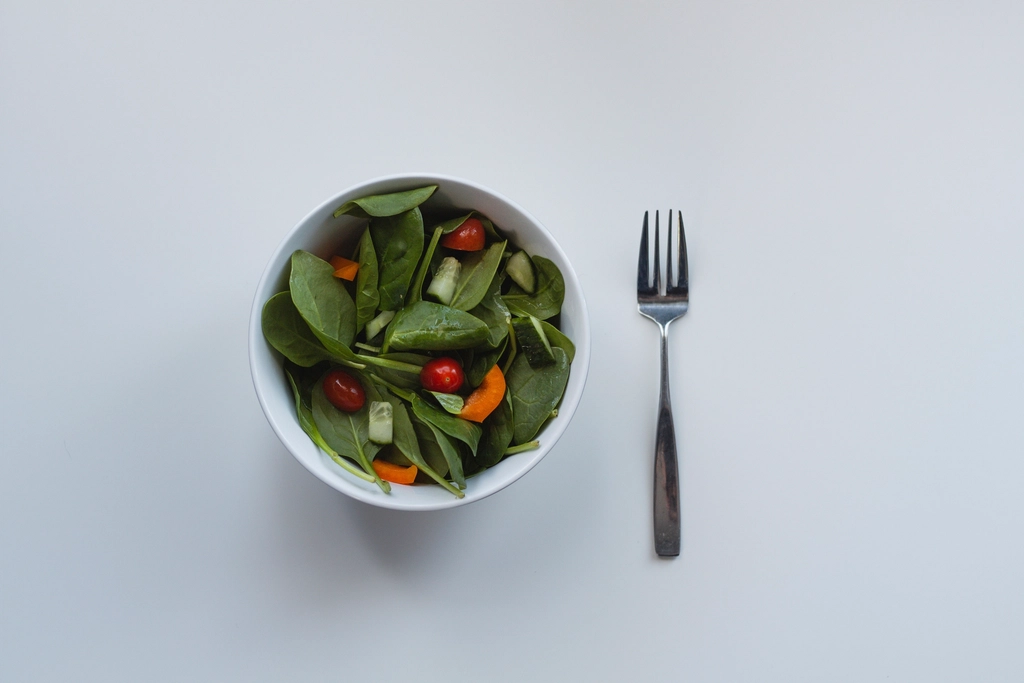
Each one starts the same way, with acid and salt in the bowl and a teaspoon of smooth mustard whisked in before the oil.
- Red wine and shallot. Minced shallot left to sit in the vinegar ten minutes, olive oil at three to one. For bitter leaves and anything with cheese in it.
- Lemon and garlic. Lemon juice at four to one, one grated clove. Made within the hour it is used, because raw garlic sharpens as it sits.
- Sherry and walnut. Sherry vinegar at two and a half to one, half walnut oil and half neutral. Walnut oil goes rancid fast, so keep it cold.
- Rice vinegar and sesame. Two to one, neutral oil, a teaspoon of toasted sesame oil stirred in last, a pinch of sugar. Good on cabbage and cucumber.
- Maple and cider. Cider vinegar at three to one, coarse mustard alongside the smooth. Built for roasted squash and grains rather than leaves.
- Yogurt and herb. Two tablespoons of plain yogurt whisked in before the oil, then a fistful of chopped soft herbs. Thick enough to spoon.
The same base scales down to a spoonful for two and up to a jar for the week. A Greek salad with halloumi takes the lemon version, and most seasonal salads will accept whichever of the six matches the plate.
When it splits anyway
The oil went in too fast. The most common failure by a distance. Six tablespoons dumped in at once gives the mustard no chance to coat anything, and you get a loose cloudy mixture that splits immediately.
It came straight out of the refrigerator. Olive oil starts to solidify below about 45 degrees, and a chilled dressing looks curdled and grainy. It is not broken. Leave it out for fifteen minutes and whisk it again.
There is more acid than the mustard can carry. A one-to-one dressing needs proportionally more emulsifier. Pull the ratio back toward three to one, or double the mustard.
Only whole-grain mustard went in. Not enough exposed mucilage. Add a teaspoon of smooth alongside it.
The rescue is the one used for mayonnaise. Put a fresh teaspoon of mustard in a clean bowl, add a teaspoon of the broken dressing, and whisk until it thickens. Then feed in the rest in a slow stream, whisking throughout. You are not repairing the old emulsion, you are building a new one around it.
A jar that survives an afternoon on the counter is not a trick and does not need anything bought for it. It is one teaspoon, added before the oil rather than after, and thirty seconds of attention while the first tablespoon goes in.
Frequently Asked Questions
Can I use a different mustard than Dijon?
Yellow ballpark mustard holds nearly as well, though it brings turmeric color and a milder flavor. English mustard works and is much hotter, so halve it. Mustard powder works too, but let it sit in the vinegar ten minutes first: the compounds responsible for its heat only develop once the powder is wet.
How long does a vinaigrette keep in the refrigerator?
A plain oil, vinegar and mustard dressing keeps about two weeks. Add raw garlic or shallot and treat it as three or four days, since both change flavor sharply in acid. Anything with yolk, yogurt or dairy follows the shelf life of that ingredient, not the oil.
Why does my dressing taste bitter after blending?
Almost always the olive oil. A peppery extra-virgin that tastes fine from a spoon can turn harsh once it has been through a blender, and the fine dispersion is the likely reason. Blend with a neutral oil and whisk the good one in at the end.
Does the emulsifier change how much dressing the leaves hold?
Noticeably. A split dressing coats unevenly, oil clinging to some leaves and acid pooling at the bottom of the bowl. A stable one goes on as a single thin film, so a smaller quantity does the same job. Two tablespoons dresses about four cups of leaves.
Is there any way to make it hold without mustard at all?
Several. A tablespoon of aquafaba, two teaspoons of tahini or miso, a tablespoon of mayonnaise, or half an egg yolk. Failing all of those, an immersion blender holds plain oil and vinegar for an hour or two purely by making the droplets small, with nothing added.