Three canisters sit on the same shelf, all labeled oats, all holding the same grain. One takes twenty-five minutes and gives separate chewy beads that hold their shape in the bowl. One takes five and turns creamy. One takes a kettle and ninety seconds and lands somewhere close to paste.
None of that was decided in the field. It was decided at the mill, by how far the kernel was cut and how much cooking the machinery did in advance. Those two variables set cook time, they set texture, and they set the one thing that genuinely separates the three products: how fast the starch shows up in your blood.
What follows is what each cut actually is, the times and ratios that work on a real stove, what the published glycemic tables say, and the overnight soak that closes most of the gap for anyone without twenty-five minutes on a Tuesday.
- Same grain: all three start as a hulled oat groat
- Steel-cut: 20 to 30 minutes, 1 part oats to 4 parts water, chewy and separate
- Rolled: 5 minutes on the stove, 1 to 2, creamy with some bite
- Instant: 1 to 2 minutes of steeping, 1 to 1.5, soft and uniform
- Dry-weight nutrition: within a rounding error across the three
- Glycemic index: published values sit in the mid-50s for the coarse cuts and near 80 for instant
- The soak: eight hours in cold water brings steel-cut down to about ten minutes
- A serving: 40 to 50 g dry gives roughly one cup cooked
Every one of them starts as the same groat
An oat groat is the whole kernel with the inedible hull removed and nothing else taken away. Bran, germ and endosperm are all still there, which is why oats are a whole grain in every form on that shelf, including the packets.
One step happens to all of them before any cutting or rolling. Groats are kilned, meaning heated with steam and dry heat, because oats carry an unusually active lipase that would turn the fat in the germ rancid within weeks. That heat also gives oats the toasted smell they have straight out of the bag. Nobody sells raw oats, whatever the label suggests.
Groats can be cooked whole, and it is worth doing once. They take about fifty minutes at a simmer and come out like a chewy grain salad, closer to farro than to breakfast. Everything else on the shelf is a shortcut away from that starting point.
Cut, steamed, pressed: what the mill actually does
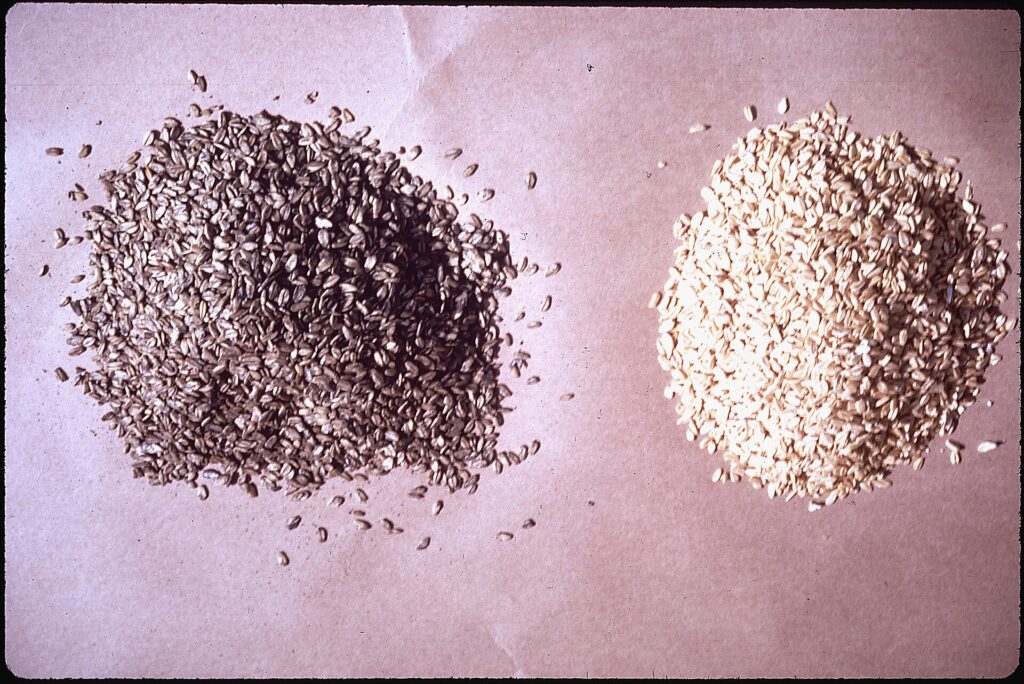
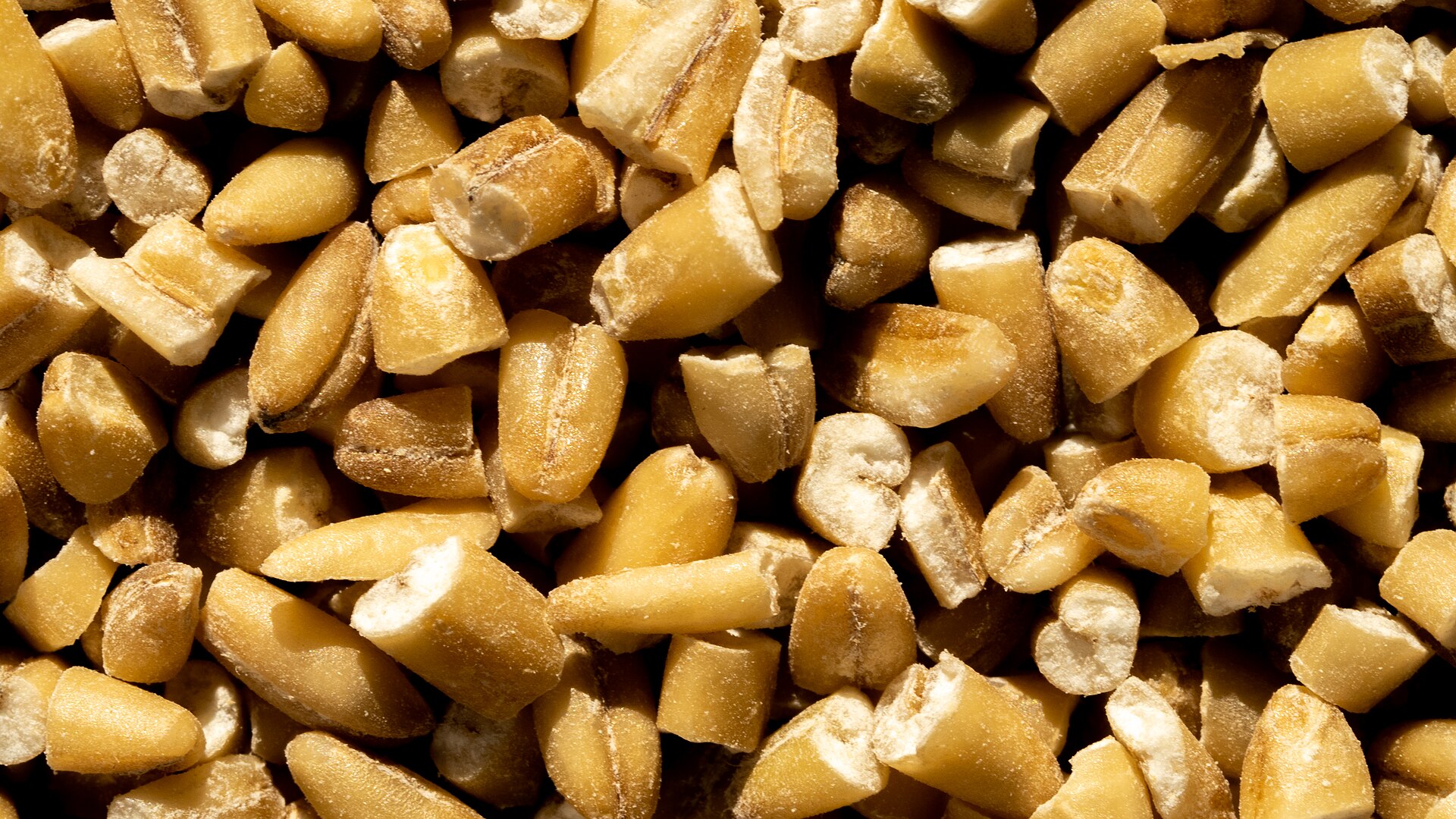
Steel-cut oats, also sold as Irish or pinhead oats, are groats chopped into two or three pieces by rotating steel blades. Nothing is flattened and nothing is pre-cooked beyond the kilning, so the pieces stay dense and take a long time to hydrate.
Scottish oatmeal is a different beast that gets confused with steel-cut. It is stone-ground rather than cut, so the particles are uneven and include a lot of fine flour, and it cooks to a smooth, thick porridge rather than to distinct grains.
Rolled oats, sold as old-fashioned, are groats steamed soft and then pressed flat between rollers. The steaming partly gelatinizes the starch and the rolling gives each flake a large surface for water to enter, which is the whole reason five minutes is enough.
Quick oats are the same idea taken further: the groat is cut first, then rolled thinner. Smaller pieces, less water to travel, one or two minutes.
Instant oats are cooked through at the factory, dried, and rolled thinnest of all. They do not cook in your bowl at all. They rehydrate.
Steel cut vs rolled oats, timed on the same stove
| Cut | Oats to liquid | Cook | Texture | Holds up reheated |
|---|---|---|---|---|
| Whole groats | 1 : 4 | 45 to 55 min | separate, firm, chewy | excellent |
| Steel-cut | 1 : 4 | 20 to 30 min | beads with bite in a loose porridge | excellent |
| Steel-cut, soaked overnight | 1 : 3 | 8 to 12 min | slightly softer, still distinct | very good |
| Rolled | 1 : 2 | 5 min | creamy with flake still visible | fair, goes pasty |
| Quick | 1 : 2 | 1 to 2 min | soft, little definition | poor |
| Instant | 1 : 1.5 | 1 min steeping | uniform, smooth, thickens fast | poor |
The steel cut vs rolled oats question is, in practice, a question about how much of the milling you want done for you. Everything the rollers accomplish with steam and pressure, the steel-cut pot has to accomplish with time and heat.
Dry measures are not interchangeable, which trips people up. A quarter cup of steel-cut and a half cup of rolled both weigh somewhere around 40 to 45 grams and both give about a cup cooked, because the flakes are so much bulkier per gram.
Where instant earns the name, and what it gives up
Instant oats deserve less scorn than they get and more label-reading than they usually get. Plain instant oats with nothing added are the same whole grain as the canister next to them, and a minute of hot water on a bad morning beats skipping breakfast.
The flavored packets are a different product. A single sweetened packet commonly carries somewhere around ten to thirteen grams of added sugar, roughly three teaspoons, plus a few hundred milligrams of sodium and often a thickener. Two packets, which is what most adults actually eat, doubles that.
The texture cost is structural rather than a matter of technique. Flakes that were cooked, dried and pressed to a fraction of a millimeter have no cell structure left to give bite. No amount of careful stirring brings it back.
The nutrition panel barely moves
| Per 100 g dry | Steel-cut | Rolled | Instant, plain |
|---|---|---|---|
| Energy | about 380 kcal | about 380 kcal | about 380 kcal |
| Protein | about 13 g | about 13 g | about 13 g |
| Total fiber | about 10 g | about 10 g | about 10 g |
| Of which beta-glucan | about 4 g | about 4 g | about 4 g |
| Added sugar | none | none | none plain, 10 to 13 g in a flavored packet |
Steaming and rolling do not remove bran, germ or fiber. They change the geometry of the particle, and the panel on the side of the box reflects that by staying almost identical across all three columns.
Anyone shopping on protein or fiber alone should therefore buy on price and convenience. The differences that matter are texture, how the bowl behaves later in the morning, and the number in the next section.
Glycemic index is the number that does move
Published glycemic index tables put steel-cut oats and large rolled flakes in the mid-50s, and instant oats up near 80. That is not a small spread. It puts two products made from the same kernel in different categories, one considered low and the other high.
Two caveats belong with those numbers. Individual studies scatter widely, because the value depends on the exact product, how long it was cooked and who ate it, so the figures are best read as a ranking rather than as a measurement of your own breakfast. And the index describes a fixed dose of available carbohydrate, not a plausible portion.
What survives both caveats is the direction. Coarser and less pre-cooked reads lower; finer and pre-cooked reads higher. The same effect shows up in bread and rice, which is a reasonable check that the mechanism is real rather than an artifact of oat studies.
None of this makes instant oats a problem food for most people. It makes them a faster-digesting version of the same grain, which matters more if you are managing blood sugar and less if you are eating a bowl before a long walk.
Why a thinner flake digests faster
Digestion of starch is a surface problem. Amylase works at the boundary between enzyme and granule, so anything that increases exposed surface or opens up the granule speeds the process.
Rolling does both. It flattens the particle, which multiplies surface area per gram, and the steam that precedes it gelatinizes part of the starch, meaning the crystalline structure has already absorbed water and swollen. A cooked, dried, thinly pressed instant flake arrives at the bowl with most of that work finished.
A steel-cut piece is the opposite case. It is dense, it keeps intact cell walls, and the enzyme has to work inward from a comparatively small surface. That is the same property that makes it take twenty-five minutes on the stove: the water and the enzyme face the same obstacle.
Two practical levers follow. Cooking longer than necessary pushes any oat toward the faster end, so a steel-cut pot simmered for fifty minutes into mush gives up part of its advantage. And adding fat or protein to the bowl slows gastric emptying, which is why a bowl built on yogurt and chia behaves differently from the same oats in water.
Beta-glucan and the three-gram figure
The soluble fiber that gives oats their reputation is beta-glucan, which dissolves into a viscous solution rather than passing through as bulk. That viscosity is what slows gastric emptying, and it is the mechanism behind the effect on cholesterol.
Regulators on both sides of the Atlantic settled on the same threshold for a health claim: about three grams of oat beta-glucan a day. At roughly four grams per hundred grams of dry oats, that works out to somewhere near seventy-five grams of dry oats, which is a genuinely large bowl and more than most people eat at a sitting.
The important detail for this comparison is that all three cuts carry the same beta-glucan on a dry weight basis. Milling does not destroy it. Very fine grinding can reduce the viscosity the fiber develops, which is a reason to prefer flakes over oat flour, but the difference between steel-cut and rolled here is negligible.
An overnight soak closes most of the gap
Steel-cut oats left in cold water overnight, roughly one part oats to three parts water, cook in eight to twelve minutes instead of twenty-five. The grain hydrates while you sleep, so the pot only has to gelatinize starch that is already wet. Texture stays noticeably chewier than rolled oats, which is the entire reason to bother.
The technique scales down. A five-minute soak while the kettle boils takes two or three minutes off. Two hours takes off closer to eight. There is no minimum below which it does nothing.
Rolled oats take the same idea in a different direction. Left cold in milk or yogurt they never get cooked at all, which is what the overnight oats method is: hydration without heat. Uncooked flakes stay less gelatinized than simmered ones, which points in the same direction as the lower published values, though the tables do not cover every possible jar.
One warning about the slow cooker. Steel-cut oats left on low for seven hours scorch at the edges and turn to glue in the middle. If you want a hot pot waiting in the morning, a soak plus ten minutes gets you there with better results and less cleaning.
Liquid ratios, salt, and the pan
Salt goes in with the water, not on top at the end. A quarter teaspoon per serving is the working figure, and oats cooked without it taste flat in a way that no amount of maple syrup covers. Salt added at the table sits on the surface and reads sharp.
Use a heavy pan for steel-cut. The pieces sink and the sugars scorch on a thin base, and a scorched pot flavors the whole batch. Keep the heat at a lazy simmer, stir every few minutes, and leave the lid ajar so it reduces rather than boiling over.
Toasting is the one optional step that repays itself. Two or three minutes of steel-cut oats in a knob of butter, stirred, before any liquid goes in, gives a nuttier result and slightly more separate grains. It also makes the kitchen smell like the version with apple and cinnamon before anything else is added.
Milk instead of water thickens sooner and scorches faster, so cook in water and finish with milk off the heat, or use half and half from the start with the heat lower than feels right.
When the twenty-five minutes is worth it
It is worth it when the bowl has to hold up. Steel-cut oats reheat without collapsing, they travel in a jar, and they still read as a grain rather than a puree at nine in the morning. Rolled oats do none of that as well.
It is worth it when texture is the point. A porridge with actual chew is a different dish from a smooth one, and no technique makes rolled flakes chewy.
It is not worth it on a weekday morning with a train to catch, and pretending otherwise is how people end up eating nothing. Rolled oats at five minutes are an excellent breakfast, and a jar blended the night before is a better one than a skipped meal.
Batch cooking and reheating without paste
Cook four to six servings of steel-cut at once, at 1 to 4, then spread the pot into a shallow dish so it cools quickly rather than sitting warm for an hour. Portion into containers once cold.
Refrigerated, that batch holds four to five days. It sets firm, which looks alarming and is not: a splash of milk or water and two minutes in a pan or ninety seconds in a microwave brings it back, and the grains stay distinct because they were never overcooked in the first place.
For longer storage, press portions into a muffin tin, freeze, then bag the pucks. One puck plus a splash of liquid reheats from frozen in about three minutes. Rolled oats can be batched the same way but come back gluier, and instant oats do not survive the trip at all.
Buy the cut that matches the morning you actually have. Keep steel-cut for the days when the pot can sit, keep rolled for everything else, and read the panel before buying anything with a flavor printed on the front.
Frequently Asked Questions
Are steel-cut oats healthier than rolled oats?
On the nutrition panel, no: same grain, same fiber, same protein, same beta-glucan per gram. The measurable difference is how fast the starch is digested, where the coarser cut has the edge. If that matters for you, it is a real reason to choose it; if it does not, buy on texture and time.
Can I substitute rolled oats for steel-cut in a recipe?
Not one for one. Halve the liquid, cut the time from twenty-five minutes to five, and expect a creamier result. In baking the swap is worse, because recipes built around rolled flakes rely on them softening in the batter, and steel-cut pieces stay hard and gritty.
Do I need to soak oats to make them digestible?
No. Soaking is a time and texture technique, not a safety step. It does reduce some of the phytic acid in the bran, which binds minerals, though the size of that effect in a mixed diet is modest and easy to overstate.
Why did my oats boil over?
Beta-glucan again. It makes the cooking liquid viscous, so the bubbles cannot break and the foam climbs. Use a pan at least three times the volume of the finished porridge, keep the lid ajar, and drop the heat the moment it comes up.
Is instant oatmeal still a whole grain?
Plain instant oats are, since nothing is removed from the groat, only cooked and pressed. The question is what else is in the packet. A flavored one is a whole grain plus roughly three teaspoons of sugar, and buying plain instant and sweetening it yourself costs nothing and settles the issue.