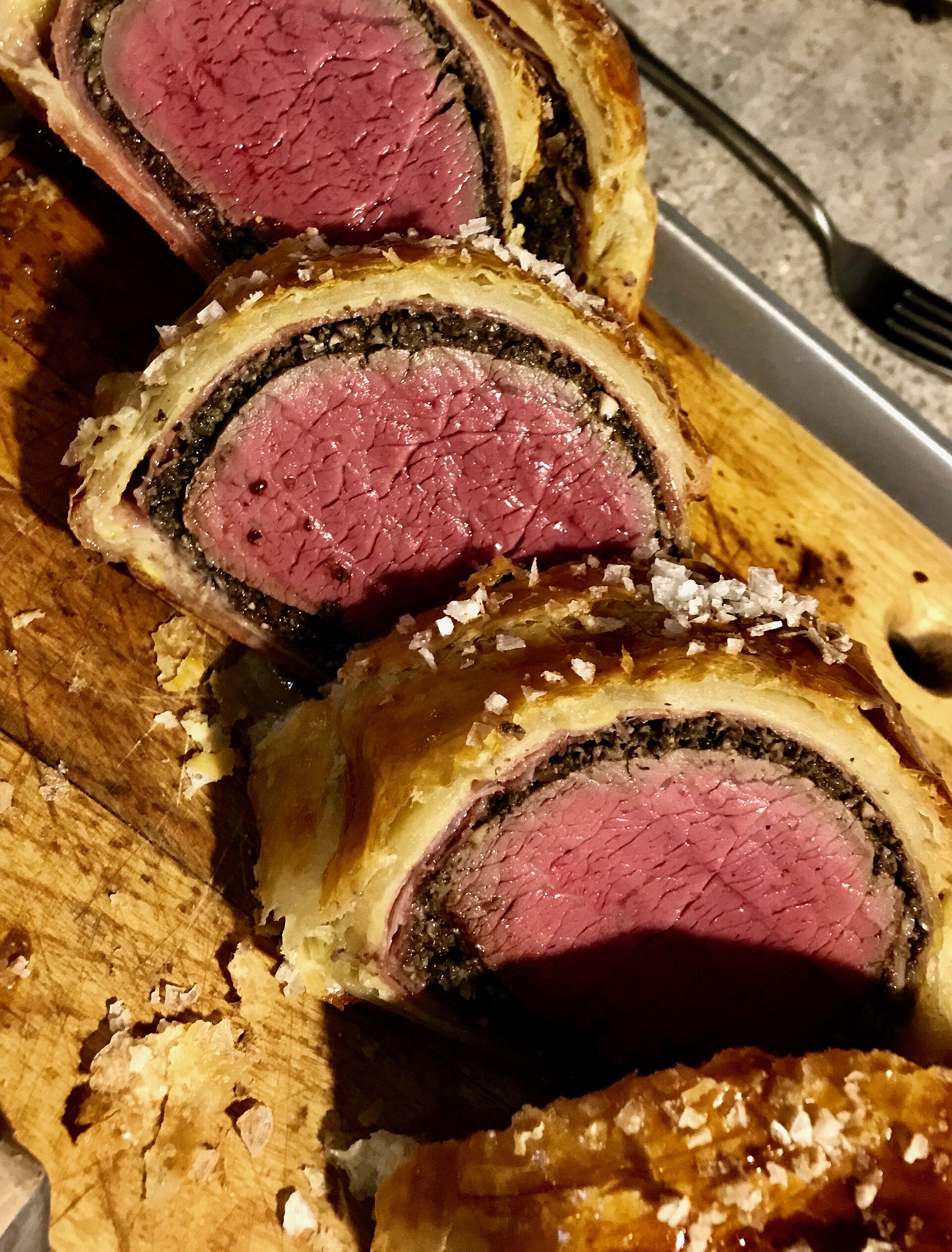
There is a moment during the slicing of a properly executed beef Wellington that almost qualifies as ceremonial. The deeply golden pastry shell gives way under a sharp knife with a satisfying papery crack. Inside, you see the layers: a thin band of cooked-through pastry, then a rind of pink-edged crispy prosciutto, then a dark layer of mushroom duxelles, and finally the rose-pink bullseye of medium-rare beef tenderloin. The geometry is precise. The colors are dramatic. Every Wellington shop on the planet is built around producing this exact cross-section.
Beef Wellington is a Valentine’s Day standard not because the British dish is romantic by nature but because it is technically demanding and dramatic on the plate – perfect for a special-occasion home dinner that demonstrates seriousness. The dish, despite its English name (probably from the Duke of Wellington, though the etymology is disputed), bears resemblance to the French boeuf en croute and is essentially a beef-and-mushroom pie elevated.
The professional method – popularized by Gordon Ramsay’s BBC programs and home cooking books – uses a roll-and-chill technique that removes most of the anxiety from the dish. The duxelles is wrapped around the beef and chilled before the puff pastry goes on, which keeps everything cold and prevents the moisture seepage that causes soggy bottoms. The rest of this article is the full method with notes on every variable.
The Right Cut of Beef
Center-cut beef tenderloin is the canonical Wellington cut. The center is the most uniform part of the tenderloin, producing even cooking. Avoid: end-cut tenderloin (tapered, cooks unevenly), tied roasts (the string complicates the wrap), or any cut that is not tenderloin (rib-eye or strip do not have the right shape and texture for Wellington).
A 1 kg (2.2 lb) center-cut tenderloin serves 6. For 2 people, use a 400 g (14 oz) portion. The beef should be at room temperature 1 hour before searing – cold-from-fridge beef takes too long to develop a crust, oversearing the surface.
The Mushroom Duxelles: Cook Out All Moisture
Duxelles is the foundation of Wellington flavor. Cremini or button mushrooms are pulsed in a food processor with shallots and garlic until finely chopped, then cooked in butter for 15 to 20 minutes until all moisture has evaporated. The cooked mass should be dry-ish, almost pâté-like in texture – moisture in the duxelles is the most common cause of soggy Wellington pastry.
Test by squeezing a small amount in your palm: if water releases, cook longer. The duxelles should hold together when pressed but release no liquid. White wine and thyme added at the end provide aromatic complexity. Cool completely before assembly – warm duxelles wilts the prosciutto and softens the pastry.
The Roll-and-Chill Method
The Ramsay-method roll-and-chill is the key technique that produces professional Wellington at home. After searing and cooling the beef, you arrange overlapping prosciutto slices on plastic wrap, spread the duxelles over them, place the beef on top, and roll the whole thing tightly into a log using the plastic wrap. Then refrigerate 30 minutes. The chill solidifies the duxelles around the beef, producing a tight cylindrical package ready for the final pastry wrap.
Skipping this step is what causes home Wellington to fall apart. The wrap-roll-chill sequence is the technique that makes the dish manageable for home cooks. Once you understand it, the entire Wellington workflow becomes possible to execute on Valentine’s afternoon while watching a movie.
All-Butter Puff Pastry
Puff pastry choice decides 30% of the final result. All-butter puff pastry (Dufour, Tate’s All-Butter Puff) produces flaky layered crust with rich butter flavor. Vegetable-shortening puff pastry (Pepperidge Farm) produces a softer, less flaky result that lacks butter flavor. The $8 price difference is the most worthwhile upgrade in the whole recipe.
Find Dufour at Whole Foods (refrigerated section, frozen). Roll to 5 mm thick – thinner and the pastry tears under the weight of the filling; thicker and it does not cook through. Brush every external surface with egg wash for the deep golden finish. Score decoratively but only score – do not cut through to the filling.
Beef Temperature Control
Beef tenderloin overcooks in the time it takes to bake the pastry. The solution is high oven temperature (220 C / 425 F) which browns the pastry quickly while the meat stays inside the temperature window. Use an instant-read thermometer pushed through the side of the pastry into the meat. Pull at 52 C (125 F) – residual heat carries it to 55 C (130 F) during rest.
Without a thermometer, you are guessing. Beef tenderloin is too expensive to ruin. A $30 Thermapen ONE pays for itself in one good Wellington.
Ingredients
- 1 kg (2.2 lb) center-cut beef tenderloin
- Salt and freshly ground black pepper
- 2 tbsp olive oil
- 2 tbsp Dijon mustard (Maille brand)
- 500 g (1 lb) cremini mushrooms
- 2 shallots, peeled
- 3 garlic cloves
- 2 tbsp unsalted butter
- 100 ml (1/3 cup) dry white wine
- 2 tbsp fresh thyme leaves
- 8-12 slices prosciutto di Parma
- 500 g (1 lb) all-butter puff pastry (Dufour)
- 2 egg yolks beaten with 1 tbsp cream (egg wash)
- Flaky sea salt
Making It
- Sear beef. Tie tenderloin into uniform cylinder. Season heavily. Sear in hot oil over high heat 2 min/side, all sides browned. Remove. Brush all over with Dijon. Cool completely.
- Make duxelles. Pulse mushrooms+shallots+garlic in food processor finely. Cook in butter 15-20 min until dry. Add wine and thyme. Cool completely.
- Roll + chill. Lay plastic wrap. Arrange prosciutto in overlapping rectangle. Spread cooled duxelles. Place cold beef. Roll tightly into log using wrap. Refrigerate 30 min.
- Wrap in pastry. Roll puff pastry to 5 mm. Unwrap beef onto pastry. Brush edges with egg wash. Roll tightly. Trim excess. Seal with fork. Score decoratively. Brush with egg wash.
- Final chill. Refrigerate assembled Wellington 30 min. Preheat oven 220 C (425 F).
- Bake. 25-35 min until pastry deeply golden. Internal temp 52 C (125 F) for medium-rare.
- Rest 15 min. Slice with sharp serrated knife into 2 cm slices.
- Serve. With red wine pan jus or hollandaise sauce.
Frequently Asked Questions
Why does my puff pastry go soggy?
Warm duxelles or beef, or skipping prosciutto barrier. ALL components must be cold. The roll-and-chill 30-min refrigerate solves this.
What kind of puff pastry should I use?
All-butter (Dufour, Tate’s). Vegetable-shortening pastry produces inferior result. The $8 price difference is the most worthwhile upgrade.
What internal temperature?
52 C (125 F) for medium-rare – residual heat carries to 55 C during rest. Use instant-read thermometer. Visual cues unreliable.
Can I assemble ahead?
Yes – up to 24 hours ahead. Bake from cold, add 5-8 min to bake time. This is how restaurants handle Wellington service.
Sources
- Serious Eats — Beef Wellington — Detailed roll-and-chill walkthrough.
- Gordon Ramsay — Beef Wellington — The canonical method.
- USDA FoodData Central — Nutritional data.
Each serving contains roughly 685 calories, 42 g protein, 42 g fat, 22 g carbs.
Please note: Contains beef, pork (prosciutto), dairy, eggs, gluten (pastry). Not suitable for dairy, gluten, or pork allergies. The medium-rare meat is not recommended during pregnancy. Consult a dietitian for specific needs.