A supermarket aisle carries a dozen bottles that all say they are for cooking, at prices that run from four dollars to twenty-eight. Most home kitchens end up with six of them open at once, three of them past their useful life, and no clear idea which one belongs in a hot pan.
Smoke point is the number printed on the shelf talker, and it is the wrong thing to shop by on its own. It tells you when an oil starts visibly breaking down. It does not tell you how fast it degrades below that point, how it holds up to a second and third use, or whether it will taste like anything by March.
What follows is fourteen oils with their working temperatures, what refinement actually changes, which fats fail fastest under repeated heat, the two rules for an oil fire, and a four-bottle kitchen that covers every method a home cook uses.
- Highest working temperatures: refined avocado, refined safflower, rice bran, ghee
- Most stable under repeated heat: high monounsaturated oils and saturated fats
- Fastest to degrade: high polyunsaturated oils, particularly flaxseed and walnut
- Refinement is worth: roughly 50 to 150 degrees of smoke point over the unrefined version
- Deep frying range: 325 to 375F, well under most refined oils’ limits
- Never on a burner: toasted sesame, walnut, flaxseed, most nut and seed finishing oils
- The four-bottle kitchen: a neutral high-heat oil, extra virgin olive, a solid fat, and one finishing oil
Smoke point is a symptom, not the property itself
The smoke point is the temperature at which an oil produces continuous visible smoke in a controlled test. What is actually smoking is not the fat itself but the small molecules it is shedding, chiefly free fatty acids and the volatile fragments they break into.
That makes the number a measure of how clean the oil currently is, not a fixed property of the plant it came from. Two bottles of the same oil can differ by fifty degrees depending on how they were processed and how long they have been open, and every published figure is a rough average rather than a threshold.
It also means the number moves during cooking. An oil used to fry a batch of anything picks up free fatty acids and food particles, and its smoke point falls with each use. The bottle that read 450 degrees when it was new might smoke at 380 after three sessions in a fryer.
Refinement moves the number more than the plant does
Unrefined oils are pressed and filtered and nothing else, so they keep the particles, free fatty acids, pigments and aromatic compounds of the seed or fruit. Those are exactly the things that smoke, which is why unrefined oils have low working temperatures and a lot of flavor.
Refining strips them out through some combination of degumming, neutralizing, bleaching and deodorizing. The result is nearly colorless, nearly tasteless, and stable at much higher temperatures. Refined coconut oil handles roughly fifty degrees more than virgin. Refined sesame handles sixty more than toasted.
The trade is flavor for heat and it is not a hierarchy. A refined oil in a pan of vegetables contributes nothing to the taste, which is precisely what you want when the vegetables are the point. An unrefined one contributes a great deal, which is why it belongs on the plate rather than in the pan.
A cooking oil smoke point chart, fourteen rows deep
| Oil or fat | Approximate smoke point | Dominant fat | Flavor | Best for |
|---|---|---|---|---|
| Avocado, refined | 500 to 520F | monounsaturated | neutral | searing, high-heat roasting |
| Safflower, refined high-oleic | 490 to 510F | monounsaturated | neutral | frying, searing |
| Ghee, clarified butter | 480 to 490F | saturated | nutty, buttery | sauteing, roasting, Indian cooking |
| Rice bran | 470 to 490F | mixed | very mild | deep frying, tempura |
| Olive, refined or light | 450 to 470F | monounsaturated | faint | frying, general cooking |
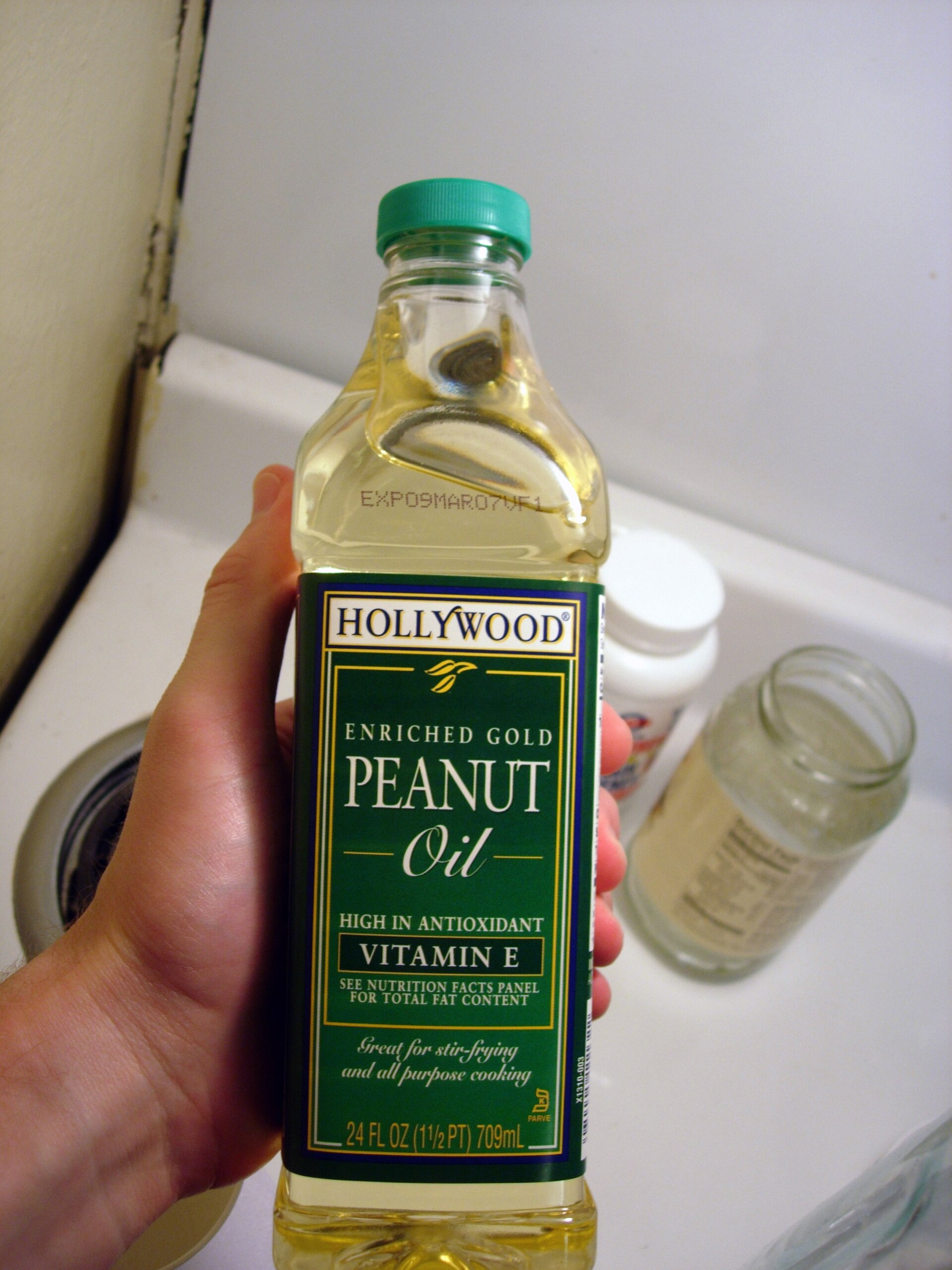
| Peanut, refined | 440 to 450F | monounsaturated | neutral | deep frying |
| Corn, refined | 440 to 450F | polyunsaturated | neutral | frying, baking |
| Sunflower, refined | 430 to 450F | varies by cultivar | neutral | frying, baking |
| Canola, refined | 400 to 440F | monounsaturated | neutral | everyday cooking, baking |
| Grapeseed | 390 to 420F | polyunsaturated | clean, light | sauteing, dressings |
| Coconut, refined | 390 to 400F | saturated | neutral | sauteing, baking |
| Extra virgin olive | 375 to 410F | monounsaturated | peppery, green | sauteing, roasting, finishing |
| Lard, rendered | 360 to 375F | mixed | savory | pastry, frying, refried beans |
| Butter, whole | 300 to 320F | saturated | rich | low sauteing, sauces, finishing |
Every figure above is a range on purpose. Batch, freshness, storage and processing all shift it. Treat the ranking as reliable and the individual numbers as approximate.
Saturated, monounsaturated, polyunsaturated: what breaks first
The chemistry that decides stability is the number of double bonds in the fatty acid chains. A saturated fat has none, a monounsaturated has one, a polyunsaturated has two or more, and every double bond is a place where oxygen can attack.
That produces a clean ranking for oxidative stability: saturated fats are the most stable, monounsaturated next, polyunsaturated the least. It is the reason a jar of coconut oil sits on a counter for a year while a bottle of walnut oil turns in three months.
Stability and smoke point are separate properties and they do not always line up. Refined corn oil has a high smoke point and a polyunsaturated profile, so it copes with one hot session and degrades quickly across several. Extra virgin olive oil has a moderate smoke point and is highly stable, which is why it outperforms its number in practice.
What actually happens when oil degrades
Three processes run at once in a hot pan. Water from the food splits fatty acids off the glycerol backbone, which is why the smoke point falls fastest when frying wet things. Oxygen attacks the double bonds, producing aldehydes and other small compounds, some of which smell rancid at very low concentrations. And heat drives molecules to link into larger polymers.
You can see all three. The oil darkens, thickens, and starts to foam at the surface instead of bubbling cleanly. A sticky varnish builds on the pan walls, which is polymerized oil, the same reaction that seasons a cast iron pan on purpose. The smell turns sharp and acrid.
Commercial kitchens measure this rather than guess, testing for total polar compounds and discarding the oil when it passes a set threshold, which in many countries is around a quarter of the total. At home the four signals are color, viscosity, foam and smell. Any two of them together mean the oil is finished.
Repeated heating: which oils fail fastest
| Oil | First fry | After three fries | Practical reuse limit |
|---|---|---|---|
| Peanut, refined | excellent | good, slightly darker | 4 to 6 sessions |
| Rice bran | excellent | good | 4 to 6 sessions |
| Refined olive | excellent | good | 4 to 6 sessions |
| Canola | good | noticeably darker | 3 to 4 sessions |
| Sunflower, standard | good | foaming begins | 2 to 3 sessions |
| Corn | good | foaming begins | 2 to 3 sessions |
| Grapeseed | fine | flat and thickening | 2 sessions |
| Extra virgin olive | good, flavor fades | still stable, flavor gone | 3 to 4 sessions, expensive |
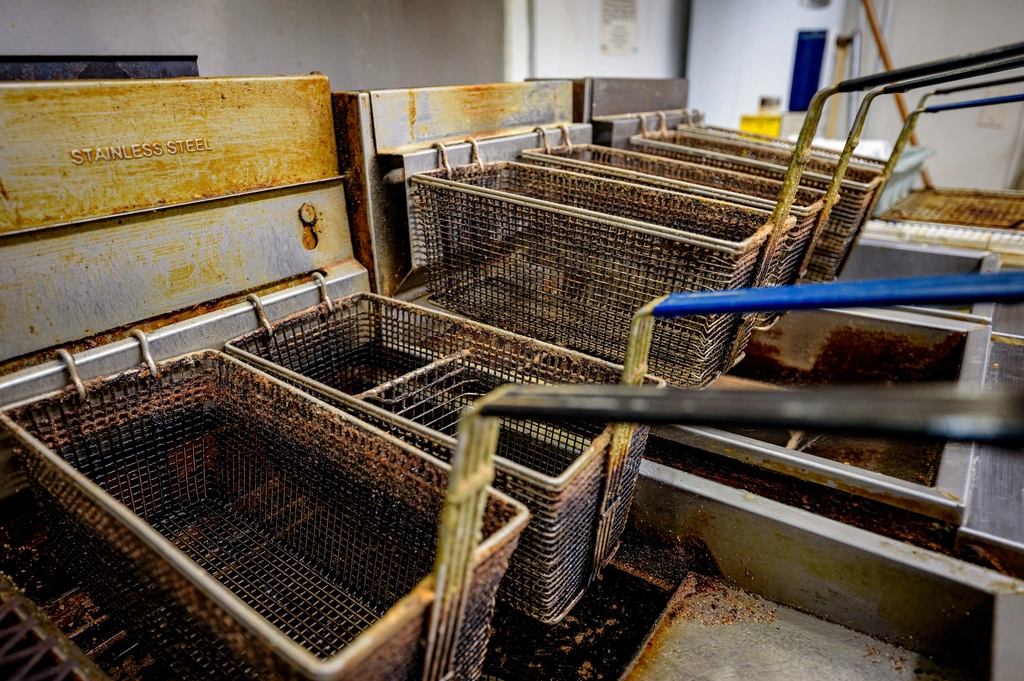
Strain the oil through a fine sieve or a coffee filter while it is warm but not hot, store it in a sealed jar in a dark cupboard or the refrigerator, and keep the fish oil separate from everything else. Anything used for battered or breaded food carries more crumbs and degrades faster than oil used for plain fries. A double-fry method is harder on oil than a single one, since the pot spends longer at temperature.
Matching oil to method, not to a number
Almost no home cooking method needs the top of the chart. Deep frying runs at 325 to 375 degrees. Pan searing on a domestic burner puts the fat somewhere near 400 at the peak. A 425-degree oven heats the pan, not the oil, and the oil on a tray of vegetables rarely exceeds the oven temperature.
Where the number does matter is a very hot dry pan, a wok on a powerful burner, or the moment a pan is preheated empty and then the fat goes in. Those are the situations that put oil past 450 degrees, and they are the reason to own one high-smoke-point bottle.
The rest of the time, choose for flavor and stability. Vegetables roasted hard take extra virgin olive oil without complaint. A pan of eggs takes butter. The idea that everything should be cooked in whatever has the highest number is how kitchens end up with tasteless food and an expensive bottle of avocado oil.
Olive oil and the frying argument
Extra virgin olive oil sits in the middle of the chart and gets dismissed for frying on that basis, which misreads what the number measures. Its high monounsaturated content and its natural antioxidants make it genuinely resistant to oxidation, and it holds up across repeated heating better than several oils that smoke a hundred degrees higher.
What it does lose is flavor. The peppery, grassy compounds that justify the price are volatile and they largely disappear in a hot pan. Frying with a good bottle of oil is not dangerous; it is wasteful.
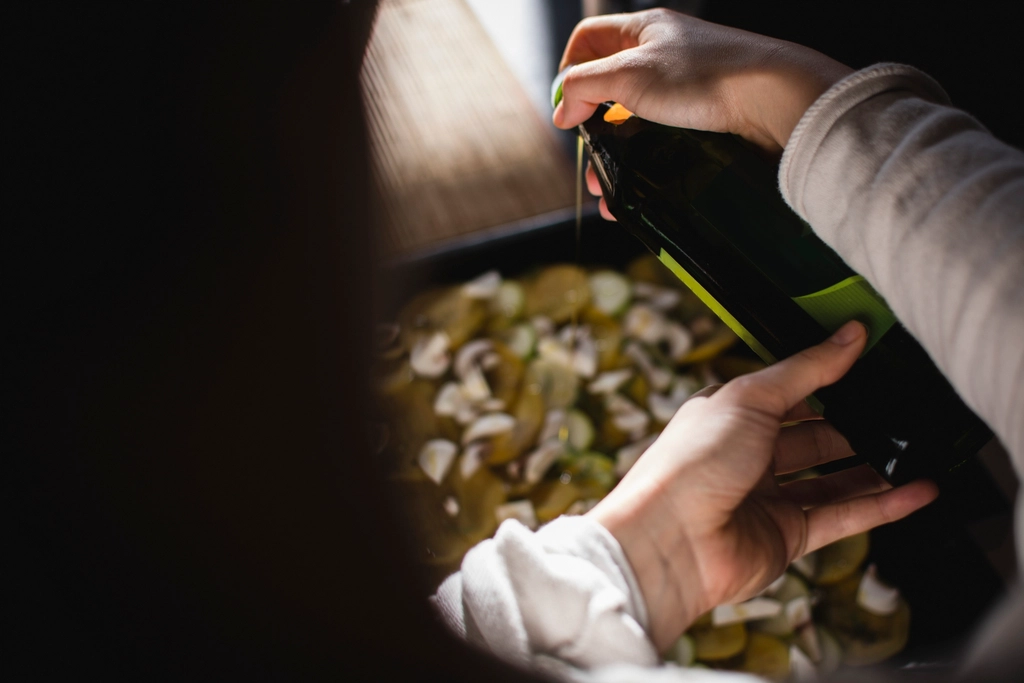
The sensible arrangement is two olive oils. A mid-priced one for cooking, where the stability is doing the work, and a good one kept for dressings, finishing and the cakes where the flavor is the point. Refined or light olive oil is a third option for high heat, with the flavor already removed at the factory.
Flavor oils that should never see a burner
Toasted sesame oil smokes low, tastes of almost nothing once it has been heated, and turns faintly bitter. It goes in at the end, off the heat, a teaspoon at a time. The untoasted refined version is the one for cooking, and they are not interchangeable.
Walnut, hazelnut and pistachio oils behave the same way and cost more. They belong in dressings, over roasted vegetables, or stirred into something warm rather than hot. Flaxseed oil is the extreme case: it starts breaking down below 250 degrees and goes rancid faster than anything else on the shelf, so it lives in the refrigerator and never touches a pan.
Chile oils, garlic oils and herb oils are flavoring rather than cooking fats. If they contain fresh aromatics rather than dried, they belong in the refrigerator and should be used within a few days, because fresh low-acid ingredients held under oil at room temperature create the conditions that allow the bacterium behind botulism to grow.
Oil fires, and the two things not to do
Oil that reaches its flash point ignites, and on a domestic stove that happens a few hundred degrees above the smoke point. It is the most likely serious fire in a home kitchen and it is entirely survivable if the first reaction is right.
Two things not to do. Never throw water on burning oil: water sinks, flashes instantly to steam, and throws burning fat across the room in a fireball. And never pick up the pan, because a moving pan spills and spreads the fire onto you and the floor.
What to do instead: turn off the heat, slide a metal lid or a baking sheet over the pan from the side rather than from above, and leave it covered until it is completely cold. Baking soda smothers a very small flare-up. Keep a lid within reach whenever a pan of oil is heating, never leave one unattended, and if the fire is not out within seconds, leave and call the fire service. A dry powder or wet chemical extinguisher rated for cooking fats is a reasonable thing to own; a water extinguisher is not.
Storage, rancidity, and how to tell
Rancidity is oxidation continuing slowly at room temperature, driven by air, light and heat. A bottle stored above the stove gets all three, which is why the most convenient spot in the kitchen is the worst one.
Store oils in a dark cupboard away from the range, in glass or tinned metal rather than clear plastic, and keep the caps on. Buy sizes you will finish: a three-liter tin is only a bargain if it is gone within a few months. Refrigerate the delicate ones, meaning nut oils and flaxseed, and accept that they cloud when cold and clear again on the counter.
The test is your nose, and the reference is a fresh bottle. Rancid oil smells like old crayons, putty or stale nuts, and it tastes faintly of cardboard with a bitter finish. It will not make a healthy adult ill in ordinary amounts, but it makes food taste bad and there is no cooking around it. On the health side, the broad advice from major nutrition bodies is to favor unsaturated fats over saturated ones in the overall diet; specific needs vary, and anyone managing cholesterol or another condition should take that up with their own clinician rather than with a chart.
The four-oil kitchen
One neutral high-heat oil. Refined peanut, rice bran, refined safflower or canola. This is the searing and frying bottle, bought in a size you will use, kept in the cupboard.
Extra virgin olive oil, mid-priced. The default for sauteing, roasting, braising and anything where a background of olive flavor is welcome, which is most savory cooking.
One solid fat. Butter for sauces, eggs and finishing; ghee if you want butter flavor at higher temperatures; lard if you make pastry or beans regularly. Any one of the three covers the job.
One finishing oil. A good extra virgin, or toasted sesame, or a nut oil, depending on what you cook. Small bottle, used a teaspoon at a time, replaced when it stops smelling like itself.
Four bottles handle a whole kitchen. Deep frying uses the first, everything roasted uses the second, breakfast uses the third, and the fourth is what makes a finished plate taste like someone was paying attention.
Buy for the method and the shelf life rather than for the largest number on the label. Most of what a home kitchen does happens under 400 degrees, which puts almost every oil in the chart comfortably inside its range.
Frequently Asked Questions
Is it dangerous to cook past an oil’s smoke point?
Briefly, no, and habitually, it is a bad idea. Smoking oil is shedding compounds you do not want in the food, it tastes acrid, and it is a step closer to the flash point. If a pan starts smoking before the food goes in, take it off the heat, wipe it out and start again rather than pressing on.
How many times can I reuse frying oil?
Between two and six sessions depending on the oil and on what was fried in it. Strain it warm, store it sealed and dark, and judge by color, thickness, foaming and smell rather than by a count. Oil that foams across the whole surface or smells sharp when it heats is finished.
Does olive oil become harmful when heated?
The claim circulates and does not hold up well. Extra virgin olive oil is among the more oxidation-resistant cooking fats and comes through normal pan and oven temperatures in good shape. What it loses is aroma, which is a reason to keep the expensive bottle off the heat rather than a safety concern.
Can I mix oils in a fryer?
You can, and the mixture takes on the properties of the least stable component. Mixing a stable oil into a degraded one does not rescue the degraded one. If you are topping up during a session, use the same oil; if you are starting fresh, start fresh.
How do I dispose of used frying oil?
Cool it completely, pour it back into a bottle or a sealed container, and put it in the household waste, or take it to a collection point if your area has one. Never pour it down a drain, where it solidifies and blocks the line, and never into a compost heap or a garden bed.