
A thermometer that reads five degrees high pulls a turkey breast at what looks like a safe 165F while the meat is actually sitting at 160F, still short of done. A thermometer that reads five degrees low does the opposite, leaving a roast in the oven well past the point it was actually ready, drying it out for no reason. Neither error shows up unless the thermometer itself gets checked first.
Every instant-read and leave-in probe drifts out of true accuracy eventually, from drops, from age, from a battery running low, or simply from manufacturing variance that was never perfectly zeroed to begin with. None of that is visible on the display, which only ever shows a number with total confidence whether or not that number is correct.
Two checks, one using ice water and one using boiling water, catch this before it matters, and both take under five minutes. What follows is how to run each one, the offset worth writing down and taping to the thermometer itself, and why altitude changes one of the two tests in a way most home cooks never account for.
- Fastest check: ice water, should read 32F within a degree or two
- Second check: boiling water, should read 212F at sea level, less at altitude
- How often: before any major roast, and after any drop or battery change
- What to do with an offset: tape it to the thermometer as a running adjustment
- Applies to: both instant-read and leave-in probe thermometers
- Replace rather than adjust: if the offset is more than 4 to 5 degrees
How to calibrate a meat thermometer with ice water
The simplest way to check how to calibrate a meat thermometer at home needs nothing but a glass, ice, and water. Fill a glass with ice, then add cold water until the ice is fully floating and the glass is nearly full, and stir it for about a minute so the mixture settles at a stable temperature throughout.
Insert the thermometer probe into the center of the ice water, avoiding the sides or bottom of the glass, and wait for the reading to stabilize, which usually takes under a minute for an instant-read probe. A properly functioning thermometer should read 32F, the freezing point of water, within a degree or two in either direction.
This test works reliably at any altitude, since the freezing point of water changes far less with elevation than the boiling point does, which is the main reason it is the more dependable of the two standard checks for a home kitchen.
The boiling water check, and why it is less reliable
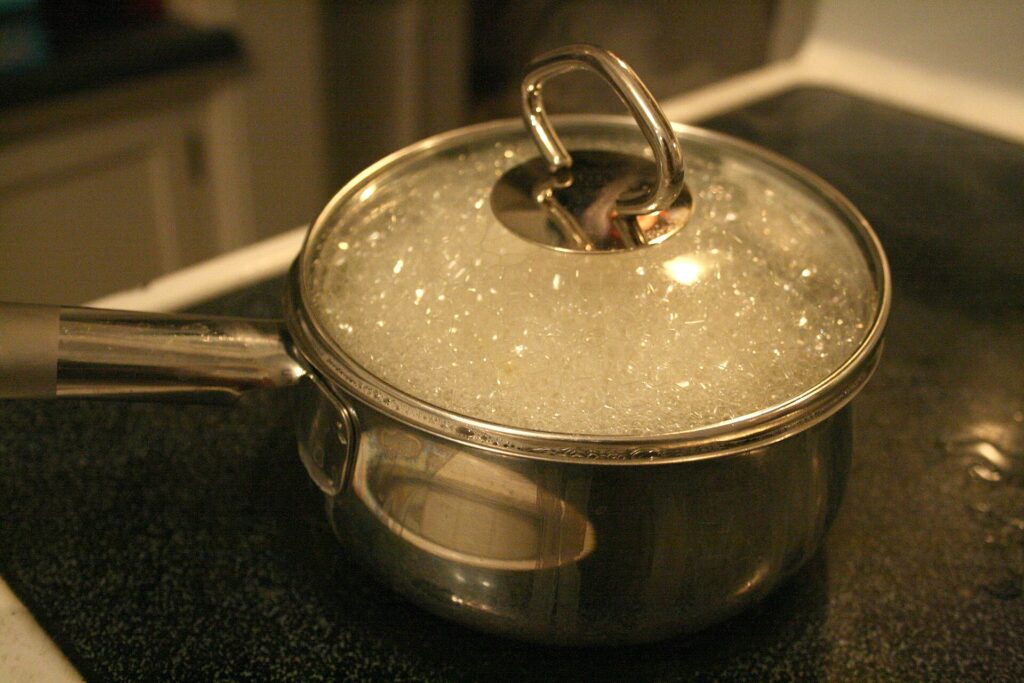
The second standard method brings a pot of water to a full rolling boil, then inserts the thermometer probe into the water without letting it touch the bottom or sides of the pot. At sea level, a correctly calibrated thermometer reads 212F once the reading stabilizes.
The catch is that boiling point drops as elevation increases, since lower atmospheric pressure at altitude means water boils at a lower temperature. A kitchen at 5,000 feet sees water boil closer to 203F, and using 212F as the reference at that elevation would make an accurate thermometer look several degrees off when it is not.
Looking up the correct boiling point for a specific elevation, widely available from weather and cooking reference sources, is necessary before this test means anything above roughly 2,000 feet. Below that, the difference is small enough to mostly ignore for kitchen purposes.
Reading and recording the offset
| Ice water reading | Interpretation | Action |
|---|---|---|
| 31 to 33F | within normal accuracy | no adjustment needed |
| 28 to 30F or 34 to 36F | a small, consistent offset | note the offset, adjust readings mentally or via the thermometer’s calibration screw |
| Below 28F or above 36F | a significant error | replace the thermometer or the battery, then retest |
Many digital instant-read thermometers include a small calibration adjustment, sometimes a screw on the back of the display, sometimes a button-based reset accessed by holding a specific combination while the probe sits in ice water. Checking the specific model’s manual for this feature turns a known offset into a corrected reading permanently, rather than requiring mental math every time.
Taping the offset to the handle
For a thermometer with no adjustment feature, or for a small offset not worth fully resetting, a strip of tape on the handle with the offset written in permanent marker, something as simple as add 2F, turns every future reading into an accurate one without requiring memory or a second calculation in the middle of a busy cook.
This matters most during a high-stakes roast like a holiday turkey, where a small, forgotten offset compounds with the general stress of the day into a real risk of pulling a bird that reads done but is not, or leaving one in far longer than necessary out of overcaution.
Retesting periodically, particularly after the thermometer has been dropped, exposed to extreme temperature swings, or had its battery replaced, catches any drift that develops over the tool’s working life rather than assuming a single calibration lasts forever.
Leave-in probes: a different calibration problem
A leave-in probe thermometer, connected by a cable to a base unit or wireless transmitter and left in the meat throughout the entire roast, tests the same way as an instant-read: submerged in ice water, checked against the 32F reference. The probe tip itself is what needs to be fully surrounded by the ice water, not the cable or the base unit.
These probes are more prone to a specific kind of error that ice water testing alone will not catch: a probe placed too shallow or too close to bone during the actual roast reads a temperature that does not reflect the thickest, slowest-cooking part of the meat, regardless of how accurate the sensor itself is. Calibration confirms the sensor is honest; correct placement confirms the sensor is measuring the right spot.
For a large roast, checking the reading from a leave-in probe against a separate instant-read thermometer at a couple of points near the end of cooking is a reasonable second check, catching a placement problem that calibration testing alone cannot.
Why this matters most before a holiday roast
A thermometer used weekly for weeknight chicken breasts and steaks gets implicitly recalibrated by experience: a home cook notices over time if a piece of meat that reads done keeps coming out underdone, and adjusts. A thermometer that sits in a drawer for eleven months and comes out once a year for a holiday turkey gets no such feedback loop.
Checking it the week before, rather than the morning of, catches a dead battery or a significant drift with enough time to replace the thermometer if needed, rather than discovering the problem while a fourteen-pound bird is already in the oven and there is no backup on hand.
The same logic applies to any large cook where a mistake is expensive in time or ingredients, whether that is a large holiday roast or a whole smoked shoulder that takes most of a day.
Common causes of a drifting reading
A dropped thermometer is the single most common cause of a sudden, significant offset, since the internal sensor or its connection can shift slightly from the impact even without any visible external damage. A thermometer that has taken a fall is worth checking even if it still turns on and displays numbers normally.
A weak or aging battery causes a slower, more gradual drift in many digital models, which is part of why a fresh battery is worth installing before a calibration check rather than after, since testing on a dying battery can produce a false reading that a fresh battery would not reproduce.
Repeated exposure to extreme heat, such as leaving an instant-read thermometer resting directly on a hot oven rack instead of setting it aside between uses, can degrade some models’ internal components over time, gradually shifting their accuracy even without a single dramatic failure.
When to replace instead of recalibrate
An offset of more than four to five degrees, or a thermometer that gives inconsistent readings on repeated ice water tests rather than a stable, repeatable number, is generally past the point where a written offset or a manual adjustment is worth trusting. At that level of error, a new thermometer is a small cost relative to the risk of misjudging a roast that took hours to prepare.
A thermometer that fails to stabilize at all, drifting continuously rather than settling on a number, or one with a cracked or unresponsive display, should be replaced outright regardless of what the calibration test shows, since a physically damaged unit is not a reliable measuring tool at any offset.
The two checks, start to finish
- Fill a glass with ice, then add water until the ice floats and the glass is nearly full. Stir for about a minute.
- Insert the probe into the center of the mixture, avoiding the glass itself. Wait for the reading to stabilize.
- Confirm the reading is 32F within a degree or two. Note any offset.
- Bring a pot of water to a full rolling boil. Insert the probe without touching the pot.
- Confirm the reading matches the correct boiling point for your elevation. Look this up if above 2,000 feet.
- Adjust the thermometer if it has a calibration feature, or tape the offset to the handle. Replace it if the offset exceeds 4 to 5 degrees.
Keeping a backup thermometer on hand
A single thermometer failing mid-roast, whether from a dead battery or a drop onto a tile floor, leaves no way to confirm doneness at the exact moment it matters most. A second, inexpensive instant-read thermometer kept in a drawer as backup costs little relative to the risk of having no working way to check a large roast.
Testing both thermometers against each other in the same glass of ice water, rather than only testing the one currently in regular use, confirms the backup is ready to go before it is actually needed, rather than discovering a second failure right when the first one already let you down.
For a household that cooks large roasts only a few times a year, storing the backup thermometer alongside other holiday-specific equipment, rather than in a general kitchen drawer, makes it easier to remember it exists when the day it is needed finally arrives.
Five minutes with a glass of ice water is the entire difference between trusting a number on a screen and knowing that number is actually true. For a roast that takes hours and cannot be undone once it is overcooked, that is a cheap trade.
Frequently Asked Questions
How often should I calibrate my meat thermometer?
Before any major roast, after any drop, after a battery change, and roughly every few months with regular use is a reasonable schedule. It takes under five minutes and catches drift before it affects a real cook.
Can I use tap water instead of ice water for the cold check?
No, tap water is not reliably at a known, fixed temperature the way an ice-and-water mixture is. The ice water test only works because 32F is a stable, verifiable reference point that plain cold water cannot guarantee.
My thermometer has no calibration adjustment feature. What do I do with an offset?
Write the offset on a piece of tape and attach it to the thermometer handle, then mentally adjust every reading by that amount. It is less elegant than a built-in reset but works just as well in practice.
Does calibration matter for a leave-in probe used throughout a long smoke or roast?
Yes, arguably more than for an instant-read, since a leave-in probe’s reading is trusted continuously over hours rather than checked once at the end. Test it the same way in ice water before a long cook begins.
Is a more expensive thermometer automatically more accurate?
Generally more reliable and more stable over time, but not immune to drift or damage. Even a premium thermometer should be checked before a high-stakes roast rather than trusted purely on price.