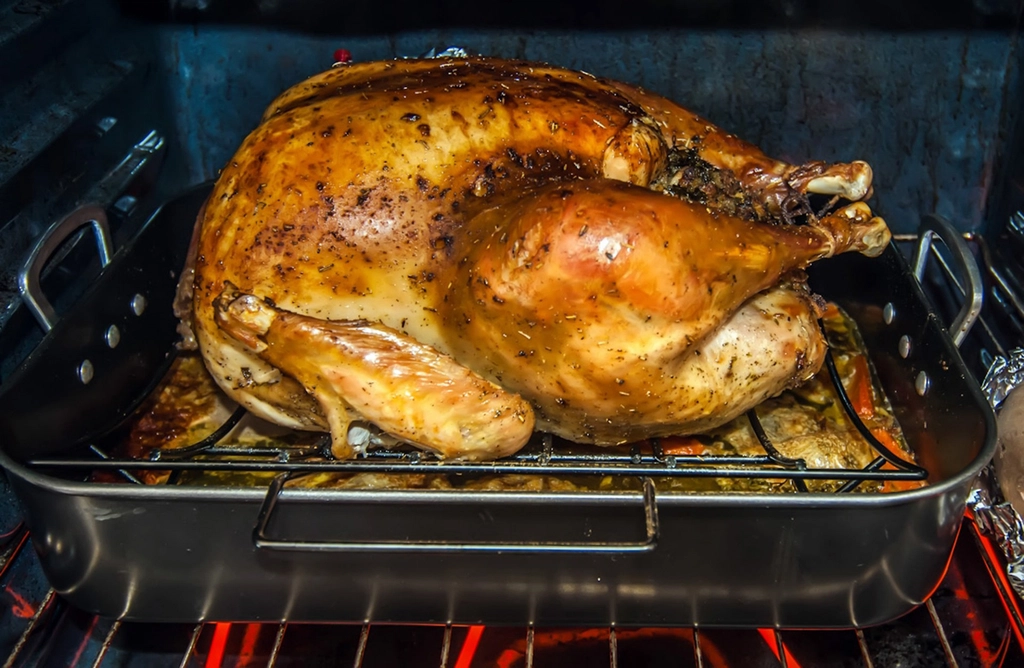
A heritage turkey costs three to five times what a standard supermarket bird costs, sometimes more, and the marketing around it leans hard on words like heirloom, pasture-raised, and slow-grown. None of that tells you what actually shows up on the plate, which is the only question that matters once the bird is already in the oven and the money is already spent.
Two birds of similar weight, a heritage breed and a standard broad-breasted supermarket turkey, roasted the same way, at the same temperature, pulled at the same internal reading, give a much clearer answer than any package label does. The differences turn out to be real, but not evenly distributed across the bird, and not the differences most people expect going in.
What follows is the breast-to-leg ratio, how much fat each bird rendered into the pan, the actual cook time difference, and a tasting note that treats the two roughly the same weight of meat honestly rather than assuming the expensive one automatically wins.
- Breast-to-leg ratio: supermarket birds carry noticeably more breast per pound; heritage birds carry more dark meat
- Rendered fat: heritage birds render less fat overall, distributed differently under the skin
- Cook time: heritage birds generally cook faster per pound due to a leaner, less blocky breast shape
- Texture: heritage leg and thigh meat is noticeably firmer with more chew
- Flavor: heritage meat reads as more intensely turkey-flavored, especially in the dark meat
- Where it matters most: the legs and thighs, not the breast
What actually differs before the oven

A supermarket turkey has been bred for decades specifically to maximize breast meat yield, since breast meat is what most shoppers buy turkey for. The result is a bird with a proportionally larger, blockier breast and a body shape that looks almost front-heavy compared to a heritage bird of the same total weight.
A heritage turkey, raised from breeds that predate that selective breeding program, keeps a more traditional proportion between breast and leg, closer to what a wild turkey’s body actually looks like. That shape difference alone accounts for a meaningful part of what people notice once both birds are carved.
Heritage birds are also typically raised over a longer period, often twice as long as a standard commercial turkey, with more time spent moving around outdoors rather than in a barn. More muscle use over more time produces denser muscle fiber, which shows up directly as firmer texture once cooked.
Heritage turkey vs supermarket: what the two birds actually compare on
| Measure | Heritage turkey | Supermarket turkey |
|---|---|---|
| Breast-to-leg ratio (by weight) | closer to even, less breast-dominant | breast makes up a clearly larger share |
| Rendered pan fat | noticeably less | considerably more |
| Cook time per pound at 325F | slightly shorter | slightly longer |
| Leg and thigh texture | firm, more chew, denser | softer, more uniformly tender |
| Flavor intensity | stronger, more distinctly turkey | milder, closer to a blank canvas |
| Skin | thinner, crisps quickly | thicker, more fat cushion underneath |
The heritage turkey vs supermarket comparison is closer than the price gap suggests in some categories and wider than expected in others, which is the part a label alone never communicates.
Rendered fat: why the pan tells a clear story
A supermarket turkey, raised for fast, uniform weight gain over a short growing period, carries a thicker fat layer under the skin than a heritage bird typically does. That fat renders out steadily during roasting, which is part of why a standard turkey often bastes itself reasonably well without much intervention.
A heritage bird renders noticeably less fat into the pan over the same roasting time, which is directly tied to its leaner build. This is not a flaw, but it does change how the bird behaves in the oven: a heritage turkey benefits more from an added fat source, whether butter under the skin or a basting routine, since it has less of its own to work with.
Less rendered fat in the pan also means a leaner drippings base for gravy, similar to the drippings shortfall that comes up when cooking a turkey breast on its own rather than a whole bird, and the same fix, roasting on aromatic vegetables and adding stock partway through, applies here too.
Cook time: why the leaner bird finishes faster
Cook time scales roughly with the thickest part of the bird, and a heritage turkey’s less blocky breast shape means heat reaches the center faster than it does through a supermarket bird’s larger, denser breast mass. At the same oven temperature and similar total weight, a heritage bird commonly finishes ten to fifteen percent faster.
This makes an early check with a thermometer more important with a heritage bird than with a supermarket one, since the margin between properly done and overcooked arrives sooner than a standard recipe’s timing chart, written mostly around commercial breeds, would suggest.
Raw poultry of either kind carries the same handling requirements regardless of price or breed: wash hands and surfaces after contact, never rinse the raw bird in the sink, and confirm doneness with a thermometer reading 165F in the thickest part of the breast and thigh, not by color or by the clock alone.
Texture: where the firmness actually shows up
The breast meat difference between the two birds is real but modest; both cook up reasonably tender when handled with care, and an overcooked breast from either bird turns dry in roughly the same way. The larger, more consistent difference is in the legs and thighs.
Heritage dark meat has noticeably more bite to it, closer to what a well-exercised muscle should feel like, while supermarket dark meat is softer and more uniform, shaped by a shorter growing period with less movement. Neither is objectively better; the difference is closer to the gap between a pasture-raised chicken thigh and a standard one.
Slow, moist cooking methods narrow this gap somewhat, since heritage dark meat responds well to the same collagen-softening logic behind a good slow roast, but it never becomes identical to the softer supermarket version, and trying to force it there with excessive cooking time just dries out the breast instead.
Flavor: the honest tasting note
Supermarket turkey is bred partly for mildness, since a neutral base plays well with gravy, stuffing, and cranberry sauce without competing for attention. It is not flavorless, but it reads closer to a blank canvas than a standout ingredient on its own.
Heritage turkey carries a noticeably more concentrated flavor, especially in the dark meat, closer to what people who grew up eating wild-caught game birds describe as more turkey than turkey. Whether that reads as an improvement or simply as different depends on what a household actually wants from the centerpiece.
A guest expecting the familiar, mild flavor of a standard roasted bird can genuinely be caught off guard by a heritage turkey’s more assertive taste, which is worth mentioning before serving one at a table that has never had it, rather than letting the flavor be a total surprise.
Skin: thinner, and it behaves differently
Heritage turkey skin is thinner than a supermarket bird’s and crisps faster under the same heat, which means it can also go from crisp to overly dark sooner if left unattended. Checking the skin visually in the final thirty minutes of roasting matters more with a heritage bird than with a thicker-skinned commercial one.
A dry brine, the same technique used to crisp skin on any roast turkey, works on both birds identically in principle, though the thinner heritage skin often needs slightly less total drying time in the refrigerator before it is ready for the oven.
Because the underlying fat cushion is thinner too, a heritage bird’s skin is more prone to tearing during handling and trussing, which is a practical, not a flavor, consideration worth knowing before the bird is on the counter.
Is the price difference worth it for most tables
For a table that wants the familiar, mild flavor most people associate with a holiday turkey, and that plans to lean heavily on gravy and sides to carry the meal, a supermarket bird delivers that experience reliably at a fraction of the cost. There is no failure in choosing it.
For a table that specifically wants a more distinct, old-fashioned turkey flavor and does not mind firmer dark meat and less pan drippings, a heritage bird delivers something genuinely different rather than simply a more expensive version of the same thing. It is a different product, not an upgraded one.
A reasonable middle option some households choose is a heritage bird every few years as an occasion, rather than a default, treating the higher price and different result as a deliberate change of pace rather than an annual habit.
Sourcing a heritage bird without a last-minute scramble
Heritage turkeys are raised in far smaller numbers than commercial birds and are rarely stocked on a supermarket shelf the week of a holiday. Most households that want one order directly from a small farm, a butcher that works with regional producers, or a specialty holiday order form months ahead, often as early as September or October for a November delivery.
Reserving a specific weight range in advance matters more with a heritage bird than a supermarket one, since farms typically sell out of their smaller batch entirely rather than restocking mid-season the way a large commercial supplier can. A household deciding late in November that they want a heritage bird this year may find the closest available farm already sold through its full allocation for the season.
Local pickup is common with smaller producers, and asking directly about the bird’s exact breed, growing time, and typical finished weight range gives a clearer picture of what to expect than a generic heritage label alone, since the term covers a number of different historic breeds with somewhat different characteristics from one another.
Adjusting a standard recipe for a heritage bird
- Dry brine as usual, but check the skin a day earlier. Thinner skin dries out faster under refrigeration.
- Add extra fat under the skin before roasting. Softened butter or rendered duck fat compensates for the lower natural fat content.
- Start checking internal temperature earlier than the chart suggests. Begin probing at roughly 75 percent of the estimated cook time.
- Watch the skin in the last 30 minutes rather than trusting the clock. It browns faster than a supermarket bird’s skin does.
- Build the gravy base with added stock from the start. Do not expect the pan drippings alone to be enough.
Neither bird is the wrong choice. One delivers the familiar centerpiece most guests expect without a second thought; the other delivers a firmer, more assertively flavored bird that some households genuinely prefer once they have tried it side by side.
Frequently Asked Questions
Is a heritage turkey actually safer or more nutritious than a supermarket one?
Not in any meaningfully documented way. Both need to reach the same 165F safe internal temperature, and neither offers a proven nutritional advantage over the other; the differences are in texture, flavor, and how the animal was raised, not food safety or nutrition content.
Why is a heritage turkey so much more expensive?
Heritage breeds grow slower, often taking twice as long to reach market weight, require more feed and land over that longer period, and are raised in smaller batches than commercial breeds bred specifically for fast, uniform growth. The price reflects that longer, lower-volume production.
Can I brine a heritage turkey the same way I would a supermarket one?
Yes, the same dry brine ratio and timing apply to both, though the thinner skin on a heritage bird means it is worth checking a day earlier than usual to avoid over-drying the surface before it goes in the oven.
Does a heritage turkey need a different roasting temperature?
Not fundamentally; 325F works for both. The real adjustment is timing: start checking internal temperature earlier, since the leaner, less blocky breast on a heritage bird tends to reach a safe temperature faster than a supermarket bird of similar weight.
Will a heritage turkey feed the same number of people as a supermarket bird of equal weight?
Roughly, though a heritage bird carries proportionally less breast meat and more dark meat, so a table that strongly prefers white meat may find the usable breast yield somewhat smaller than expected for the total weight.