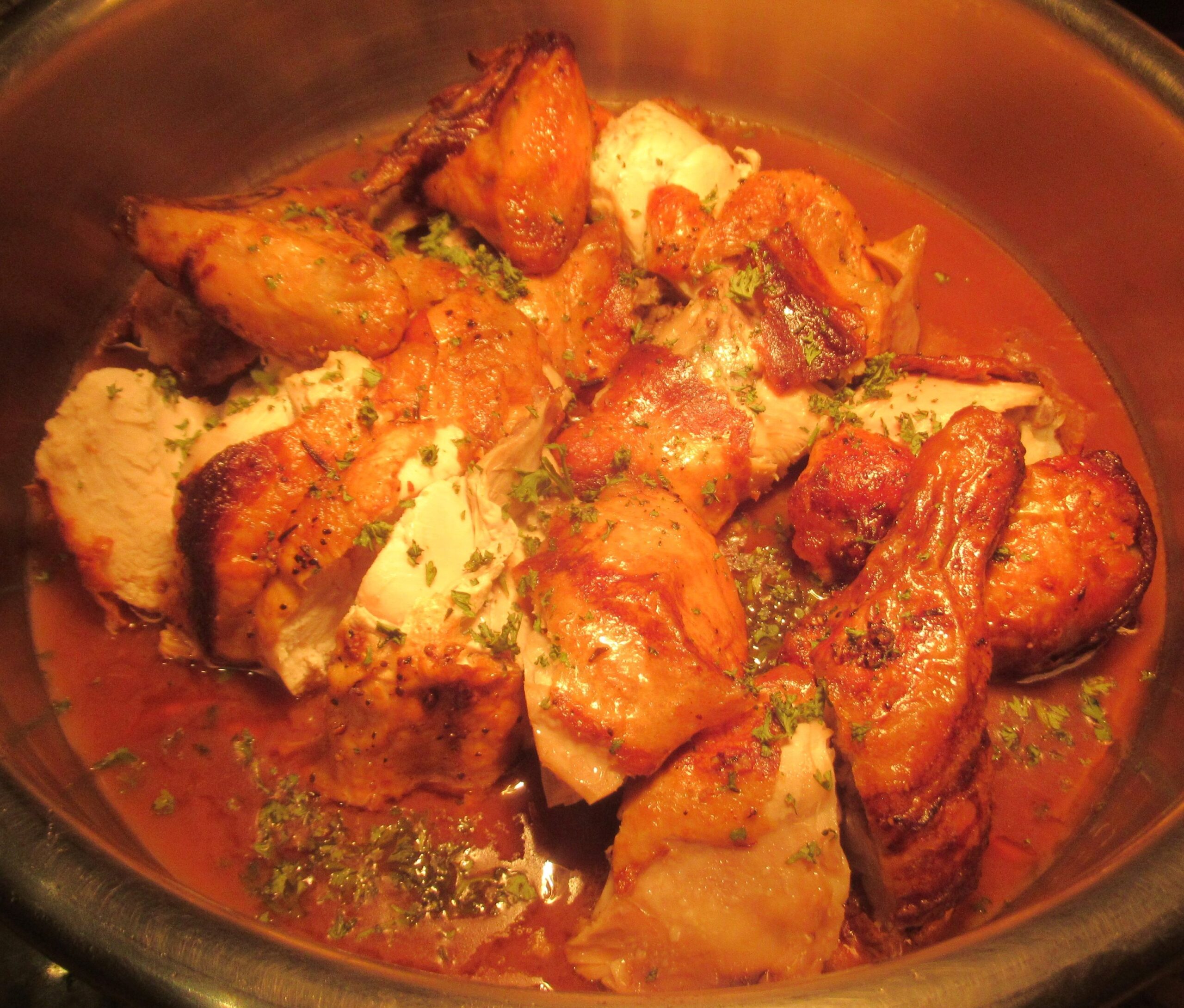
A six-pound chicken costs a fraction of what a fourteen-pound turkey does, and it fits in a single roasting pan with room to spare. Two weeks before Thanksgiving, it is also the cheapest rehearsal available for a meal that only gets one real attempt.
Running a full-scale practice with the actual oven, the actual probe thermometer, and the actual roasting pan surfaces problems that no amount of reading a recipe catches: an oven that runs hot in one corner, a thermometer that reads five degrees off, a pan that is a half-inch too wide for the rack it needs to sit on.
None of that is expensive to find out with a chicken. All of it is expensive to find out with a turkey, in front of guests, with no time to fix anything before dinner needs to be on the table.
- Cost of the rehearsal: roughly a fifth of what a turkey-day mistake costs in wasted bird and stress
- What to test: oven calibration, probe placement, resting time, and pan fit
- Timing: two weeks out gives enough runway to fix anything found
- Target: 165F in the thigh, checked away from the bone
- What repeats exactly: the same oven rack position and pan the turkey will use
- What does not scale directly: total cook time, which depends on weight, not just method
- Bonus: dinner for the household while the practice run happens
Why a six-pound chicken is the right stand-in
A chicken shares the same basic anatomy as a turkey: a breast that finishes faster than the thighs, a cavity that traps heat unevenly, and skin that needs to start dry to crisp properly. Every lesson learned roasting a chicken transfers directly to roasting the much larger bird two weeks later.
What does not transfer directly is the total time, since a chicken at a sixth the weight of an average turkey cooks in a fraction of the time regardless of oven or technique. The rehearsal is not about memorizing a number of minutes; it is about confirming the process, the equipment, and the reading on the thermometer.
A whole roasted chicken is also simply useful on its own. This is not two weeks of wasted food; it is a normal Sunday dinner that happens to double as a full-scale test of everything Thanksgiving depends on.
Oven calibration: the single most valuable thing this test reveals
Home ovens routinely run five, ten, or occasionally twenty degrees off their dial setting, and that gap is often consistent enough to matter but small enough that nobody notices until a recipe’s timing consistently comes out wrong. A chicken roasted at a stated 375F while an oven thermometer sits on the rack next to it reveals that gap directly.
An inexpensive oven thermometer, left clipped to a rack for the full roast, gives a real reading of what temperature the oven is actually holding, independent of what the dial claims. If it reads 15 degrees higher than the dial says, that is exactly the adjustment to make on Thanksgiving Day, rather than discovering the same fifteen-degree gap by watching a turkey brown too fast with no time to correct it.
This single check is worth doing even for a cook who has used the same oven for years, since ovens drift over time and a unit that ran accurately two years ago is not guaranteed to still be accurate now.
Probe placement: where readings go wrong
An instant-read or leave-in probe thermometer only reports the temperature at its exact tip, which means a probe that has drifted into a bone, rather than sitting in the center of the meat, gives a reading that can be off by ten degrees or more in either direction, since bone conducts and holds heat differently than surrounding muscle.
Practicing probe placement on a chicken, where the anatomy is smaller and more forgiving of a slightly wrong angle, builds the muscle memory for finding the thickest part of the thigh without touching bone, which is exactly where the same measurement needs to happen on a much larger, harder-to-navigate turkey.
This is also the moment to confirm the thermometer itself reads accurately, by testing it in a cup of ice water, where it should read close to 32F. A thermometer that reads 40F in ice water is off by eight degrees everywhere it is used, and finding that out on a chicken costs nothing compared to finding it out on the one bird that matters.
A Thanksgiving practice run, two weeks out
- Buy a chicken close in proportion to the turkey’s cooking method. If the turkey will be dry-brined, dry-brine the chicken the same way, scaled down.
- Roast it at the exact oven temperature and rack position planned for the turkey. Use the same roasting pan if it will fit, to test the fit itself.
- Clip an oven thermometer to the rack and record what it reads against the dial setting. Note any gap for Thanksgiving Day.
- Practice probe placement in the thigh, away from the bone, and confirm the reading against a second thermometer if one is available. Consistency between two thermometers is a good sign; a mismatch means one needs recalibrating.
- Pull the chicken at 165F in the thigh and rest it for the planned amount of time. Time the actual rest with a clock rather than guessing.
- Carve it the way the turkey will be carved. If a specific carving method or tool is planned for the turkey, this is the low-stakes place to practice it.
- Write down anything that surprised you. An oven running hot, a pan that did not fit as expected, a thermometer with a slow read time: all of it is useful information two weeks out and nearly useless information discovered on the day itself.
What the resting time actually teaches
Resting time is one of the most commonly rushed steps in a home-cooked roast, and a rehearsal is the place to actually time it with a clock rather than estimating. A chicken rested the planned fifteen to twenty minutes, timed and observed, gives a concrete sense of how much the internal temperature continues to climb during that window.
That carryover behavior scales differently with size. A much larger turkey holds its heat longer and its temperature can climb further during a rest than a chicken’s does, so the exact number of degrees observed on the chicken will not transfer directly, but the habit of resting for a measured, deliberate window rather than an approximate one does transfer, and that habit is worth building before the day it actually matters.
This rehearsal is also a good moment to test where the resting bird will actually sit, since a countertop near a drafty window cools food faster than one near a warm stove, a detail that matters more on the day a much larger, longer-resting turkey needs a stable spot to hold its heat.
The timing errors that only show up on a real bird
Reading a recipe’s stated cook time and roasting an actual bird are different experiences, and a rehearsal surfaces gaps that no amount of reading catches: an oven that takes longer than expected to preheat fully, a roasting pan that needs to be repositioned partway through because one side is browning faster than the other, or a smoke alarm triggered by rendered fat dripping onto an element.
None of these are unusual problems, and none of them are difficult to fix once identified. The value of finding them during a chicken rehearsal is that there is no dinner riding on the outcome, and there is time before Thanksgiving to address whatever the test revealed, whether that means moving an oven rack, buying a larger drip pan, or simply building in extra time for a preheat that runs slower than expected.
A cook who has already roasted one bird successfully in a given oven, with a given thermometer, using a given pan, walks into Thanksgiving morning with far less unknown than one who is doing all of it for the first time on the day itself.
What scales directly from chicken to turkey, and what does not
| Factor | Scales directly | Needs separate calculation |
|---|---|---|
| Target internal temperature | yes, 165F in the thigh either way | – |
| Oven’s real temperature versus dial | yes, the gap is consistent regardless of bird size | – |
| Probe placement technique | yes, same anatomy, larger scale | – |
| Total roasting time | – | no, depends heavily on total weight |
| Carryover temperature rise during rest | – | no, larger mass climbs more and longer |
Treating the rehearsal as a proof of process rather than a proof of exact timing keeps expectations calibrated correctly. The chicken will not predict the turkey’s total roasting time to the minute, but it will predict nearly everything else that determines whether the actual cook day goes smoothly.
Handling raw poultry safely during the rehearsal
The same food safety rules that apply to a turkey apply in full to the practice chicken: never rinse raw poultry in the sink, since it spreads bacteria across surrounding surfaces rather than removing it, and wash hands, the cutting board, and any surface the raw bird touched thoroughly with hot soapy water immediately after handling.
Cooking to a verified 165F in the thigh, rather than trusting a visual cue like clear juices or a certain color, is the actual safety threshold, and confirming the thermometer’s accuracy during this rehearsal, as covered above, is directly a food safety practice, not just a technique exercise.
Leftover chicken from the rehearsal should go into the refrigerator within two hours of coming off the heat, the same two-hour rule that will apply to turkey leftovers after the holiday meal itself.
Turning the rehearsal into an actual dinner
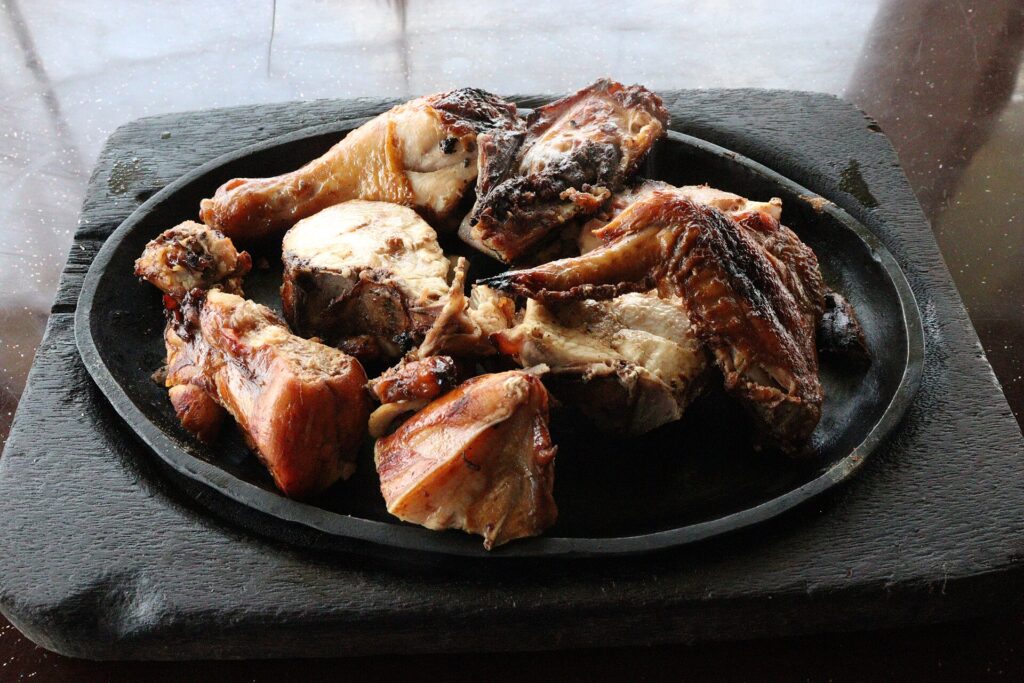
A roasted chicken two weeks before Thanksgiving is not a sacrifice made purely for practice; it is a complete, satisfying dinner on its own, and treating the rehearsal as a normal weeknight or weekend meal rather than a chore makes the whole exercise easier to justify and more likely to actually happen.
Leftover chicken carves into sandwiches, gets folded into a quick soup, or turns into a simple weeknight risotto the following day, which means the cost of the rehearsal is close to zero once the household eats the results across a couple of meals.
The only real cost is the roughly hour and a half of active attention the roast requires, and that is a small price for walking into Thanksgiving with a calibrated oven, a trusted thermometer, and a rehearsed process rather than four unknowns converging on the one day with no room for a second attempt.
What to write down before the actual day
A short note, even just a few lines on a phone or a piece of paper stuck to the refrigerator, capturing the oven’s real temperature versus its dial, the rack position that worked best, and any pan-fit issue discovered, turns this rehearsal into something more useful than a one-time exercise.
That note is what gets checked again on Thanksgiving morning, and it is what prevents the same oven-temperature guesswork from happening twice. A rehearsal without a written record is still useful in the moment but loses most of its value by the time the actual cook day arrives two weeks later and memory has faded.
Two weeks, a six-pound chicken, and an oven thermometer clipped to a rack answer more questions than any recipe can, and they answer them while the stakes are still just dinner.
Frequently Asked Questions
Do I need to dry-brine the practice chicken the same way I plan to dry-brine the turkey?
It helps, since it lets you practice the salting and timing process itself, but it is not strictly necessary if the goal is mainly to test the oven and thermometer. A simply salted chicken still tests the equipment side of the rehearsal fully.
What if my oven thermometer and my dial agree, with no gap at all?
That is a good outcome. It means the oven can be trusted at its stated setting, and the rehearsal still served its purpose by confirming that rather than leaving it as an assumption going into Thanksgiving.
Is a five-pound chicken close enough, or does it need to be closer to six?
Either works fine for this purpose. The exact weight matters far less than actually running the full process once with real equipment; a four or five-pound bird still surfaces the same oven and thermometer issues a six-pound one would.
Should I test the same brand of roasting pan I plan to use for the turkey?
Yes, if possible. Pan material and shape affect browning and how evenly heat reaches the bird, so testing with the actual pan gives a more accurate rehearsal than testing with a different one and hoping the results transfer.
How far in advance should I buy the practice chicken?
A day or two ahead is plenty for a fresh chicken; frozen ones need more lead time to thaw safely in the refrigerator, generally about 24 hours for every four to five pounds, which for a chicken this size is well under a full day.