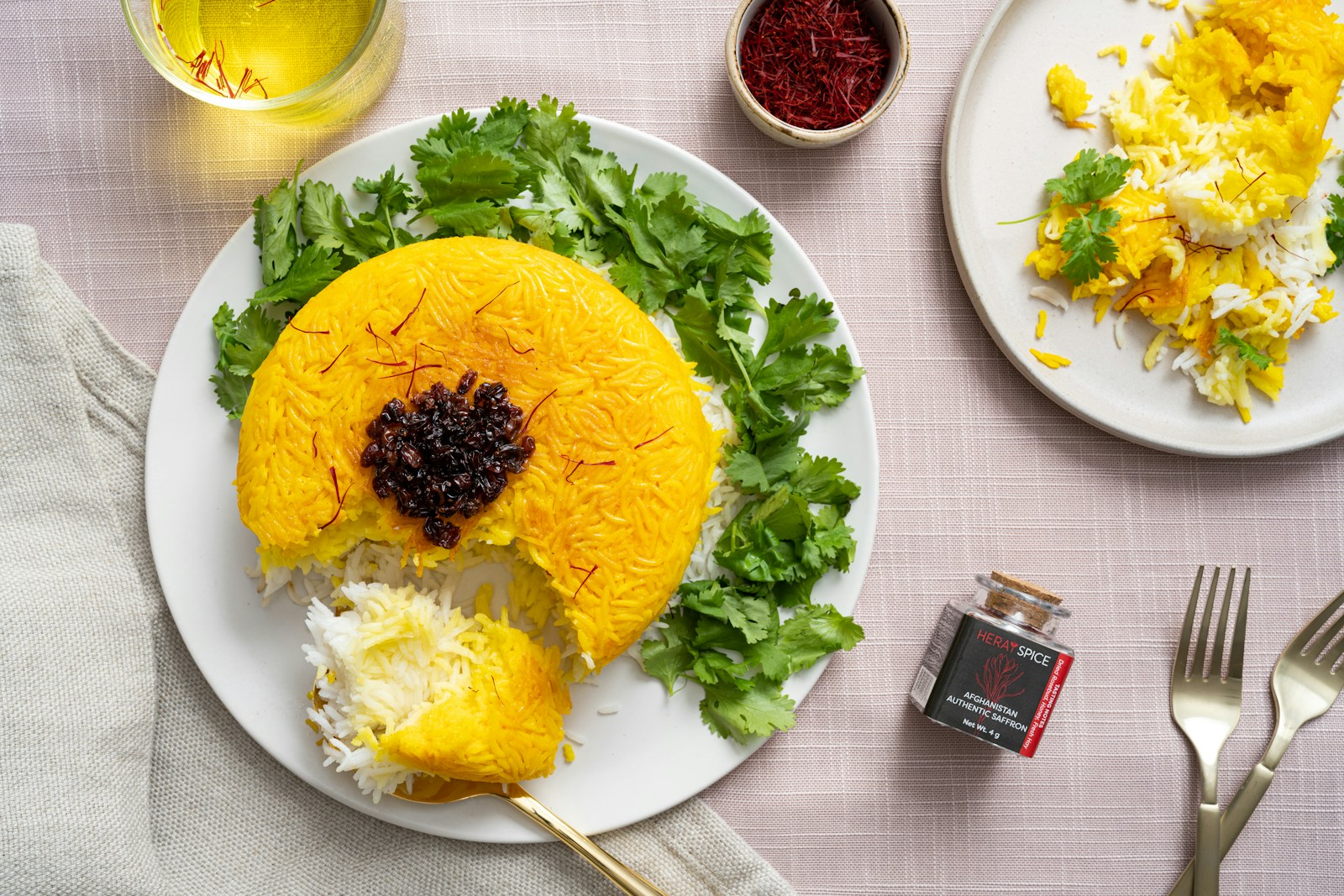
When a tahchin is flipped successfully — when the platter comes down on top of the pot, the pot comes up in a confident arc, and the cake lands intact, golden as an ingot, its saffron-stained crust crackling as it settles — the kitchen goes quiet. Every Persian home cook knows this moment. It is the single most theatrical plating gesture in Iranian cuisine, and it is also the most precarious. Tahchin is the dish that announces that tonight is not an ordinary Tuesday. It is someone’s birthday, or Nowruz, or the cousin from Tehran is visiting, or you have finally decided that three hours of cooking is exactly how you want to spend an afternoon. There is no casual tahchin.
The name is geometry. Tah means bottom. Chin means arranged, layered. Tahchin is, literally, the thing that has been arranged at the bottom — the saffron-bound crust that forms the visible, photogenic surface of the finished dish once it is inverted. It is a distillation of the Persian rice obsession. Every Iranian rice dish produces some form of tahdig — the crisp bottom layer that is the single most competed-for morsel in a Persian household — but tahchin is the one dish where the tahdig becomes the entire point. Instead of being a thin golden wafer underneath the fluffy chelow, the tahchin crust is thick, structural, and bound by yogurt and egg yolks into something closer to a savory soufflé with a crackling lacquered shell.
Najmieh Batmanglij, the Iranian-born cookbook author whose Food of Life has been the English-language bible of Persian cooking for almost forty years, writes that tahchin “is the dish that teaches Iranians abroad that they can still be Iranian, even without the right basmati.” Samin Nosrat’s Iran chapter in Salt Fat Acid Heat devotes pages to the physics of a proper tahdig — the butter, the heat, the steam management — and calls the technique “the most satisfying single gesture in any cuisine I have cooked in.” The admiration is warranted. Tahchin is not difficult so much as deliberate. Every step has a reason. Understanding those reasons is the difference between a tahchin that releases in a golden ingot and one that sticks to the bottom of the pot in heartbreaking shards.
The Soul of Persian Rice
To understand tahchin is to understand something older and deeper: the Persian relationship with rice. Rice arrived in Iran from India over a thousand years ago and quickly became the central carbohydrate of the Persian table, displacing bread from the position of honor. Unlike in most of the Middle East and North Africa, Iranian rice is not a side dish. It is the main event around which the rest of the meal is arranged. A Persian home cook will spend as much time on the rice as on the protein, sometimes more. The techniques are specific, non-interchangeable, and defended fiercely. There is no substitute for parboiling and then steaming the rice separately. There is no excuse for short-grain rice. And there is certainly no acceptable version of tahchin made without saffron.
The rice itself matters. Iranian basmati — long-grain, aromatic, aged — is the gold standard, but high-quality aged Indian basmati is a close second and much easier to source outside Iran. Look for the word “aged” on the package; aged basmati has been stored for at least twelve months (often up to two years), which reduces moisture content, firms the starch structure, and produces the long, separated grains Persian cooks worship. Brands like Tilda, Lal Qilla, and Pari are widely available in the United States and meet the standard. Generic American long-grain rice will not work. Jasmine rice will definitely not work. The grain structure is different; the result will be gummy.
The Saffron Problem
Saffron is the most expensive spice in the world by weight, and Iran produces roughly 90 percent of the global supply, most of it from the region around Mashhad and the town of Qa’enat. The best threads are long, deep red (not yellow), and brittle-dry when crumbled between the fingers. Stale or low-grade saffron is a false economy. Two grams of real saffron is worth more than fifty grams of counterfeit. At home, the test is simple: crush a thread between your fingers. Real saffron leaves a bright orange-red stain immediately; adulterated saffron leaves only yellow or nothing at all.
Never add saffron threads directly to a hot dish. The flavor and color compounds are water-soluble and need time to extract. The Persian method is universal: grind the dry threads with a mortar and a pinch of sugar (which helps break down the brittle filaments into a fine powder), then bloom the powder in three tablespoons of hot — not boiling — water for at least twenty minutes. Boiling water denatures some of the aromatic compounds; stick with water that is just off the boil. A properly bloomed saffron liquid is deep, opaque, and red-orange, with a perfume that is complex and slightly medicinal. That liquid is what flavors the dish.
The yogurt matters too. Use full-fat Greek yogurt or, if you can find it, Persian-style strained yogurt (maast). The fat content is what creates the creamy binding that holds the rice grains in a cohesive cake; low-fat yogurt weeps water and produces a soggy crust. Sour cream is not a substitute — it lacks the tang and the structure. The egg yolks contribute both binding and color, and they must be yolks only: whole eggs introduce too much water, and the whites tend to puff up and produce an unpleasant soufflé-like sponginess instead of the dense, almost lacquered crust you are after.
The Two-Stage Rice Technique
Persian rice cookery is a two-stage process: parboil first, then steam. For tahchin, the parboil stage is critical. The rice must be cooked to a specific point — al dente, tender on the outside but still firm in the center — because it will continue to cook for over an hour in the oven. Undercooked rice at the parboil stage produces chalky grains; overcooked produces a gummy, pasty crust. Six to seven minutes in heavily salted boiling water is the standard. Test by biting a grain: the outer layer should give way, but the core should still resist slightly. That window is brief; have your colander ready.
After parboiling and draining, the rice is split into two populations. About one-third is folded into the saffron-yogurt-egg batter and becomes the tahdig layer. The remaining two-thirds stays plain and becomes the cushioning layer above the chicken. This separation is what gives tahchin its internal structure when inverted: a dense, crackling golden crust on top, a fluffy stratum of saffron-tinted rice underneath, tender chicken in the middle, and more fluffy rice below. Each layer has a role. Each layer tastes slightly different. The textural contrast is what separates tahchin from a generic rice bake.
Tahchin vs. Other Persian Rice Dishes
If you are new to Persian rice cookery, the landscape can be confusing. Here is how tahchin relates to its cousins:
| Dish | Key Technique | Shape When Served | Occasion |
|---|---|---|---|
| Chelow | Parboil + steam, plain basmati | Fluffy mound, thin tahdig | Daily, with any main |
| Polow | Chelow method + folded ingredients | Mound with fruit/herbs/nuts mixed in | Guests, Nowruz |
| Tahchin | Yogurt-egg-saffron layered bake | Inverted cake with thick saffron crust | Celebrations, guests |
| Morasa polow | Jeweled polow with dried fruits/nuts | Saffron mound with jewels on top | Weddings, New Year |
| Adas polow | Rice layered with lentils, raisins, dates | Layered mound with date-raisin topping | Weeknight, comfort |
Ingredients
- 3 cups (600 g) aged Iranian or Indian basmati rice
- 1½ lb (680 g) boneless, skinless chicken thighs
- 1 large yellow onion, grated
- 2 cups (480 g) full-fat Greek yogurt
- 4 large egg yolks
- ½ teaspoon high-quality saffron threads, ground and bloomed in 3 tablespoons hot water
- 3 tablespoons fine sea salt, divided
- 1 teaspoon freshly ground black pepper
- 1 teaspoon ground turmeric
- ½ teaspoon ground cardamom
- 6 tablespoons unsalted butter, melted
- 3 tablespoons neutral oil (grapeseed or sunflower)
- 2 tablespoons fresh lemon juice
- ¼ cup (35 g) dried barberries (zereshk), rinsed (optional but traditional)
- 1 tablespoon sugar, for plumping the barberries
- ¼ cup (30 g) slivered pistachios, for garnish
- ¼ cup (30 g) slivered almonds, lightly toasted (optional)
Making It
- Rinse and soak the rice. Place the basmati in a large bowl and rinse under cool water, swirling with your hand, until the water runs nearly clear. This typically takes four or five changes of water. Drain, then cover with fresh cool water by three inches. Add two tablespoons of salt and stir to dissolve. Soak for at least two hours, ideally four to six. This step is non-negotiable. Unsoaked basmati produces short, broken grains.
- Bloom the saffron. Grind saffron threads with a small pinch of sugar in a mortar to a fine red powder. Place in a small bowl or cup, pour over three tablespoons of hot (just off the boil) water, cover with a saucer or plastic wrap, and let bloom for at least twenty minutes. The liquid should develop into a deep, glowing orange-red.
- Cook the chicken. Place chicken thighs in a medium pot with the grated onion, turmeric, one teaspoon salt, black pepper, and just enough water to barely cover (about 2 cups). Bring to a gentle simmer and cook, covered, for 25 to 30 minutes until fully tender and cooked through. Let cool in the broth. Reserve ¼ cup of the cooking liquid for the batter. Shred the cooled chicken into large bite-size pieces, discarding any cartilage or hard fat.
- Parboil the rice. Bring four quarts of water with two tablespoons of salt to a rolling boil in a wide pot. Drain the soaked rice. Add the rice to the boiling water, stir once gently, and boil uncovered for exactly six to seven minutes. Test a grain: the outer layer should be tender, the core should still have slight resistance. Drain immediately in a fine-mesh colander and give a brief rinse with cool water to stop cooking. Set aside.
- Make the tahchin batter. In a large bowl, whisk together the yogurt, egg yolks, one-half cup of the bloomed saffron water (reserve the rest for drizzling), one tablespoon lemon juice, the cardamom, ¼ cup of the reserved chicken broth, and one teaspoon salt. Whisk vigorously for 30 seconds until the mixture is completely smooth, uniform, and a vivid saffron-yellow color. Taste and adjust salt — it should taste pleasantly seasoned on its own, as the plain rice underneath will be less seasoned.
- Fold the saffron rice layer. Scoop about one-third of the parboiled rice into the batter. Use a rubber spatula to fold gently until every grain is coated in the yellow mixture. Do not overmix or stir too aggressively — the rice grains should stay intact.
- Assemble and bake. Preheat oven to 350°F (175°C). Brush a 10-inch non-stick oven-safe pot (with a snug lid) or a deep 10-inch Pyrex dish with three tablespoons of the melted butter — be generous along the entire bottom and sides. Spread the saffron-yogurt rice evenly across the bottom and press firmly with the back of a spatula until the layer is compact and smooth. Layer the shredded chicken on top in a single even layer. Cover with the remaining plain parboiled rice, mounding gently. Drizzle the remaining melted butter and two tablespoons of the bloomed saffron water over the top. Cover tightly with a layer of aluminum foil, then the pot lid.
- Bake undisturbed. Place the pot on the middle rack of the oven. Bake for one hour and fifteen minutes. Do not open the oven before the one-hour mark; the steam needs to remain trapped. A properly baked tahchin should have a deep golden, crackling crust at the bottom; you will smell it before you see it — a faint caramelized perfume will escape toward the end.
- Prepare the barberries. In the last ten minutes, rinse the barberries in cool water, shaking vigorously to remove any grit (they are notorious for hiding small stones). Drain well. Melt one tablespoon of butter in a small skillet over medium-low heat. Add the barberries and one tablespoon of sugar. Stir for 60 seconds only — until glossy and plump. Barberries burn to bitter black in an instant; watch them closely. Remove from heat.
- Rest and flip. Remove the pot from the oven. Let rest, covered, for ten minutes — this allows the crust to firm up and release slightly from the pan. Run a thin knife or offset spatula around the edge to loosen. Place an inverted serving platter flat on top of the pot. Grasping firmly with both hands (oven mitts!), flip the pot and platter together in a single confident motion. Lift the pot straight up. If all is well, the tahchin will release as a golden cake with the saffron crust on top. If a patch sticks to the pan, scrape it gently with a spatula and patch it into place — no one will know. Scatter the barberry mixture, slivered pistachios, and toasted almonds over the top. Serve immediately, cut into wedges like a cake.
Common Mistakes
Tahchin rewards patience and punishes shortcuts. The most frequent errors:
- Skipping the rice soak. Unsoaked basmati absorbs water unevenly during parboiling and produces broken, short grains. Two hours is the minimum; four is better.
- Adding saffron threads directly to the dish. Saffron must be ground and bloomed in hot water for at least 20 minutes to release its full flavor and color. Un-bloomed saffron produces a pale, underwhelming tahchin.
- Using low-fat yogurt. The fat is what binds the crust. Low-fat yogurt weeps water and produces a soggy, structurally weak tahdig.
- Using whole eggs instead of yolks. Egg whites contribute water and produce a spongy, soufflé-like texture instead of the dense lacquered crust you want.
- Not greasing the pot generously. The butter at the bottom of the pot is what allows the tahchin to release cleanly. Skimp here and you will have a broken, sticking disaster.
- Opening the oven during baking. The trapped steam is essential. Every opening drops the oven by 50+ degrees and extends cook time.
- Flipping too soon or too late. Too soon (no rest), and the crust has not firmed and will crack. Too late (over 20 minutes), and the moisture re-absorbs and the crust softens.
What to Serve With It
Tahchin is a complete meal in itself — rice, protein, crust, jeweled toppings — but a Persian table never has just one dish. The traditional accompaniments are sabzi khordan, a platter of fresh herbs (mint, basil, tarragon, radishes, scallions) and feta cheese with flatbread; mast-o-khiar, a yogurt-cucumber dip seasoned with dried mint and crushed rose petals; and torshi, the puckering vegetable pickles that cut through the richness of the rice. A salad of chopped cucumber, tomato, and onion (salad Shirazi) with lemon and dried mint rounds out the plate perfectly.
For a more elaborate Persian dinner, consider pairing tahchin with a light stew like khoresh-e fesenjan (chicken in walnut-pomegranate sauce) or a simple grilled kebab. If your guests are approaching Persian food for the first time, serve it with nothing more than the yogurt dip and the herb platter — let the tahchin itself do the work of introduction. For another dish that showcases the dramatic plating of rice with protein, our seafood paella guide covers the Spanish tradition — different technique, similarly celebratory. For another saffron-forward recipe, butter chicken uses saffron less centrally but demonstrates a related Indian approach to layered aromatic cooking.
Storage and Reheating
Leftover tahchin keeps well for three days refrigerated in an airtight container. The crust will soften overnight, which is unavoidable; accept this trade-off. To reheat, slice into wedges and warm in a covered skillet with two tablespoons of water over low heat for five to seven minutes, until the rice is hot throughout. A 350°F oven for ten to twelve minutes also works and is gentler. Do not microwave — the rice dries and the yogurt crust turns rubbery.
Tahchin is not a dish that freezes well; the delicate rice structure and yogurt binding do not survive the thaw. If you are planning ahead for a dinner party, you can do everything up to assembling the pot the day before, refrigerate covered overnight, and bake the next day — add ten extra minutes to the bake time to account for the cold start. The chicken can be cooked up to two days ahead. The bloomed saffron water keeps for one week in the refrigerator and can be made in advance.
Frequently Asked Questions
What is tahdig, and how is it different from tahchin?
Tahdig literally means “bottom of the pot” in Farsi. It refers to the golden, crisp rice crust that forms at the bottom of any Persian-style steamed rice — a prized element in every Iranian household, often fought over at the dinner table. Tahchin is a specific dish in which the tahdig concept is elevated: the bottom layer of rice is bound with saffron, yogurt, and egg yolks to create a thicker, more structured crust that holds its shape when inverted. Tahdig is a component of most Persian rice; tahchin is a dish built around making that component the centerpiece.
Why does the saffron need to be bloomed in water?
Saffron’s flavor and color compounds — primarily picrocrocin and crocin — are water-soluble and release slowly. Grinding the threads first increases surface area, and blooming them in hot (not boiling) water for at least 20 minutes extracts the maximum color and aroma. Adding dry saffron threads directly to a dish produces an uneven distribution and wastes much of the spice’s potency. The bloomed liquid should be a deep, glowing red-orange. The depth of color is a direct measure of saffron quality — pale yellow suggests old or adulterated threads.
Can I make tahchin without a non-stick pot?
Yes, but use a heavy glass Pyrex dish instead. Traditional Persian cooks use a heavy-bottomed pot with a snug lid and a clean dish towel stretched under the lid to absorb steam, creating the dry environment that produces a proper crust. For home cooks without a non-stick pot, a well-oiled Pyrex baking dish works beautifully — the glass conducts heat gently, the butter prevents sticking, and the transparent sides let you see the crust developing. Cast iron is not recommended unless seasoned to near-non-stick perfection; the acid in yogurt can also react with reactive metals.
What are barberries and can I substitute something else?
Barberries, called zereshk in Farsi, are tiny, tart, brilliantly red dried berries from the Berberis vulgaris shrub, widely used in Persian cuisine as a bright tart counterpoint to rich rice dishes. They are briefly sautéed with butter and a pinch of sugar before serving and sprinkled over tahchin. In the United States, look for them in Persian or Middle Eastern markets, or order online from Sadaf or Kalamala. Good substitutes include dried cranberries (soak in water 5 minutes first, then sauté) or fresh pomegranate seeds scattered raw. Currants are a distant third choice. The role is acidic contrast, not bulk.
Sources
- NYT Cooking — Persian Tahchin — Samin Nosrat’s detailed guide to the flipping technique and saffron-yogurt ratio.
- Saveur — Persian Food Guide — Broader context on Persian rice technique and regional variations.
- USDA FoodData Central — Basmati Rice — Nutritional profile used for per-serving calculations.
Each serving contains roughly 528 calories, 32 g protein, 22 g fat, 52 g carbohydrates, and 2 g fiber — based on 6 servings using basmati rice, chicken thighs, full-fat Greek yogurt, and butter. Sodium reflects the salt used in both the rice water and the batter.
Please note: Nutritional estimates are derived from the USDA FoodData Central database and may vary depending on specific brands of rice, yogurt, and chicken. This recipe contains dairy and egg. Nothing in this article should be interpreted as medical or dietary guidance. If you have food allergies, sodium-sensitive conditions, or specific dietary needs, consult a registered dietitian or healthcare provider before preparing this recipe.

Tom Nakamura
Tom learned to cook from his obaachan during summers in Japan - pickling daikon at the kitchen table, watching her stir miso into broth without ever measuring. Later, family trips with cousins took him through markets in Bangkok, Shanghai, and Hanoi, and the food stuck with him. His writing focuses on making authentic Asian techniques accessible to home cooks without diluting the technique or the culture that defines them. He handles Chinese, Japanese, Korean, Thai, Vietnamese, Indian, and Middle Eastern recipes at the publication.