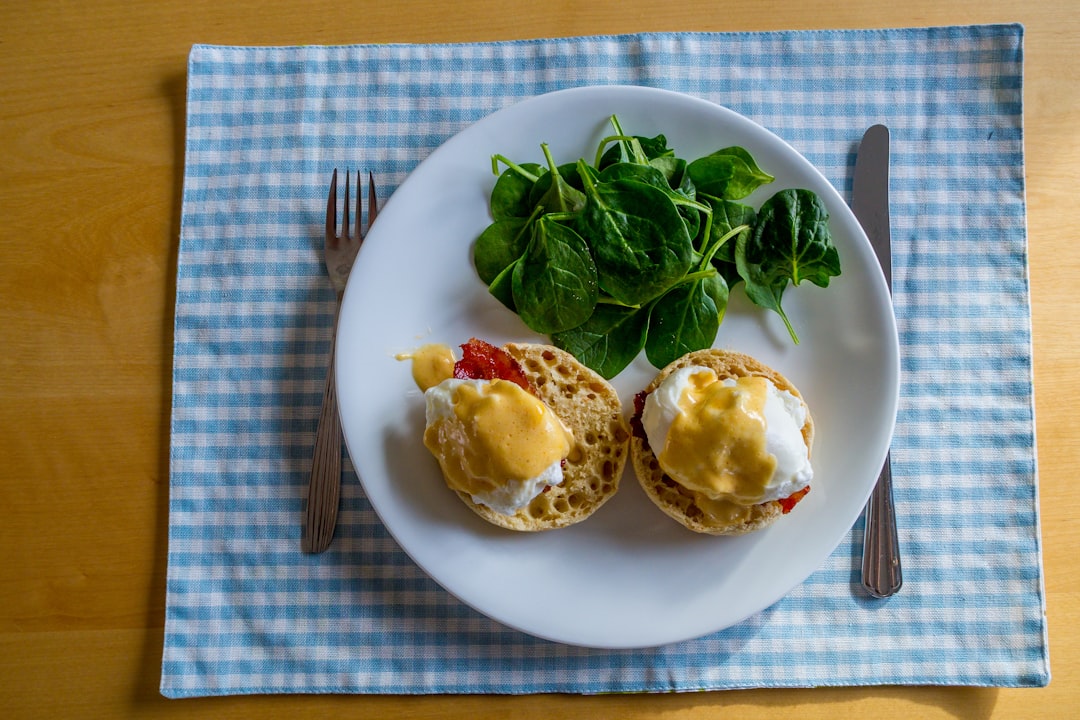
There is a reason eggs Benedict has survived more than a century as the undisputed king of brunch. The combination of a toasted English muffin, savory Canadian bacon, a trembling poached egg, and a cascade of warm hollandaise sauce is one of the most satisfying bites in the entire breakfast canon. It is also one of the most intimidating recipes for home cooks — and it absolutely should not be.
I have served eggs Benedict to weekend guests more times than I can count, and the version below is the one that finally convinced me this dish belongs in a home kitchen, not just a restaurant. The hollandaise uses an immersion blender, which takes the fear out of the emulsion entirely. The poached eggs use a method refined over dozens of attempts. And the whole plate comes together in about 30 minutes, which is faster than most brunch restaurants will seat you.
The key insight that changed everything for me was understanding that eggs Benedict is not one difficult recipe — it is four simple components assembled at the right moment. Master each piece individually, and the assembly becomes almost effortless. Let me walk you through every detail so you can pull this off with confidence, even on a lazy Saturday morning with coffee in hand.
Classic Eggs Benedict with Hollandaise
Prep Time: 15 minutes
Cook Time: 15 minutes
Total Time: 30 minutes
Servings: 4 (8 halves)
Difficulty: Medium
Cuisine: American / French
Ingredients
Hollandaise Sauce
- 3 large egg yolks
- 1 tablespoon fresh lemon juice
- 1/2 teaspoon Dijon mustard
- 10 tablespoons (1 1/4 sticks) unsalted butter, melted and hot
- Pinch of cayenne pepper
- 1/4 teaspoon kosher salt, plus more to taste
- 1 teaspoon warm water, if needed to thin
Poached Eggs
- 8 large eggs, as fresh as possible
- 2 tablespoons white vinegar
- 1 teaspoon kosher salt
- Water (about 4 inches deep in a wide saucepan)
Assembly
- 4 English muffins, split and toasted
- 8 slices Canadian bacon (or back bacon), about 1/4 inch thick
- 1 tablespoon unsalted butter, for warming the bacon
- Fresh chives, finely chopped, for garnish
- Freshly cracked black pepper
- Smoked paprika, for garnish (optional)
Instructions
- Make the hollandaise (immersion blender method). Place egg yolks, lemon juice, Dijon mustard, cayenne, and salt in a tall, narrow container (the cup that came with your immersion blender is ideal). Melt the butter in a small saucepan until fully liquid and bubbling hot — the temperature matters because the hot butter gently cooks the yolks on contact, creating a safe and stable sauce. Place the immersion blender at the bottom of the container and turn it on. Slowly pour the hot melted butter in a thin, steady stream while blending. The sauce will emulsify within 30 seconds into a thick, creamy, pale yellow hollandaise. Taste and adjust salt and lemon. If the sauce is too thick, blend in warm water one teaspoon at a time. Cover the container and set it in a bowl of warm water to keep the hollandaise at serving temperature while you prepare everything else.
- Prepare the poaching water. Fill a wide, deep saucepan or sauté pan with about 4 inches of water. Add the white vinegar and salt. Bring to a temperature between 180°F and 190°F (82°C–88°C) — you want small bubbles forming on the bottom of the pan but no rolling boil. A gentle simmer is the goal. If the water boils, it will tear the egg whites apart.
- Crack each egg into a fine-mesh strainer. This is the professional trick that guarantees clean poached eggs every time. Crack each egg into a fine-mesh strainer set over a small bowl. The thin, watery outer white will drain away in about 10 seconds, leaving only the tight inner white surrounding the yolk. Transfer the strained egg to a small ramekin or cup. Repeat with all eggs.
- Poach the eggs. Gently lower each egg from its ramekin into the simmering water. You can poach 4 eggs at a time in a wide pan. Do not stir or disturb the water. Set a timer for exactly 3 minutes for a runny yolk, or 4 minutes for a yolk that is jammy but not fully set. Remove each egg with a slotted spoon and place on a plate lined with a clean kitchen towel to drain excess water. Season each egg with a pinch of salt.
- Warm the Canadian bacon. While the eggs poach, melt one tablespoon of butter in a skillet over medium heat. Add the Canadian bacon slices and cook for about 90 seconds per side until lightly golden and warmed through. The edges should just begin to curl. Set aside on a warm plate.
- Toast the English muffins. Split the muffins and toast them until golden and crisp. You want a sturdy surface that will support the weight of the bacon, egg, and sauce without becoming soggy. A toaster works, but I prefer the broiler for a more even, crispier result.
- Assemble. Place two muffin halves on each plate, cut side up. Top each half with a slice of Canadian bacon, then a poached egg. Spoon a generous amount of hollandaise over the top — at least 2 tablespoons per egg, letting it cascade down the sides. Garnish with chopped chives, cracked black pepper, and a light dusting of smoked paprika if desired.
- Serve immediately. Eggs Benedict waits for no one. The hollandaise cools, the egg yolk sets, and the muffin absorbs moisture. Get it to the table within 2 minutes of assembly.
The Art of Poaching Eggs
Poaching eggs is the step that scares most home cooks away from eggs Benedict, but once you understand the science, it becomes routine. There are three variables that determine success: egg freshness, water temperature, and that fine-mesh strainer trick.
Why Egg Freshness Matters
A fresh egg has two distinct layers of white: a thick inner layer that clings tightly to the yolk, and a thin outer layer that spreads freely. As eggs age, the thick inner white gradually breaks down and becomes thin. This is why old eggs produce those wispy, ragged poached eggs with tentacles spreading everywhere. According to J. Kenji Lopez-Alt’s extensive egg-poaching tests at Serious Eats, eggs less than one week old produce the most compact, beautiful results. Check the pack date on your carton (it is the three-digit Julian date) and count forward.
The Vinegar Trick Explained
Adding white vinegar to the poaching water is not an old wives’ tale — it has a real chemical basis. Vinegar (acetic acid) lowers the pH of the water, which causes the egg white proteins to denature and coagulate faster. The result is that the outer white sets more quickly, wrapping around the yolk before it has a chance to spread. One to two tablespoons per quart of water is the sweet spot. More than that and you can taste the vinegar in the finished egg.
Water Temperature: The Non-Negotiable Detail
The ideal poaching temperature is between 180°F and 190°F (82°C–88°C). At a full rolling boil (212°F / 100°C), the turbulent water tears the delicate egg white into shreds. At too low a temperature, the white never sets properly and you get a shapeless, translucent mass. Small bubbles on the bottom of the pan with an occasional bubble rising to the surface is your visual indicator. If you have an instant-read thermometer, use it until you can recognize the right simmer by sight.
The Vortex Method: Does It Work?
Many recipes recommend creating a whirlpool in the water and dropping the egg into the center, claiming the spinning motion wraps the white neatly around the yolk. In practice, this method only works for a single egg and is unreliable even then. The fine-mesh strainer method described above produces better, more consistent results and allows you to poach four eggs simultaneously. Skip the vortex.
Hollandaise Without Fear
Traditional hollandaise requires whisking egg yolks over a double boiler while slowly drizzling in clarified butter — a process that demands constant attention and punishes any lapse with scrambled eggs or a broken sauce. The immersion blender method produces an identical result in 60 seconds with virtually zero risk of failure.
Immersion Blender Method vs. Traditional Double Boiler
The immersion blender works because the high-speed blade creates an extremely powerful shearing force that breaks the butter into microscopic droplets, each one immediately coated by the lecithin in the egg yolks. The emulsion forms almost instantly and is remarkably stable. The traditional double boiler achieves the same result through gradual incorporation and constant whisking, but it requires more skill and attention. For a weekday brunch, the immersion blender wins every time. For a formal dinner where you want absolute control over texture and thickness, the double boiler gives you finer precision.
Rescuing a Broken Hollandaise
If your hollandaise separates (you will see pools of melted butter floating on a curdled yellow mass), do not throw it away. Place one tablespoon of warm water in a clean bowl. Slowly whisk the broken sauce into the water, adding a tablespoon at a time. The fresh water provides new space for the emulsion to re-form. Alternatively, blend a fresh egg yolk in the immersion blender cup and slowly pour the broken sauce into it while blending. The new yolk provides fresh emulsifying power.
The Science of Emulsion
Hollandaise is a warm emulsion — a stable mixture of two liquids that normally do not combine (in this case, water from the egg yolks and lemon juice, and fat from the butter). The magic ingredient is lecithin, a phospholipid naturally present in egg yolks. Each lecithin molecule has a water-loving head and a fat-loving tail, which allows it to sit at the boundary between a water droplet and the surrounding fat, preventing them from separating.
The reason hollandaise must be served warm (not hot, not cold) is that temperature affects the stability of this emulsion. Above 160°F (71°C), the egg yolk proteins overcook and lose their emulsifying ability, causing the sauce to break. Below 100°F (38°C), the butter begins to solidify, turning the sauce thick and greasy. The sweet spot is 120°F to 145°F (49°C–63°C). Keeping your hollandaise in a bowl of warm (not hot) water maintains this temperature range easily.
The ratio of fat to emulsifier also matters. Each egg yolk can emulsify approximately 3 to 4 tablespoons of butter reliably. Push beyond that ratio and the yolk runs out of lecithin, leaving un-emulsified butter that will eventually separate. This recipe uses a conservative ratio of roughly 3.3 tablespoons of butter per yolk, which keeps the sauce well within the safe emulsification zone.
Eggs Benedict Variations
| Variation | Protein Swap | Base Swap | Sauce Adjustment | Best For |
|---|---|---|---|---|
| Eggs Florentine | Sautéed spinach | English muffin | Add pinch of nutmeg to hollandaise | Vegetarian brunch |
| Eggs Royale / Hemingway | Smoked salmon (lox) | English muffin | Extra lemon juice, garnish with dill | Special occasions |
| California Benedict | Sliced avocado + bacon | Sourdough toast | Add sriracha to hollandaise | Brunch crowd-pleaser |
| Mushroom Benedict | Roasted portobello caps | Portobello as base | Add truffle oil to hollandaise | Low-carb / keto |
| Tex-Mex Benedict | Chorizo | Corn cake or arepa | Chipotle hollandaise (add 1 tsp adobo sauce) | Bold flavor lovers |
| Crab Cake Benedict | Mini crab cake | English muffin | Add Old Bay seasoning to hollandaise | Seafood lovers |
Why This Recipe Works
Every element in this dish is engineered for a specific textural and flavor role. The English muffin provides a sturdy, craggy base with nooks that catch the hollandaise. The Canadian bacon adds a salty, smoky, meaty layer that contrasts with the richness of the egg and sauce. The poached egg contributes a liquid yolk that acts as a second sauce when cut — the mingling of warm yolk and hollandaise is the defining moment of the dish. And the hollandaise itself delivers the luxurious, buttery richness that ties everything together with a sharp hit of lemon to cut through the fat.
The reason this combination has endured since the 1890s is that it hits every part of the palate: salt from the bacon, acid from the lemon, fat from the butter and yolk, umami from the egg and meat, and a subtle sweetness from the toasted muffin. It is nutritionally excessive and unashamedly so — this is a celebration dish, not a daily health food.
Substitution Guide
| Original Ingredient | Substitute | Notes |
|---|---|---|
| Canadian bacon | Thick-cut regular bacon, prosciutto, or smoked turkey | Cook bacon until crisp for textural contrast |
| English muffins | Sourdough toast, buttermilk biscuits, or hash brown patties | Biscuit Benedict is popular in the American South |
| Unsalted butter (hollandaise) | Ghee or clarified butter | Clarified butter produces a slightly more stable sauce |
| White vinegar (poaching) | Apple cider vinegar or lemon juice | Same acidifying effect, subtly different flavor |
| Lemon juice (hollandaise) | White wine vinegar | Use half the amount; vinegar is more concentrated |
| Dijon mustard | Omit or use a pinch of dry mustard powder | Mustard adds emulsification support and flavor |
Storage and Reheating
Hollandaise sauce: Hollandaise does not store well and is best made fresh. In a pinch, you can refrigerate it for up to 24 hours in a sealed jar. Reheat by placing the jar in a bowl of warm water (not hot) and stirring gently. Do not microwave hollandaise — the uneven heating will scramble the egg yolks and break the emulsion irreversibly. If the sauce thickens too much after refrigeration, whisk in warm water one teaspoon at a time until it reaches pouring consistency.
Poached eggs: You can poach eggs up to 2 days in advance and store them in a bowl of cold water in the refrigerator. To reheat, lower them into 140°F (60°C) water for 60 to 90 seconds — just enough to warm through without cooking the yolk further. This is how restaurants handle brunch service, and it works perfectly at home for entertaining.
Canadian bacon: Stores refrigerated for 5 to 7 days. Rewarm in a skillet for 30 seconds per side.
Assembled eggs Benedict: Cannot be stored or reheated. The muffin becomes soggy and the hollandaise breaks. Always assemble and serve immediately.
Looking for more breakfast inspiration? Try our Japanese souffle pancakes for something sweet, or browse the full breakfast collection for dozens of morning recipes.
Nutrition Facts (Per Serving — 2 Halves)
| Calories | 480 kcal |
| Protein | 24g |
| Carbohydrates | 26g |
| Fat | 32g |
| Saturated Fat | 17g |
| Cholesterol | 485mg |
| Sodium | 820mg |
Frequently Asked Questions
Can I make hollandaise ahead of time?
You can hold hollandaise warm for up to 1 hour by keeping it in a bowl set over warm water (around 130°F / 54°C). Stir occasionally to prevent a skin from forming. Making it more than an hour ahead increases the risk of the emulsion breaking or bacteria growing in the warm egg environment. For brunch parties, make the hollandaise last, right before assembly.
Why did my hollandaise break?
The most common cause is butter that was too hot (above 180°F / 82°C) or added too quickly. With the immersion blender method, breaking is rare, but it can happen if the butter is not hot enough to partially cook the yolks on contact. Ensure the butter is fully melted and actively bubbling before pouring. If it breaks, rescue it by blending a fresh yolk with a tablespoon of warm water and slowly adding the broken sauce.
How do I poach eggs for a crowd?
Use the make-ahead method: poach all eggs the night before, transfer them to a bowl of ice water to stop cooking, and refrigerate. When ready to serve, lower them into 140°F (60°C) water for 60 to 90 seconds. This is exactly how restaurants serve eggs Benedict to 50 people during brunch service without chaos. You can also poach up to 6 eggs at a time in a wide, deep skillet.
What is the difference between Canadian bacon and regular bacon?
Canadian bacon (also called back bacon) comes from the pork loin and is lean, round, and ham-like. Regular American bacon comes from the pork belly and is streaky with fat. Canadian bacon is traditional for eggs Benedict because its mild, meaty flavor complements the rich hollandaise without competing. Regular bacon works but adds more grease and a smokier flavor that can overpower the sauce.
Is eggs Benedict safe to eat with runny yolks?
The risk of Salmonella in commercially produced eggs in the United States is approximately 1 in 20,000 according to the USDA. Pasteurized eggs eliminate this risk entirely and can be used in this recipe with no change in technique. Pregnant individuals, young children, elderly adults, and immunocompromised individuals should use pasteurized eggs or cook yolks to 160°F (71°C).
Final Thoughts
This eggs benedict recipe strips away the restaurant mystique and hands you a method that works reliably every single time. The immersion blender hollandaise is foolproof. The fine-mesh strainer trick guarantees clean poached eggs. And once you have made it twice, the timing becomes second nature — muffins toasting while bacon warms while eggs poach while hollandaise stays warm in its water bath. It is a 30-minute recipe that tastes like you spent all morning in the kitchen, and that is exactly the kind of cooking I love most.
Disclaimer: This article is for informational purposes only. Nutritional values are estimates and may vary based on specific ingredients and portion sizes. Raw and undercooked eggs carry a risk of foodborne illness. Individuals who are pregnant, elderly, or immunocompromised should use pasteurized eggs. This content does not constitute medical or dietary advice.