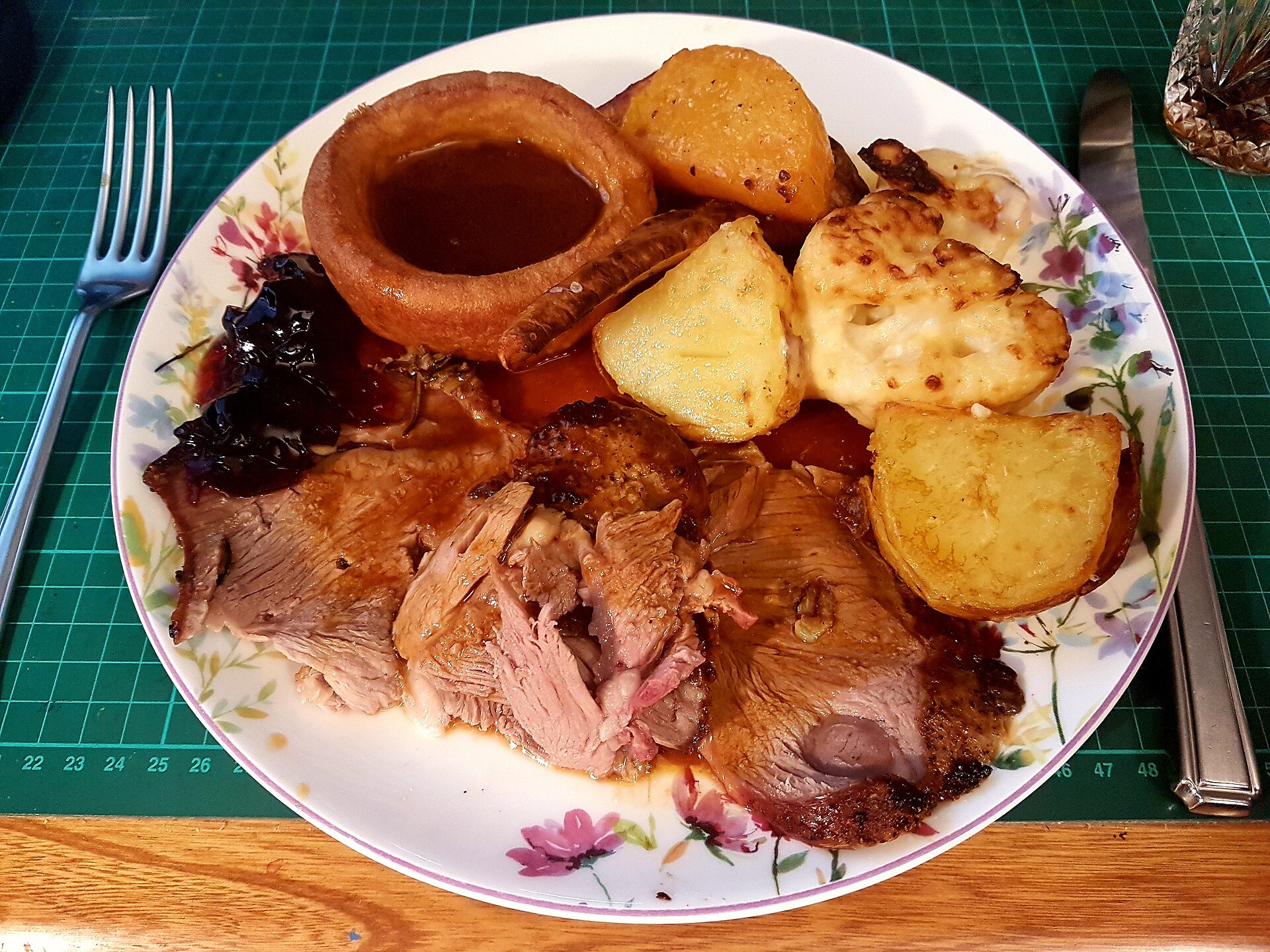
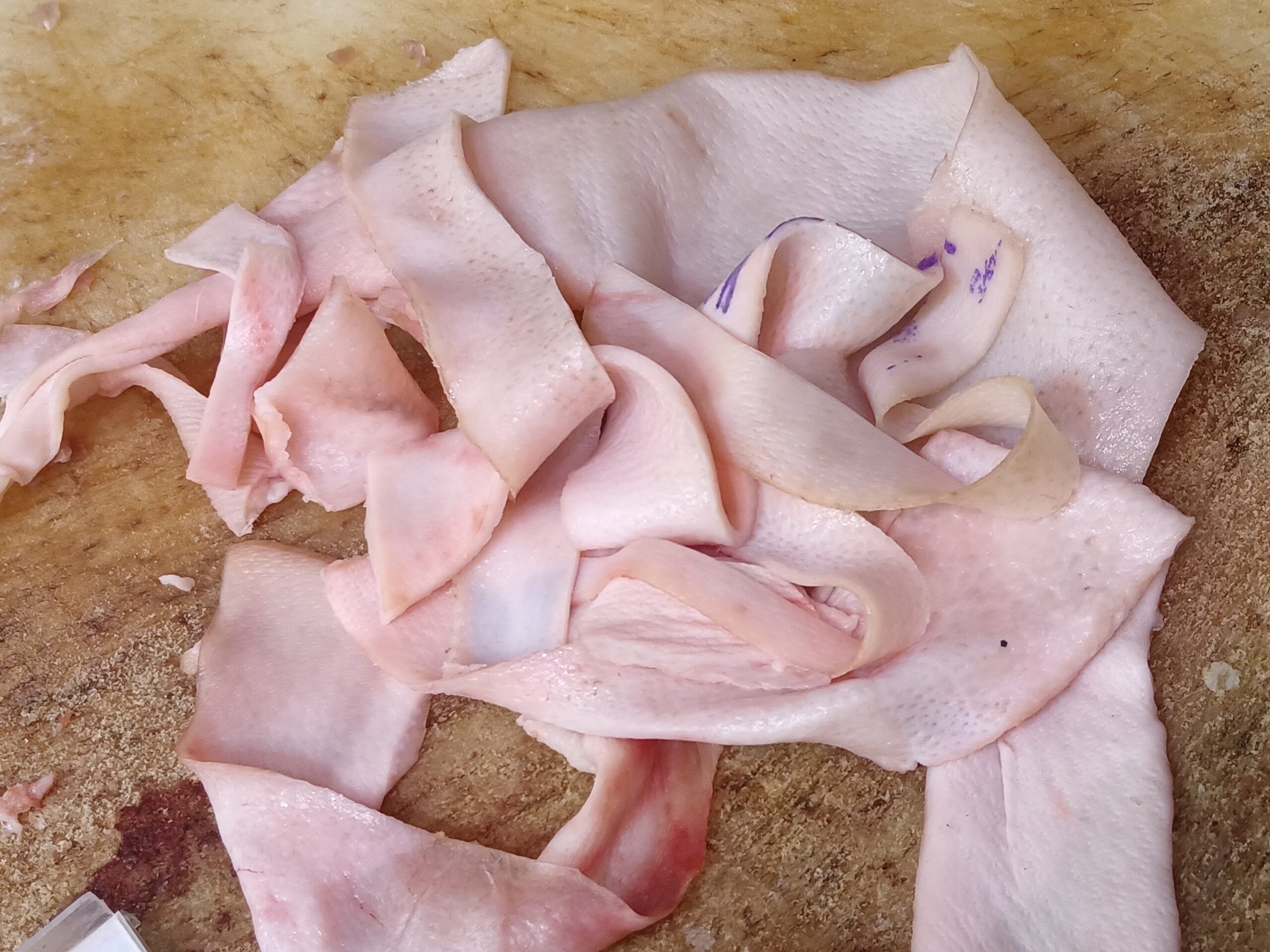
A three-pound loin comes out of the oven at 165 degrees because that is where the recipe said to stop. It rests, it gets carved, and every slice is the same uniform gray-white, firm at the edge, faintly chalky in the middle. Nobody complains. Everyone reaches for the applesauce.
Twenty degrees lower, the same cut carves into slices with a faint rose center, gives up juice onto the board, and needs no sauce at all. It is also fully within the safety standard, and has been for well over a decade. The gap between those two roasts is not skill. It is a number people learned in the 1970s and never updated.
What follows is where 145 degrees came from, what the required rest is actually doing, the cuts and preparations where a higher number still applies, and what a probe reads in the minutes when a loin crosses from juicy to dry.
- Whole cuts of pork: 145F measured at the center, followed by a 3-minute rest
- Ground pork: 160F, no exceptions
- Stuffed roasts and reheated pork: 165F
- Tough collagen cuts: 195 to 205F, cooked far past doneness on purpose
- Pull temperature for a loin roast: 137 to 140F, because carryover adds 5 to 10
- What pink means at 145: nothing about safety, everything about myoglobin
- The tool that settles it: an instant-read thermometer, checked in three places
The chop that came out gray and dry
Take two inch-thick chops from the same loin, cook them in the same pan, and pull one at 145 degrees and the other at 160. The difference is visible before anyone tastes anything.
The first is faintly pink through the middle, springs back when pressed, and leaves a small pool on the plate within a minute. The second is uniformly pale, feels firm rather than springy, and sits dry on the board because most of its juice left in the pan.
The loss is not gradual. Muscle fibers contract and squeeze water out over a fairly narrow band of temperature, and the range between roughly 150 and 165 is where a lean cut gives up most of what it had. Fifteen degrees on a thermometer is the difference between a chop and a piece of pork-flavored cardboard.
Why a generation cooked pork to 170
The habit came from a real parasite. Trichinella was a genuine hazard in the pork supply through much of the twentieth century, largely because pigs were commonly fed raw scraps and uncooked waste, and infected undercooked pork transmitted it to people.
Home cooks were told to cook pork until it was gray throughout, and the advice was sound for the conditions. It also carried a large safety margin, because the guidance was written for people without thermometers who had to judge by color.
Two things changed. Feeding practices and farm regulation cut the parasite out of the commercial supply in most producing countries, to the point where infections traced to farmed pork became rare. And the parasite itself is inactivated well below the old target, at around 137 degrees, so the extra thirty degrees was never the part doing the work. The number stayed on recipe cards long after the reason for it had gone.
Pork internal temperature 145, and where the number came from
In 2011 the United States Department of Agriculture lowered its recommended safe minimum internal temperature for whole cuts of pork from 160 degrees to 145, with a three-minute rest, bringing pork into line with the figure already used for whole cuts of beef, veal and lamb.
The number is not a compromise or a preference. It comes from the combination of temperature and time required to reduce the relevant bacteria by a set amount, and the three minutes at or above 145 is part of that calculation rather than a suggestion about juiciness.
Two categories were deliberately left out of the change. Ground pork stays at 160 degrees, because grinding distributes anything on the surface throughout the mass. And poultry, along with any stuffed roast or reheated leftover, stays at 165. Those distinctions are the whole reason to read the standard rather than to remember one number. Most common meat handling errors come from applying one figure everywhere.
The three-minute rest is part of the standard
The rest is doing two separate jobs and only one of them is culinary. The safety job is time at temperature: bacterial reduction continues while the meat holds at or above 145 degrees, and three minutes at that level is what the standard requires.
The culinary job is redistribution. Hot muscle fibers are contracted and holding pressure on the liquid inside them, and cutting immediately releases it onto the board. A few minutes lets the fibers relax and reabsorb some of that liquid.
Three minutes is the floor rather than the target. A thin chop is fine at five. A three-pound roast wants fifteen to twenty, loosely tented so the surface does not steam soft. During that window the temperature keeps climbing, which is why you take the meat out below the number you want.
Where 145 does not apply
| What it is | Target | Why it differs |
|---|---|---|
| Loin, chops, tenderloin, fresh ham | 145F plus 3 minutes | whole muscle, surface bacteria only |
| Ground pork, sausage meat | 160F | grinding mixes the surface through the whole mass |
| Stuffed loin or stuffed chops | 165F in the stuffing | the filling heats slower than the meat |
| Leftovers, reheated | 165F | standard reheating figure for cooked food |
| Shoulder, butt, belly, ribs | 195 to 205F | cooked for collagen conversion, not doneness |
| Cured and smoked ham, ready to eat | 140F to serve warm | already fully cooked at the plant |
| Pork for someone pregnant or immunocompromised | follow the higher figure if in doubt | reduced tolerance for any residual risk |
The bottom row deserves an extra line. Anyone pregnant, very young, elderly or managing a condition that affects immune response is generally advised to be more conservative with all undercooked animal products, and the sensible move in a mixed household is to cook to the higher number rather than to argue about it. Slow-cooked shoulder sits at the other end of the table entirely, where the target is texture and the temperature is far past anything to do with safety.
What the probe reads on the way up
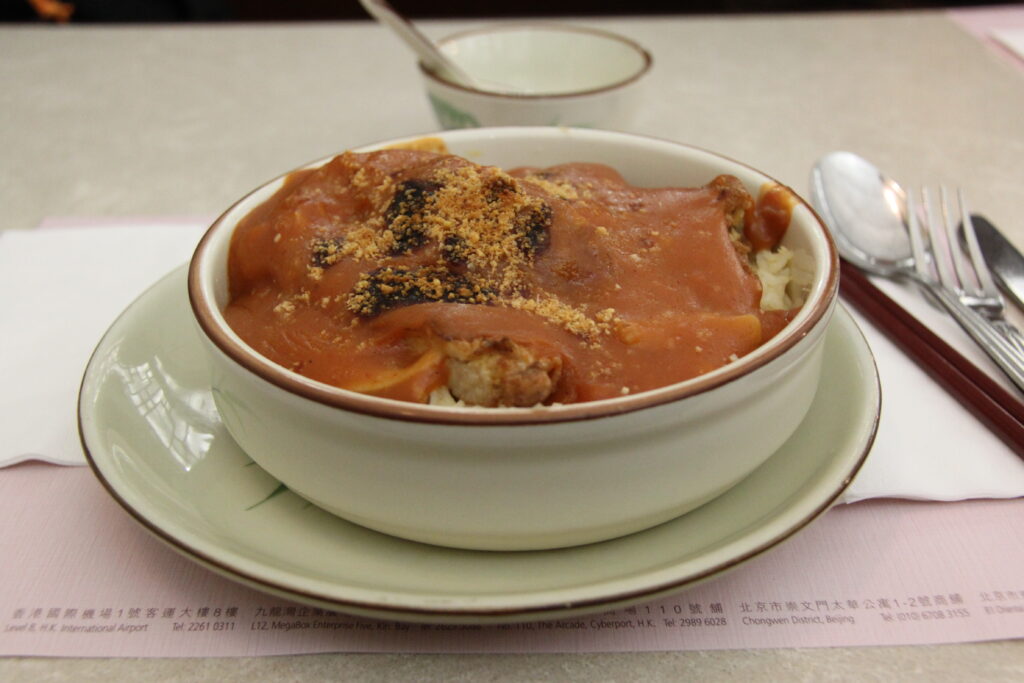
| Center temperature | Appearance | Texture | Verdict |
|---|---|---|---|
| 130F | deep rose, wet | soft, slightly translucent | under the standard, not recommended |
| 140F | rose center, opaque edges | tender, very juicy | pull here for a roast |
| 145F | faint pink at the center | springy, juicy | the standard, after a 3-minute rest |
| 150F | trace of pink, mostly pale | firm, still juicy | the safe upper edge for eating quality |
| 155F | uniformly pale | noticeably firmer | drying starts here |
| 160F | white-gray throughout | tight, chewy | the old target, and the dry one |
| 170F | gray, shrunken | chalky, fibrous | the roast that needs applesauce |
The interesting row is 150. It is comfortably above the standard, still pleasant to eat, and it gives a cook who is nervous about pink somewhere to stand. Above 155 there is nothing to gain and a measurable amount to lose.
Pink is not a doneness reading either
Color in cooked meat comes from myoglobin and how heat has altered it, and several things shift that independently of temperature. The pH of the muscle matters. So does whether the meat was frozen. So does nitrite, which is why a cured chop or a smoked loin stays pink to any temperature at all.
Meat near a bone often stays pinker than the rest of the same cut, and a loin cooked at low temperature for a long time can hold color that a fast-roasted one would lose. None of that tells you anything about whether the meat is safe.
The reverse error is more dangerous and more common. Meat can turn convincingly gray-brown well before it reaches a safe internal temperature, particularly ground meat, which means judging by color can leave you undercooked as easily as overcooked. Doneness is a temperature, checked with an instrument. It is not a color, a timer or a finger test.
Carryover, and why you pull before the number
A piece of meat taken out of the oven keeps cooking, because the outer layers are hotter than the center and heat continues to move inward. That rise is carryover, and ignoring it is how careful cooks still overshoot.
How much depends on mass, on shape and on how hot the oven was. A three-pound loin roasted at 350 degrees typically climbs 5 to 10 degrees after it comes out. A tenderloin, being thin, climbs 3 to 5. A one-inch chop from a screaming hot pan climbs about 5, and a chop cooked gently climbs almost nothing.
The practical rule is to pull a roast at 137 to 140 and let it arrive. If it stalls at 143, that is not a crisis: return it to a low oven for a few minutes. Overshooting is the failure with no remedy.
Thermometer placement, and the calibration nobody checks
An instant-read thermometer reads the temperature at the very tip of the probe, not along its length, so where you put that tip is the entire measurement. Aim for the thickest part, in the center, away from bone, and push the probe through and pull it slowly back until the number stops falling. That low point is the center.
Check three places on a roast. Ovens have hot corners, roasts are not symmetrical, and a loin that reads 145 at one end can read 132 at the other. The lowest reading is the one that counts.
Calibration takes ninety seconds and almost nobody does it. Fill a glass with crushed ice, top with water, stir, and let it sit a minute; the thermometer should read within a degree or two of 32 degrees. If it does not, either adjust it if the model allows or note the offset and apply it. A probe reading eight degrees high is a probe that lets you serve undercooked pork with complete confidence.
Cut by cut: pull temperatures that work
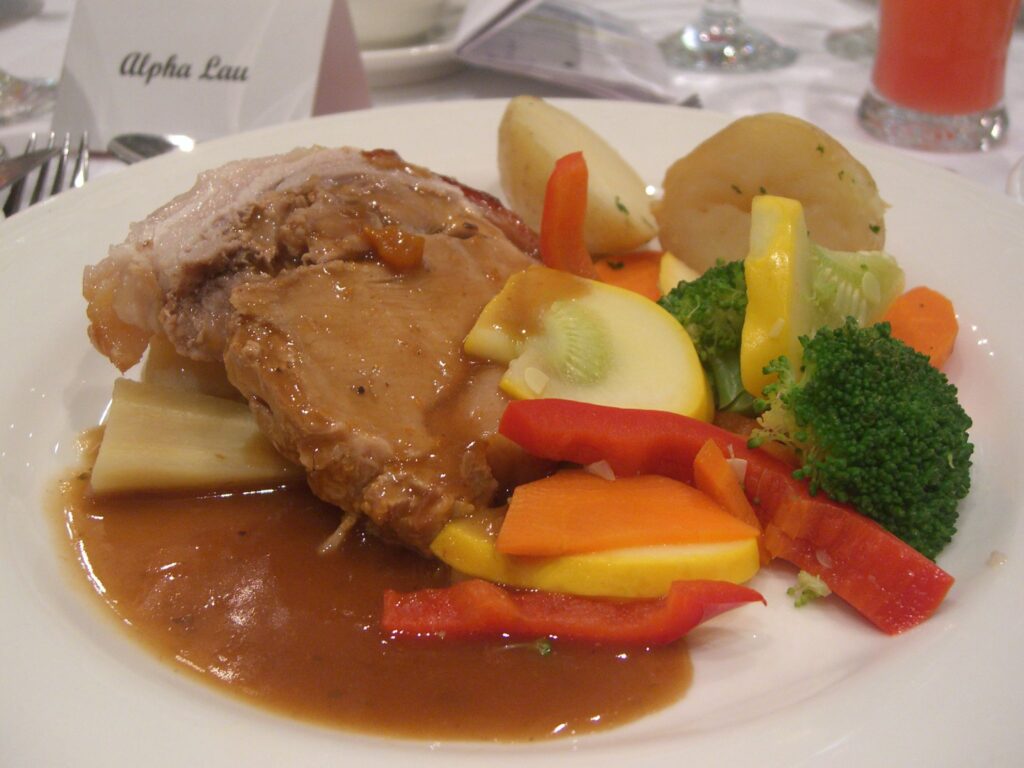
| Cut | Method | Pull at | Rest | Lands at |
|---|---|---|---|---|
| Boneless loin roast, 3 lb | 350F oven | 138F | 15 to 20 min | 145 to 148F |
| Bone-in loin roast, 4 lb | 325F oven | 137F | 20 min | 145 to 150F |
| Tenderloin, 1 lb | 425F oven or hot pan | 140F | 8 to 10 min | 145F |
| Chop, 1 inch | hot pan, flipped often | 140F | 5 min | 145F |
| Chop, 1.5 inch | reverse sear | 135F, then sear | 5 min | 145 to 148F |
| Fresh ham, 8 lb | 325F oven | 140F | 30 min | 148 to 152F |
| Shoulder, 8 lb | 250 to 275F | 203F | 60 min minimum | collagen fully converted |
Two of those rows are doing something different from the rest. A glazed ham that arrives already cured and cooked only needs warming through. Shoulder is not being cooked to doneness at all; it is being held for hours in the range where connective tissue turns to gelatin.
Reverse sear, and why it suits a lean loin
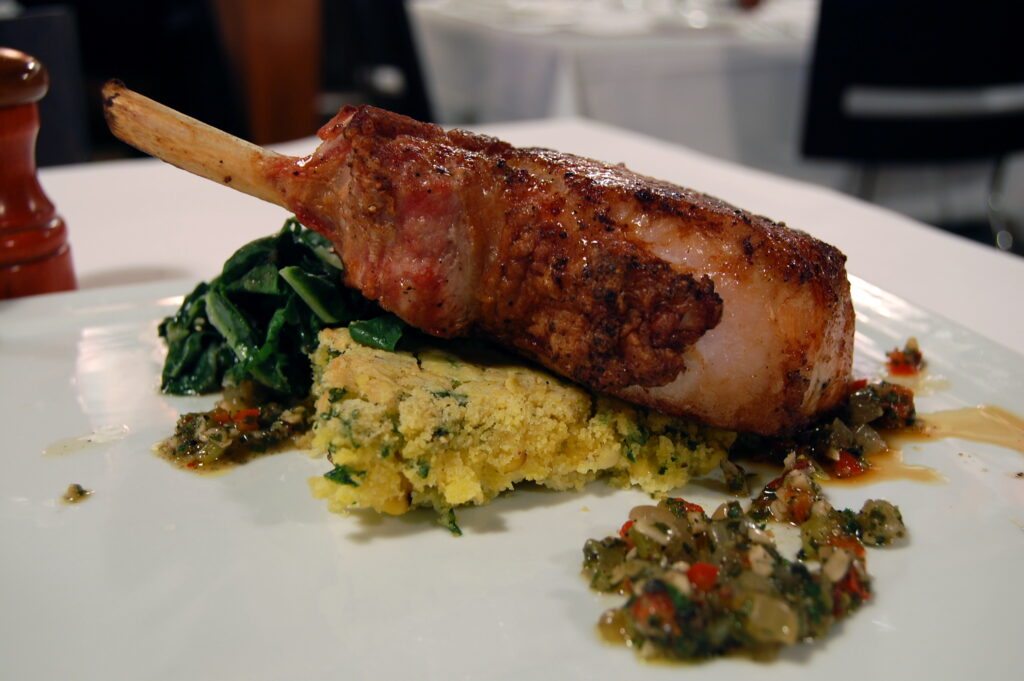
The problem with a thick lean cut in a hot pan is the gradient. By the time the center reaches 140 the outer half inch has been through 160 and beyond, so you get a gray band around a good middle.
Reverse searing inverts the order. Cook the meat gently first, in a 250-degree oven or on the cool side of a grill, until the center reads about 135. Then rest it briefly, dry the surface, and sear it hard in a very hot pan for sixty to ninety seconds a side.
Two things come out of that. The interior is nearly uniform from edge to center, because low heat gives the gradient time to even out. And the surface is bone dry when it hits the pan, which produces a better crust in less time. The method works the same way on beef, and it suits pork loin especially well because loin has so little fat to hide a mistake.
Six ways a loin still comes out dry
Cooking to a time rather than a temperature. Roasting charts assume a starting temperature, an oven that is accurate and a cut of a particular shape. Two of those three are usually wrong.
Probing next to the bone. Bone conducts heat differently and reads higher, so the center is colder than the number suggests. Stay half an inch clear.
Ignoring carryover. Pulling at 145 means serving at 152. That single mistake accounts for most disappointing pork.
Buying enhanced pork without noticing. Meat sold with an added solution behaves differently, holds more water, and tastes faintly of the brine it was injected with. Read the label; it will say.
Slicing straight off the heat. Three minutes is the minimum for a reason, and the juice on the board is juice that was supposed to be in the meat.
Trusting the oven dial. A domestic oven can run twenty-five degrees off. An oven thermometer costs less than a chop and explains a lot of otherwise mysterious results.
One thermometer, two numbers, one rest. Whole cuts to 145 and hold them three minutes, ground pork to 160, and let the color be whatever it turns out to be.
Frequently Asked Questions
Is pink pork actually safe?
If the center has reached 145 degrees and held there for three minutes, yes, by the standard that applies to whole cuts. Pink at that temperature is a function of myoglobin, pH and curing rather than of undercooking. What is not safe is assuming any pork is done because it looks a certain way, in either direction.
Does this apply to pork I bought from a small farm?
The temperature standard is the same regardless of the producer. If you are dealing with meat from an unfamiliar source, or from an animal raised with access to uncontrolled feed, the conservative choice is to cook to the higher figure. The standard describes a minimum, and nothing stops you from exceeding it.
Why is ground pork still 160 degrees?
Because grinding takes anything living on the outside surface and distributes it evenly through the whole mass. A whole chop only has to be safe at the surface, which a sear handles easily. A patty has to be safe all the way through, which is why the number is higher.
Can I use the touch test instead of a thermometer?
Not reliably, and less so with pork than with beef. Lean pork firms up over a narrow temperature band, the difference between 140 and 155 is not something a fingertip resolves, and the penalty for being wrong runs in both directions. A basic instant-read thermometer costs about as much as two chops.
How long can cooked pork sit out before it goes in the refrigerator?
Two hours at normal room temperature, or one hour if the room is above about 90 degrees. Slice or cut a large roast into smaller pieces before chilling so it cools through quickly, keep it three to four days in the refrigerator, and reheat leftovers to 165 degrees rather than just to warm.