They show up at the market in the last week of September, usually in flat boxes rather than clamshells, and the smell reaches you before the sign does. Three weeks later the same table has apples and winter squash and no grapes at all. There is no second window and nothing in a supermarket substitutes.
Table grapes are bred to travel and to keep. These are bred for neither. The skin separates from the pulp at a squeeze, the flesh is soft and full of seeds, and a box left on the counter for four days starts to ferment on its own. Every quality that makes them awkward to sell makes them worth cooking.
What follows is what to look for in a box, and three things to do with five pounds of it: juice that tastes nothing like the purple bottle, jelly that sets on its own pectin without a box of powder, and a vinegar syrup that lasts until spring. Yields and keeping times are written down at the end.
- Season: roughly three weeks, late September into early October in most northern growing regions
- Five pounds gives you: about 5 to 6 cups of juice, depending on ripeness
- Jelly ratio: 4 cups juice to 3 cups sugar, no added pectin needed
- The step nobody should skip: chilling the juice overnight to drop out tartrate crystals
- Jelly set point: 220F at sea level, or 8 degrees above the boiling point where you live
- Shrub ratio: equal parts fruit, sugar and vinegar by volume, refrigerated throughout
- Total hands-on time for all three: under two hours across two days
A slip-skin grape with a short calendar
The Concord is a North American grape rather than a European one, selected in Massachusetts in the middle of the nineteenth century and named for the town it came from. It is a different species from the grapes behind most wine and most supermarket fruit, and it behaves differently in every way that matters to a cook.
The aroma is the giveaway. That specific grape-candy smell comes largely from one aromatic compound that European wine grapes do not produce in any quantity, which is why artificial grape flavoring smells like this fruit and not like the ones in the produce aisle.
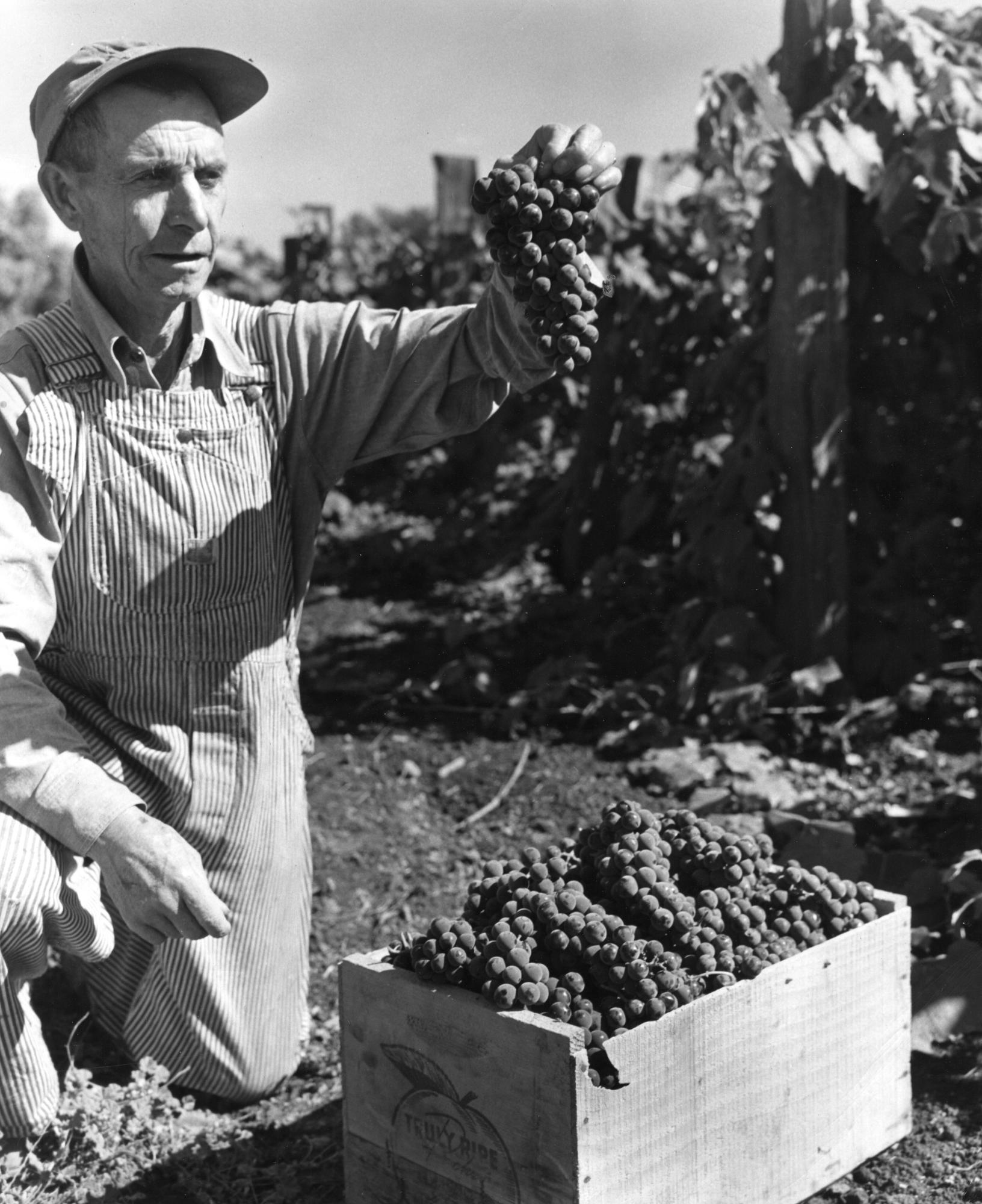
The harvest is short because the fruit does not hold. Picked ripe, it softens within days, and it does not ripen further off the vine. Growers pick over a narrow window and the boxes move fast. If you see them and intend to cook with them, buy them that day.
What slip-skin means when you are standing at the sink
Squeeze one between finger and thumb and the pulp shoots out, leaving the skin behind like an empty jacket. That single property shapes every recipe here, because the color and most of the tannin live in the skin while the sugar, acid and seeds live in the pulp.
Traditional handling separates the two and then puts them back together. Skins go in one bowl, pulp in another. The pulp gets simmered briefly and pushed through a sieve to remove the seeds, and the skins get cooked separately until soft, then recombined. That is how pie fillings and conserves keep the color without the seeds.
For juice and jelly, none of that is necessary. Crushing everything together and straining through cloth accomplishes the same separation with less work. The split-and-recombine method earns its time only when you want whole pieces of skin in the finished thing.
Buying: what a good box looks like in late September
Look at the stems first. They should be green and flexible, not brown and dry. Brown stems mean the box has been sitting, and these grapes do not sit well.
Then look for the bloom, the pale dusty film on the skin. It is natural, it is a sign the fruit has not been handled much, and it rinses off. Fruit that has lost its bloom in patches has been rubbed in transit.
Expect some fruit at the bottom to be split or leaking, and do not treat that as a reason to walk away. Sort at home, discard anything with visible mold or a sour vinegar smell, and use the rest the same day. A little softness is fine for juice; obvious mold is not, and one furry grape means checking every one around it. Buying a mix of fully ripe and slightly underripe bunches is an advantage for jelly, since the underripe fruit carries more pectin and more acid.
Three concord grape recipes from one five-pound box
Five pounds is the usual box and it divides neatly. Three pounds go to juice, most of which becomes jelly. A pound and a half goes to the shrub. The last half pound is for eating over the sink, which is the correct use of the smallest and ripest bunch.
All three start the same way: stem the fruit, rinse it in cold water, and discard anything soft, split or moldy. Stemming five pounds takes about twenty minutes and is the least interesting part of the process, so put something on.
The order matters because of one overnight rest. Make the juice on day one, start the shrub the same afternoon, and make the jelly on day two from the rested juice. Trying to do the juice and the jelly in a single session is where the gritty crystals come from.
Juice: five pounds in, about three pints out

Put the stemmed grapes in a heavy pot with about half a cup of water for every three pounds, just enough to keep the bottom from scorching before the fruit releases its own liquid. Crush them with a potato masher as they warm.
Bring to a bare simmer and hold it for ten minutes, no longer. The pulp should be broken down and the skins slack. A long boil extracts bitterness from the seeds and dulls the aroma, and there is nothing to gain from it.
Pour the whole lot into a jelly bag or a colander lined with several layers of damp cheesecloth set over a bowl, and let it drain. Two hours gets most of it; overnight in the refrigerator gets all of it. Do not squeeze the bag if you want clear jelly, because squeezing pushes fine solids through and the result is cloudy. Expect roughly 5 to 6 cups of juice from five pounds, less from very ripe fruit and more from fruit picked slightly early.
The tartrate crystals, and the overnight nobody skips
Concord juice carries a lot of tartaric acid, and some of it is present as a potassium salt that stays dissolved while the juice is warm and comes out of solution when it is cold. In a finished jelly those crystals read as grit, and people assume they got sugar crystallization or seeds through the strainer.
The fix is one step and it costs nothing but time. Refrigerate the strained juice for at least a full night, ideally twenty-four to forty-eight hours, in a tall container. The crystals settle as a fine sandy layer at the bottom, sometimes with a few larger clear shards.
Then pour the clear juice off carefully and leave the last inch behind, or filter it through damp cheesecloth a second time. This is the single difference between homemade grape jelly that is smooth and homemade grape jelly that crunches, and it is why the recipe takes two days instead of one.
Jelly with the fruit’s own pectin, no box required
These grapes are high enough in both acid and pectin that a jelly sets without commercial pectin, provided some of the fruit was slightly underripe. That is why the classic ratio is lean on sugar compared with the ones printed on a pectin box.
Measure 4 cups of rested juice into a wide pot, add 3 cups of granulated sugar, and stir over medium heat until the sugar has fully dissolved before the mixture reaches a boil. Undissolved sugar on the pot wall is where crystallization starts.
Then boil hard, uncovered, stirring often, and skim the foam that rises. A wide pot matters more than a tall one because evaporation rate sets the timing. Four cups of juice usually reaches the set point in fifteen to twenty-five minutes, and the mixture will foam up substantially as it goes, so use a pot at least three times the volume of the contents.
The sheet test, and why the thermometer lags
Two tests, used together. The thermometer target is 220 degrees at sea level, or 8 degrees above whatever water boils at where you are, which drops by roughly a degree for every 500 feet of elevation. Clip the thermometer so the tip is submerged but not touching the bottom.
The sheet test is the older method and it catches what the thermometer misses. Dip a cold metal spoon, lift it, and turn it sideways above the pot. Early on the syrup runs off in separate drops. At the set point the last of it hangs and joins into a single sheet that breaks off the edge cleanly.
A third check is worth having. Keep two small plates in the freezer, drop a half teaspoon on one, wait a minute, and push it with a fingertip. It should wrinkle rather than flood back. Pull the pot off the heat while you test so it does not overshoot, because grape jelly goes from set to rubbery in about ninety seconds.
Canning the jelly safely, jar by jar
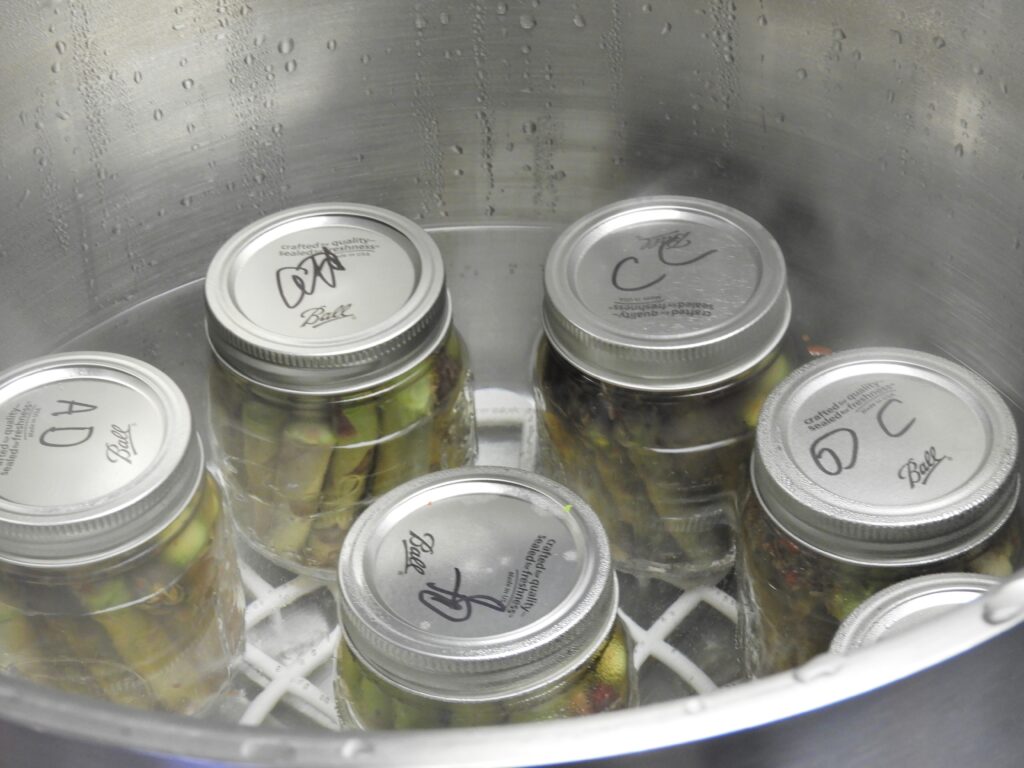
Jelly is high in acid and high in sugar, which is what makes it safe to process in a boiling water bath rather than a pressure canner. That safety depends on following the method rather than improvising it.
Wash the jars and keep them hot. Ladle the finished jelly into hot half-pint jars leaving a quarter inch of headspace, wipe every rim with a damp cloth so nothing sits between glass and lid, fit new flat lids, and screw the bands to fingertip tight rather than hard. Process in water covering the jars by an inch: about 5 minutes for half-pints at sea level, with more time added as elevation increases, following the chart from a current tested guide rather than an old family card.
Let the jars cool undisturbed for twelve hours, then check that every lid is concave and does not flex when pressed. Any jar that did not seal goes in the refrigerator and gets eaten within a few weeks. Do not invert jars to seal them, do not reuse flat lids, and do not reduce the sugar in a recipe you intend to can, since sugar is part of what makes the preserve stable. Anything that later shows mold, a bulging lid, a broken seal or an off smell gets discarded without tasting. The general rules for water bath canning apply here unchanged.
A shrub: vinegar, sugar, and three weeks in the refrigerator
The third thing to do with the box needs no cooking and no canning. Crush a pound and a half of stemmed grapes in a bowl, cover with an equal volume of sugar, stir, and refrigerate for two days, stirring once or twice. The sugar draws the juice out cold, which keeps the aroma intact in a way heat does not.
Strain off the syrup, pressing the solids lightly, then add roughly an equal volume of vinegar. Apple cider vinegar is the usual choice and white wine vinegar gives a cleaner result. Bottle it and keep it in the refrigerator.
It tastes aggressive for the first week and settles as it ages, with the sharp edge rounding off by about three weeks. An ounce in a tall glass of sparkling water is the standard use, and it also works as the acid in a vinaigrette for bitter autumn greens. Keep it refrigerated the whole time, not on a shelf, and expect it to hold six months or more. It is the most useful non-alcoholic mixer you will make all autumn.
Yields, sugar, and keeping times, side by side
| What you make | Fruit in | Yield | Sugar | Keeps |
|---|---|---|---|---|
| Juice, strained | 5 lb | 5 to 6 cups | none | 5 days refrigerated, 8 months frozen |
| Jelly, water bath canned | 4 cups juice | about 5 half-pints | 3 cups | a year sealed, 3 weeks opened and chilled |
| Jelly, refrigerator only | 2 cups juice | about 2 half-pints | 1 1/2 cups | 3 weeks, refrigerated from the start |
| Shrub syrup | 1 1/2 lb | about 2 cups | equal volume to fruit | 6 months refrigerated |
| Frozen whole grapes | any | same weight | none | a year, best used for juice later |
Freezing the fruit whole is the escape hatch when the box arrives on a week you have no time. Stem, rinse, dry, freeze on a tray and bag them. Frozen grapes actually give up juice more readily than fresh ones, since the ice crystals rupture the cells for you.
What goes wrong, and the batch worth throwing out
Gritty jelly. The juice went into the pot without an overnight chill. It is safe and it is unpleasant. There is no fix after the fact.
Jelly that never sets. Usually fruit that was all fully ripe, so the pectin and acid were both low, or a pot too narrow to evaporate properly. Recook with a tablespoon of lemon juice per cup and take it back to the set point once.
Rubbery jelly. Overshot the set point. Cut it with a little water over low heat and use it as a glaze on fruit rather than trying to rescue it as jelly.
Cloudy jelly. The bag got squeezed. Harmless, and a reason to be patient next time.
A box that smells like vinegar. Wild fermentation has started. A faintly winey smell in a few grapes is normal; a box that smells sour throughout, or fruit with visible fuzzy mold, goes in the compost rather than the pot. Cooking does not fix a bad box, and mold on soft fruit is not something to cut around.
Three weeks, five pounds, two afternoons. Come January the jelly is on toast, the shrub is in a glass, and the frozen bag in the back of the freezer is a reminder that the window closed and you were paying attention.
Frequently Asked Questions
Can I use other grapes for this?
Other slip-skin varieties behave similarly, and there are white and red ones worth trying if you find them. European table grapes do not work the same way: the skins cling, the pectin is lower, and the aroma is entirely different. If you use them, plan on added pectin and expect a milder result.
Do I have to remove the seeds?
Not for juice or jelly, because straining removes them along with the skins. For pie, conserves or anything with pieces of fruit in it, yes. Simmer the pulp for five minutes and push it through a sieve, which leaves the seeds behind and takes about ten minutes for a couple of pounds.
Why does my juice taste bitter?
Almost always because the pot boiled hard or for too long, which extracts tannin from the skins and compounds from the seeds. Ten minutes at a bare simmer is enough to break the fruit down. The second possibility is squeezing the straining bag, which pushes bitter solids through.
Is a water bath enough, or do I need a pressure canner?
A boiling water bath is the correct method for jelly, because the sugar and the natural acidity put it well inside the safe range for that process. Pressure canning is for low-acid foods such as plain vegetables, meat and stock. Follow current tested processing times for your elevation rather than a remembered number.
What do I do with the leftover skins and pulp?
The solids left in the bag still hold flavor. Simmer them with a little water and sugar, press through a sieve, and you have a thin sauce for yogurt or ice cream that keeps a week in the refrigerator. It behaves much like a berry coulis and it uses up something most people throw away.