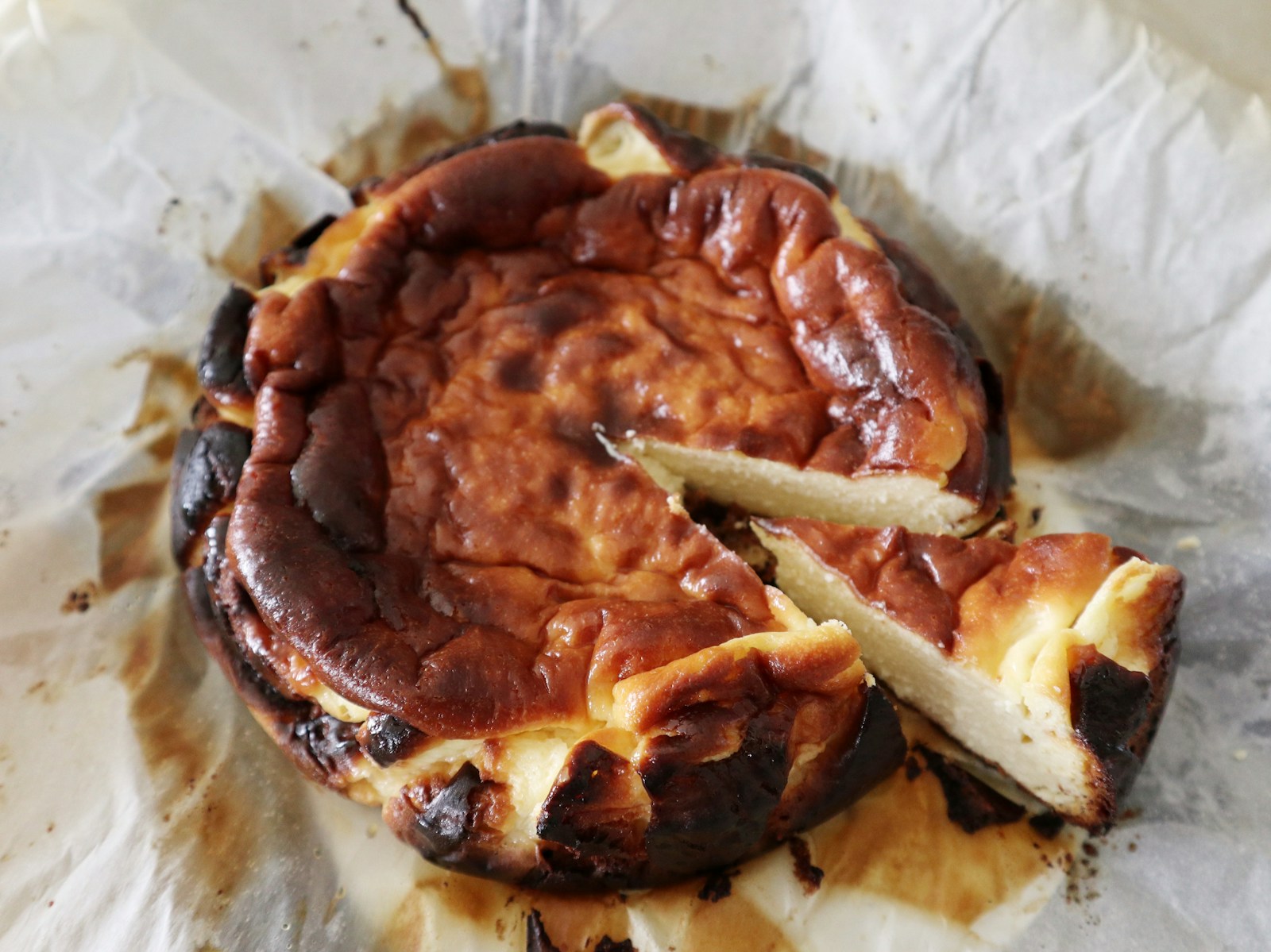
Pull it out of the oven after forty-five minutes and you will think you have ruined it. The top is blackened in patches, deeply amber everywhere else, and the center jiggles like it has not even started to set. The parchment paper has charred at the edges. The whole thing looks defiantly, spectacularly wrong. This is exactly what it should look like. Let it cool. Let it chill. Cut a wedge six hours later and what you find inside — past the bittersweet burnt crust — is custard. Not cheesecake as Americans know it. Something silkier, almost molten at the core, bound by nothing more than barely-set egg. The burnt top tastes of caramel and crème brûlée. The pistachio swirl catches green light against the bronze. You eat it standing up at the counter, slowly, and understand why this dessert has taken over the world.
La Viña, the small bar on Calle 31 de Agosto in San Sebastián’s Parte Vieja district, has been baking this cheesecake since 1990. It is not on the menu. It never has been. It simply appears each afternoon on a tiled counter near the door, wheels of it stacked behind glass, and tourists and locals alike queue to order a slice with a glass of Rioja. Santiago Rivera, the owner and inventor, has watched his creation colonize the world. Dorie Greenspan devoted a chapter to it in Everyday Dorie. Claire Saffitz tested it obsessively for her Dessert Person column at Bon Appétit. Stella Parks at Serious Eats called it “the most important cheesecake development in fifty years.” Ottolenghi’s pastry book Sweet, cowritten with Helen Goh, features a close variation. And in 2024 and 2025, a new wave of pistachio-infused versions began appearing in pastry shops from Madrid to Melbourne, riding the same broader pistachio-mania that had been building since the Dubai chocolate bar moment.
The pistachio variant I am teaching here is not the traditional La Viña original. Rivera himself makes only one version: cream cheese, sugar, eggs, cream, flour. Nothing else. But the modern Basque pastry scene — particularly at places like Cafe Iturriotz in Oiartzun and Pasteléria Txoko in Bilbao — has been experimenting with the formula, adding ground pistachios to the batter and swirling in pistachio cream to create a version that preserves the burnt-top, custardy-interior profile while adding a second dimension of flavor. This is that version.
The La Viña Origin Story
Santiago Rivera was thirty years old in 1990 when he took over La Viña from his parents. The bar had been in the family since 1959, serving the traditional pintxos of the Basque Country: tortilla, jamón, croquetas. Rivera wanted a dessert on the menu — something simple, something that could be made in volume, something that could serve as a memorable finish to a long casual meal with wine. He experimented for two years, testing cream cheese cakes in different configurations, before landing on the formula that is now globally famous. The breakthrough was accidental. Rivera has told the story many times, most recently in a 2023 interview with El País. He left a cheesecake in the oven longer than intended one night in 1990 because a large table of customers had arrived. When he pulled it out, the top was blackened. He thought he had ruined it. He served it anyway. The customers went silent. They asked for more. Within a year, La Viña was famous for it.
What is striking about the recipe is its simplicity. Rivera uses five ingredients — Philadelphia cream cheese (he has always been specific about the brand), granulated sugar, eggs, heavy cream, and a minimal amount of flour. No vanilla. No lemon. No water bath. No crust. The cake is poured into a springform pan lined with raw-edged parchment paper — the charred folded edges of which have become part of the dish’s visual identity — and baked at maximum oven heat for roughly forty minutes. The interior never fully sets. This is the point. La Viña’s cheesecake is somewhere between a cheesecake and a crème brûlée — a category of one.
The Maillard Crust: Why 450°F Matters
The burnt top is not a flaw. It is the structural and flavor foundation of the whole dessert. At 450°F — an unusually high temperature for any custard-based dessert — the sugar and milk proteins on the surface of the batter undergo aggressive Maillard browning and caramelization simultaneously. This produces bittersweet compounds (furans, pyrazines, melanoidins) that are impossible to generate at lower temperatures. The resulting crust has a flavor complexity closer to bitter caramel or crème brûlée topping than to a traditional cheesecake. Meanwhile, because the oven time is relatively short — forty to fifty minutes rather than the ninety-plus of an American cheesecake — the interior does not have time to fully set. The finished cake has a dramatic thermal gradient baked into it: deeply cooked top, barely-cooked center.
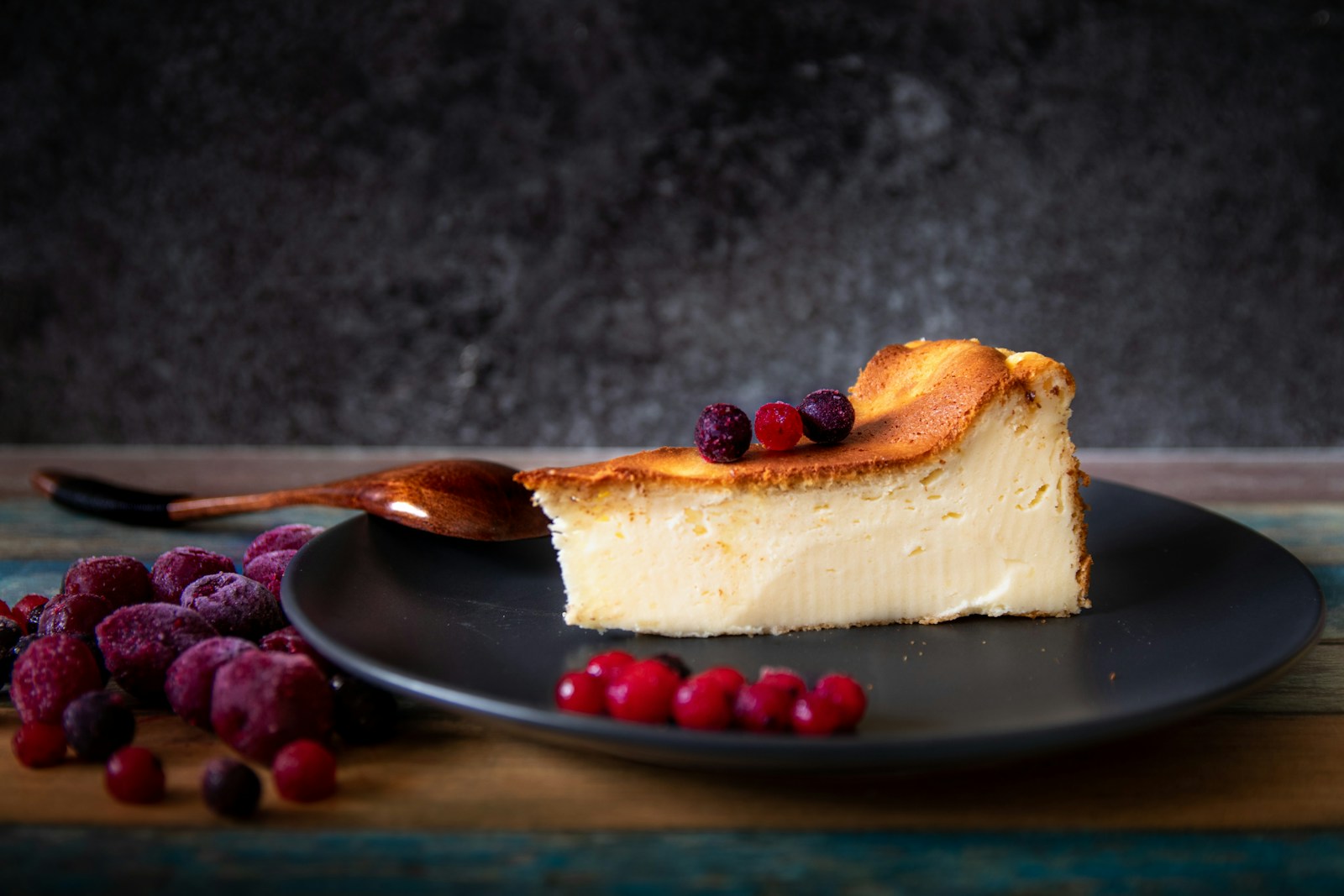
Home bakers new to Basque cheesecake almost universally undercook the top because they are afraid. The first time you pull a cheesecake out of the oven looking like yours has caught fire, the instinct is to take it out five minutes earlier next time. Resist. A pale Basque cheesecake is a wrong Basque cheesecake — it has none of the bitter-caramel complexity that makes the format legendary. The goal is a top that is deeply, aggressively burnt: mahogany to nearly black at its peaks, chestnut-brown at its valleys. If it looks alarming in the oven window, it is correct. If it looks pretty and pale golden, you have made a different dessert.
Pistachio Two Ways: In the Batter and Swirled
The pistachio variant works on two levels. Finely ground pistachios folded into the base batter add a subtle nuttiness and a pale green tint throughout the interior — the flavor reads as a savory-sweet background note, not a dominant one. A swirl of pistachio cream through the top third of the batter, introduced just before baking, adds more explicit pistachio punctuation — visible ribbons of green against the pale yellow, with more concentrated flavor in each bite that catches the swirl. Together, they produce a cake that tastes unmistakably of pistachio without sacrificing the cheesecake’s essential identity.
Source pistachio cream or paste carefully. The best comes from Bronte, Sicily — Mario Fiasconaro and Pistacchio di Bronte DOP are the gold standards, though they cost accordingly. Acceptable alternatives include Pistachio Agrimontana (Italian, widely available online), or American brands like Soom Sesame’s pistachio butter (thinner, less intensely flavored). Avoid sweetened pistachio spread sold as a dessert topping — the added sugar and oil change the texture of the swirl and the balance of the batter. You want pure, unsweetened paste or butter.
Basque vs New York vs Japanese Cheesecake
Three very different cheesecakes dominate the global pastry conversation. Knowing where each one sits helps you understand what you are making and why.
| Style | Crust | Texture | Signature |
|---|---|---|---|
| Basque (La Viña) | None (burnt top) | Custardy, nearly molten interior | Charred, bitter-sweet top |
| New York | Graham cracker | Dense, firm, crack-resistant | Rich tangy filling, sour cream top |
| Japanese soufflé | None (side-lined pan) | Light, jiggly, cottony | Whipped whites folded in |
| Italian (ricotta) | Shortcrust or none | Dry, grainy, slightly dense | Ricotta instead of cream cheese |
| German (Käsekuchen) | Sweet shortcrust | Firmer quark-based filling | Quark cheese, lighter profile |
Ingredients
Cheesecake batter:
- 2 pounds (900 g) full-fat cream cheese, room temperature (four 8 oz blocks)
- 1¼ cups (250 g) granulated sugar
- 5 large eggs, room temperature
- 2 cups (480 ml) heavy cream, room temperature
- ⅓ cup (40 g) all-purpose flour
- 1 tablespoon pure vanilla extract
- ¾ teaspoon fine sea salt
- ⅔ cup (80 g) raw pistachios, very finely ground
Pistachio swirl:
- ⅓ cup (85 g) unsweetened pistachio cream or paste
- 2 tablespoons heavy cream
- 1 tablespoon honey
Finishing:
- 3 tablespoons finely chopped pistachios
- Edible gold leaf or flaky sea salt (optional)
Making It
- Prepare the oven and pan. Position a rack in the center of your oven and preheat to 450°F (230°C). Take two large sheets of parchment paper (about 16 inches square each). Wet them briefly under running water, scrunch them into balls, and flatten — this makes them pliable enough to press into corners. Cross the two sheets at right angles in the bottom of a 9-inch springform pan, pressing firmly into the base and up the sides. Let the excess hang over the rim by at least four to five inches. The paper must be taller than the pan, because the cake rises and then falls, and the paper holds it through that whole journey.
- Beat cream cheese and sugar. In a stand mixer fitted with the paddle attachment, beat the room-temperature cream cheese with the sugar on medium-low speed for three minutes. Scrape the bowl twice during this time. The mixture should be completely smooth — no lumps, no streaks of white cream cheese, no visible sugar granules. Any lumps now are lumps in your finished cake forever. The room-temperature instruction is not flexible; cold cream cheese will not smooth out no matter how long you beat it.
- Add eggs one at a time. With the mixer on medium-low, add the eggs one at a time, beating for thirty seconds after each and scraping the bowl thoroughly between additions. Add the vanilla and salt with the last egg. The batter at this point should be smooth, glossy, and pale yellow-beige. Do not rush. If you add all five eggs at once, you break the emulsion and the finished cake will have a slight graininess.
- Stream in the cream. Switch to the whisk attachment. On low speed, pour the room-temperature heavy cream in a slow, steady stream over thirty seconds. Mix until fully incorporated, then stop. The batter will be loose and pourable — much thinner than a typical cheesecake batter.
- Fold in flour and pistachios. Sift the flour directly over the batter. Add the very finely ground pistachios (pulse in a food processor until they are the texture of almond meal — not a paste, not whole nuts). Using a rubber spatula, fold gently just until incorporated. No more than ten folds. The warning is important: over-mixing at this stage incorporates air, and the aerated batter will rise like a soufflé in the oven and then deflate unevenly, producing a split top rather than a gentle sink.
- Pour and tap. Pour the batter into the prepared pan, scraping the bowl clean. Give the pan three gentle taps on the counter to release any large air bubbles trapped during mixing. Do not bang hard; the parchment can shift.
- Make the swirl. In a small bowl, whisk the pistachio cream with two tablespoons of heavy cream and one tablespoon of honey until smooth and pourable — the consistency of softly whipped cream. It should drop off the whisk in ribbons rather than sitting in a blob. Drop six evenly spaced spoonfuls onto the surface of the batter. Using a butter knife or skewer, draw three or four loose figure-8 patterns through the batter to swirl, working down into the top inch or so. Do not overwork. The swirl should look marbled, not mixed.
- Bake. Place the pan in the oven. Bake for forty to fifty minutes. At thirty-five minutes, check: the top should be deeply golden-amber and just beginning to blacken in spots. Continue baking another five to ten minutes. The finished cake should have a top that is burnt-bronze to nearly black in patches, and a center that jiggles aggressively when the pan is shaken gently. The edges will be puffed, the center will look underdone, and every instinct will tell you to bake it longer. Do not. Pull it out.
- Cool and chill. Set the pan on a wire rack to cool at room temperature for ninety minutes. The cake will sink dramatically in the center — this is correct. Once cooled, transfer the whole pan to the refrigerator and chill at least three hours, preferably overnight. Do not skip the chilling step; the custard-like interior sets only with time, not with additional oven heat.
- Unmold and serve. Release the springform ring. Lift the cake out by the parchment overhang and transfer to a serving plate. Leave the parchment in place for the full Basque visual identity — the charred paper edges are part of the look. Sprinkle chopped pistachios generously over the top. Optional: a few flakes of Maldon sea salt or a fragment of edible gold leaf. Let the cake sit at cool room temperature for twenty minutes before cutting — it is at its best slightly below room temperature, not cold from the fridge. Cut with a knife run under hot water and wiped dry.
Troubleshooting: The Five Most Common Failures
Even an uncomplicated recipe has characteristic failure modes, and Basque cheesecake is no exception. First: a top that browns but stays soft in the middle indefinitely, even after six hours of chilling. This is almost always the result of unintentional under-measuring of flour or egg — the one-third cup of flour and five eggs are the structural backbone of the custard, and reducing either will produce something closer to a pudding than a cheesecake. Weigh your ingredients if possible.
Second: grainy texture. This comes from cold cream cheese that never fully smoothed out. The room-temperature instruction is not negotiable — pull the cream cheese blocks from the refrigerator at least two hours before mixing, or unwrap and microwave in short five-second bursts to soften without melting. Third: a top that browns unevenly, pale in patches and charred in others. This is an oven hotspot problem — rotate the pan 180 degrees at the 20-minute mark. Fourth: a leaking springform that produces a puddle of batter under the pan. Wrap the bottom of the springform in two layers of heavy-duty foil before lining with parchment; this catches any seepage. Fifth: parchment paper that burns through. Double-layer your parchment for extra insurance, and make sure the sheets extend at least four inches above the rim to protect the cake during its dramatic rise and fall.
What to Drink With Basque Cheesecake
At La Viña, the classical pairing is a glass of tempranillo-based red wine — specifically a young Rioja or Ribera del Duero. The tannins cut the richness of the custard, and the berry notes pick up the burnt caramel top. A sweet Pedro Ximénez sherry works even better for dessert mode — its intense raisin-and-molasses flavor complements rather than competes. If wine is not the move, espresso pulled short and dark (Italian style, not American-bar specialty) is the other traditional pairing; the bitterness echoes the burnt top and the heat contrasts the chilled cake. Avoid coffee with milk, which softens the whole experience into sweetness without complexity.
For a dessert spread where you are making several options, Basque cheesecake pairs interestingly with other rule-breaking cheesecakes. Our classic New York cheesecake, dense creamy and crack-free every time is the direct structural opposite — firm, crusted, stately — and makes an interesting contrast on a shared table. For something in the same custardy-dessert-with-nutty-variant family, our carrot cake with brown butter cream cheese frosting shares the Basque’s commitment to deeply caramelized flavors. And for something completely different but equally impressive, consider our matcha white chocolate panna cotta with toasted coconut.
Storage and Make-Ahead
Basque cheesecake is unusual in that it is frequently better on day two than day one. The flavors deepen in the refrigerator overnight — the burnt-sugar notes integrate with the custard interior, and the pistachio elements meld rather than sit separately. A whole cake, wrapped loosely in plastic, keeps for up to four days in the refrigerator. Individual slices can be wrapped and frozen for up to a month; thaw overnight in the refrigerator and bring to cool room temperature before serving. The burnt top survives freezing better than most cake surfaces, though there is some minor moisture loss. For genuinely fresh presentation, bake in the morning, chill through the day, and serve that evening.
Frequently Asked Questions
Why is the top supposed to be burnt?
The blackened top is not a mistake — it is the dish. Santiago Rivera created the modern Basque cheesecake at La Viña in 1990, specifically wanting a deeply caramelized exterior against a custardy interior. At 450°F, the sugar-and-protein surface undergoes aggressive Maillard browning and caramelization, creating complex bitter-sweet compounds that balance the rich creaminess. A pale Basque cheesecake is structurally wrong — it lacks the flavor architecture. The top should look alarming. The interior should look almost raw. Both are correct.
Why does Basque cheesecake have no crust?
The crustless form is part of the revolutionary simplicity. Rivera wanted a cheesecake he could make quickly without a water bath, graham crust, or precision water measurements. Instead, the top burns into a natural crust-like shell — the burnt sugar serves the same textural role as a graham base, from the opposite direction. Some home bakers add a crust anyway, but it defeats the point. The crustless form is faster, simpler, and structurally better at showcasing the custard interior.
Can I use reduced-fat cream cheese?
No. Full-fat cream cheese is the load-bearing ingredient. Reduced-fat versions (Neufchâtel or one-third-less-fat) contain more water and less fat, changing both texture and baking behavior. The fat creates the custard-like interior; water produces graininess. If you want a lighter option of a rich dessert, make a smaller slice of the full-fat version rather than compromising the core formula. The full-fat version also freezes better and holds structure longer at room temperature.
Why did my cheesecake not sink in the middle?
A proper Basque cheesecake should have a gentle depression in the center after cooling. Three likely causes if yours stays domed. First, over-mixing: air whipped in creates a soufflé effect. Mix just until smooth, then fold minimally. Second, overbaking: the interior must remain slightly underdone when pulled, with visible jiggle. Third, oven too cool: 450°F is non-negotiable. Lower temperatures produce a pale, over-set, cake-like result rather than the burnt-and-custardy Basque profile.
Sources
- Bon Appétit — Basque Burnt Cheesecake — Claire Saffitz’s tested recipe with detailed technical notes on the burnt-top method.
- Serious Eats — The Basque Cheesecake Guide — Stella Parks’s deep dive into La Viña’s formula and the pistachio variant movement of 2024-26.
- USDA FoodData Central — Cream Cheese and Pistachios — Nutritional data used for per-serving calculations.
Each serving contains roughly 462 calories, 9 g protein, 36 g fat, 24 g carbohydrates, and 1 g fiber — based on 10 servings from a 9-inch springform.
Please note: Nutritional estimates are derived from the USDA FoodData Central database and may vary depending on specific brands and component sizes. This recipe contains dairy, wheat, eggs, and tree nuts (pistachios). Nothing in this article should be interpreted as medical or dietary guidance. If you have food allergies, nut sensitivities, or specific dietary needs, consult a registered dietitian or healthcare provider before preparing this recipe.

Elena Vasquez
Elena learned to bake from her abuela on a family farm in the south of Spain - wood-fired ovens, breakfast bread before sunrise, and a tia who taught her pastry between long lunches with cousins. At CookingZone she develops desserts, pastry, breakfast, healthy recipes, and beverages - from protein-rich morning bowls to classic French patisserie and viral bakery hits. She still tests every dessert on the same crew of family and friends before it makes it onto the site.