A pork chop salted thirty seconds before it hits the pan sits in its own puddle and steams. You can watch it happen. Salt pulls water to the surface faster than a hot skillet can drive it off, the sizzle drops to a hiss, and the chop turns gray where it should have turned brown. Nothing is wrong with the salt. The timing is.
Two windows work, and they are far apart. Forty minutes gets the surface dry enough to brown and the seasoning far enough in to register on the tongue. A full day uncovered in the refrigerator does something forty minutes cannot, and it costs nothing beyond remembering the night before. The stretch between those two, from about five minutes to half an hour, is where the puddle lives.
We put four bone-in chops from the same loin through three windows plus an unsalted control, weighed what came off them, and cut them open. The differences were not subtle, and they were not all where people expect them to be.
- Cut tested: bone-in loin chops, an inch and a half thick, about 12 ounces each
- Salt used: 1 percent of each chop’s own weight, roughly 3.4 grams
- Windows: 40 minutes at room temperature, 4 hours refrigerated, 24 hours refrigerated and uncovered
- Weeknight answer: 40 minutes on a rack, salt on all faces, nothing else
- Worth planning for: 24 hours, mostly for the crust rather than the seasoning
- Skip: anything between five and thirty minutes
Four chops from the same loin, one variable
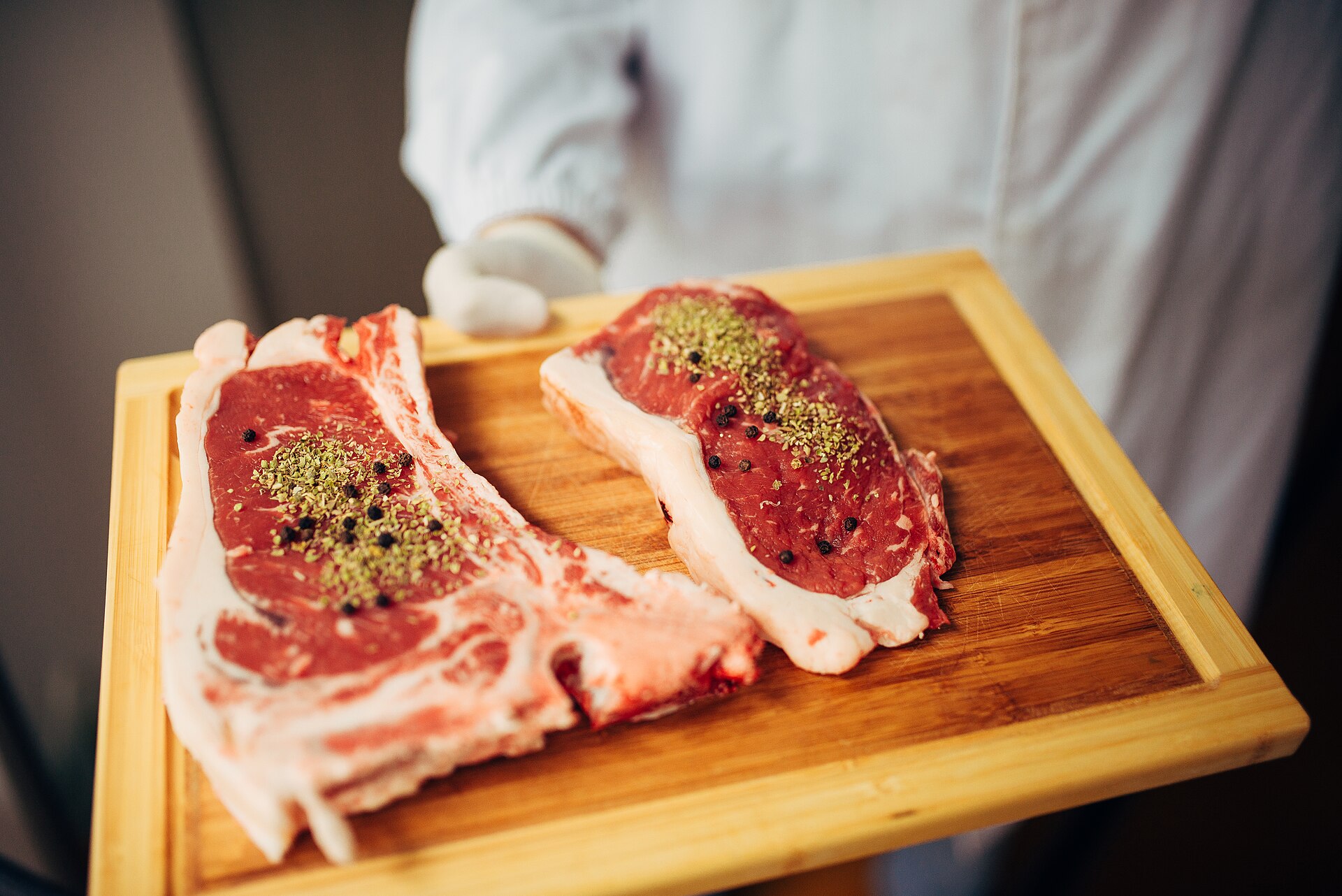
Four bone-in loin chops, cut an inch and a half thick, all within half an ounce of each other. Each one received salt at 1 percent of its own weight, which for a 12-ounce chop works out to about 3.4 grams. The only thing that changed from chop to chop was when the salt went on.
Chop A was salted 40 minutes ahead and left on a rack on the counter. Chop B was salted four hours ahead and held uncovered in the refrigerator. Chop C was salted a full 24 hours ahead, also uncovered, also on a rack set over a sheet pan so air could reach every face. Chop D got nothing until it was already in the skillet.
All four cooked the same way: cast iron, a thin film of neutral oil, medium-high heat, pulled at 140 degrees and rested five minutes. That pull temperature is doing real work, and it comes back at the end.
The first ten minutes: salt pulls, the chop weeps
Salt landing on meat dissolves into the thin film of moisture already sitting on the surface, and that film immediately becomes more concentrated than the fluid inside the muscle cells underneath it. Water moves toward the higher concentration. Within four or five minutes the chop looks wet, and by ten it carries visible beads.
This is the exact state most weeknight chops go into the pan in. Those beads have to boil away before the surface can climb past the boiling point and start browning, and while that is happening the outer layer of meat is being steamed rather than seared. On chop D, salted in the skillet, the hiss was audible within thirty seconds.
Nothing has gone wrong at this stage. The water is on its way out and then on its way back in, and the mechanism is the same one that makes a wet brine work, minus the bucket. It just has to be left alone long enough to finish the round trip.
Forty minutes: the brine goes back in
The film on the surface is now a concentrated brine, and that concentration is what reverses the flow. Salt diffuses inward, the muscle proteins it reaches hold water more readily than they did before, and the liquid follows the salt back into the meat.
At around forty minutes the rack under chop A was dry and the surface of the meat had gone tacky rather than wet. That is the signal to cook, and touch reads it better than a clock does, because a chop straight out of a cold refrigerator runs slower than one that has been sitting out.
Forty is not a magic number so much as the point where a chop of this thickness has finished reabsorbing. A half-inch cutlet gets there in fifteen or twenty minutes. A two-inch chop can want an hour. Thickness sets the clock, and the surface tells you when it has run out.
Four hours: deeper seasoning, drier surface
Four hours uncovered in the refrigerator moved salt a couple of millimeters past the surface and left the exterior noticeably drier than chop A. Cut across, chop B read seasoned for roughly the outer eighth of an inch and read like plain pork after that.
The surface is where the gain showed up. Cold refrigerator air is dry and it moves, and four hours of it wicked enough moisture off the exposed faces that the chop browned faster and more evenly than the counter-rested one. This window suits a Saturday: salt after lunch, cook at seven, nothing in between.
There is no penalty for stopping here, and no obligation to go further. Four hours is a clear improvement over forty minutes on crust, and a small one on how deep the seasoning reaches.
Twenty-four hours: a surface that behaves like a pellicle
A full day uncovered on a rack produces something different in kind. Chop C had given up somewhere between three and six percent of its starting weight to evaporation, with the spread depending mostly on how hard the refrigerator fan was running. The surface had gone matte and slightly tacky, closer to a fish fillet held before smoking than to raw meat.
That surface hits the pan and browns almost immediately. Chop A needed close to four minutes a side to build real color. Chop C was there in about two and a half, which matters because every minute spent waiting on the outside is a minute the interior spends climbing toward overcooked.
What twenty-four hours does not do is season the center. Salt travels through cold muscle on the order of a few millimeters a day. In a chop an inch and a half thick, the middle is still unsalted pork after a day, and it will still be unsalted pork after two. The gain is at the surface, and the surface is what the tongue meets first.
How long to salt meat before cooking, by cut and thickness
The useful answer scales with thickness, not with the name on the label. Anything under an inch is a short-window proposition. Anything past two inches earns a full day, and a large bone-in roast can take three without turning into ham.
| Cut | Thickness or weight | Short window | Long window |
|---|---|---|---|
| Cutlet, scaloppine, thin fillet | under 1/2 inch | 15 minutes | not useful |
| Pork or lamb chop | 1 to 1 1/2 inches | 40 minutes | 24 hours |
| Thick chop or steak | 1 1/2 to 2 inches | 45 to 60 minutes | 24 to 48 hours |
| Chicken pieces, skin on | bone in | 45 minutes | 12 to 24 hours |
| Whole chicken | 3 to 4 pounds | 1 hour | 24 hours |
| Pork loin roast | 3 to 5 pounds | 1 hour | 24 to 48 hours |
| Bone-in beef roast | 5 pounds and up | 90 minutes | 48 to 72 hours |
| Ground meat | any | at the pan | never |
Ground meat is the exception that catches people out. Salt mixed into ground beef before it is shaped dissolves the myosin and the mixture turns springy and bouncy, which is exactly what you want in a sausage and exactly what you do not want in a burger. Salt the outside of the patty as it goes into the pan and leave the interior alone.
What the purge weighed, window by window
The trays told a shorter story than expected. At forty minutes, chop A’s tray had nothing on it at all. Everything that came out had gone back in. Chop B’s tray carried a faint ring. Chop C’s tray was dry too, but the chop itself was lighter, because on a rack in cold moving air the water leaves as vapor instead of pooling as liquid.
The weight that actually matters is the one after cooking, and there all three salted chops beat the control. Chop D, salted in the skillet, gave up visibly more liquid to the pan and finished tighter and drier at the same internal temperature. Salted muscle proteins hold water under heat; unsalted ones squeeze it out.
That is the finding worth carrying to other proteins. Dry salting is not only about flavor reaching further in. It changes how much water survives the cook, which is why the same trick pays off on chicken thighs and on a whole bird.
The crust is a moisture problem, not a heat problem
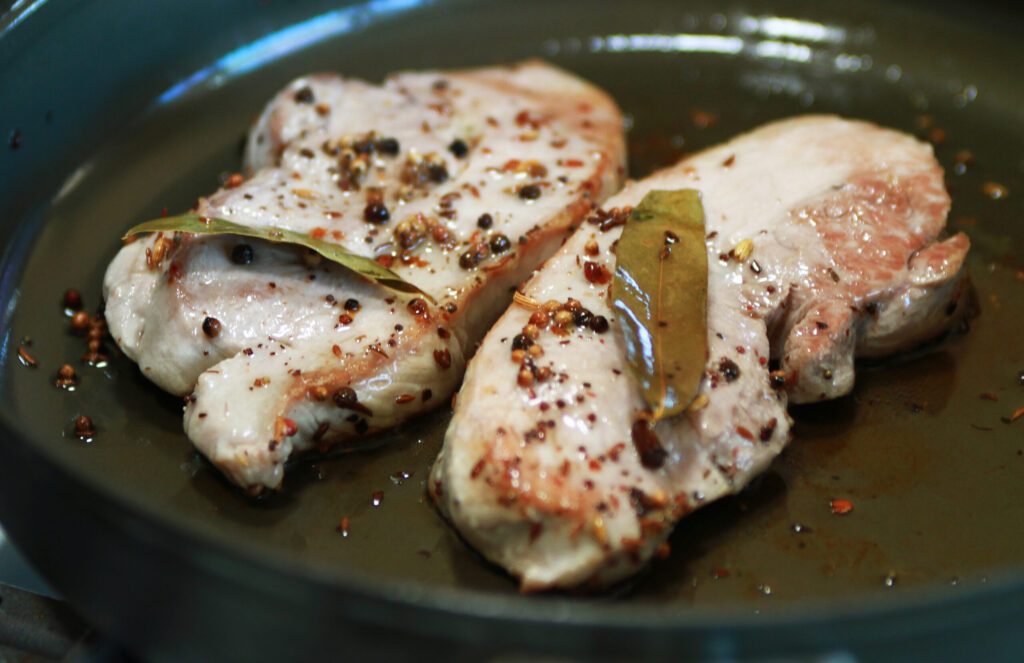
Browning does not begin in earnest until the surface is well past the boiling point of water, and a surface carrying free moisture cannot get there. Every wet gram has to be converted to steam first, and the energy spent doing that is energy not spent building color.
This is the whole reason the twenty-four-hour chop browned in roughly half the time of the forty-minute one in the same pan at the same setting. Nothing about the pan changed. The chop simply arrived carrying less water.
The practical consequence is that a hotter pan does not fix a wet chop. It scorches the spots that dry first and leaves the rest pale. If a day of lead time is not available, an hour on a rack in the refrigerator plus a hard blot with paper towel gets you most of the way. The same logic drives a good steak crust, and it is worth internalizing once rather than relearning per protein.
Salt by weight, not by teaspoon
A teaspoon of salt is not a fixed quantity of salt. Diamond Crystal kosher is built from large hollow flakes and weighs roughly 3 grams per teaspoon. Morton kosher is denser, closer to 4.8. Fine table salt packs in at around 6. Measuring a dry salting by volume with the wrong box on the counter is how a chop ends up either flat or genuinely inedible.
One percent of the meat’s weight is the working figure for chops, steaks and chicken pieces headed for a pan. Drop to somewhere between half and three-quarters of a percent for anything that will later meet soy, anchovy, capers or a salty cheese. On a 12-ounce chop, 1 percent is 3.4 grams, which is a rounded teaspoon of Diamond Crystal, three-quarters of a teaspoon of Morton, or a generous half teaspoon of table salt.
An inexpensive kitchen scale removes the entire problem. Weigh the meat, multiply, then sprinkle from a foot above the chop so the salt lands evenly instead of in stripes. Marinades run on a different set of rules, and stacking the two approaches usually produces a wet chop with scorched edges.
The window to skip, and the cuts that want none of this
Between roughly five and thirty minutes a chop is at its worst: wet on the outside, not yet seasoned underneath. If the salt is already on and the pan is already hot, there are two honest options. Wait it out, or blot the chop hard with paper towel and accept a piece of meat seasoned only on the surface.
Some things should not be salted ahead at all. Thin fish fillets firm up and go dense within twenty minutes. Shrimp and scallops turn rubbery. Ground meat, as above. And pork sold as enhanced, with a percentage of solution listed on the label, has already been pumped with salt water at the plant; adding another 1 percent on top of that produces something closer to a cured chop than a fresh one. Read the label, and if it is enhanced, cut the salt in half or skip the step entirely.
For everything else, the decision is simple. Forty minutes if dinner is tonight. A day if you thought about it yesterday. A wet brine still earns its place on lean poultry, but for a chop with a surface you want brown, dry salt wins on every measure we could put a number on.
Frequently Asked Questions
Does salting ahead dry the meat out?
The opposite, within these windows. The chop loses a few percent of its weight to evaporation over a day on a rack, but it holds far more water during cooking than an unsalted one, and the net is a juicier piece of meat. What dries a chop out is cooking it past temperature, not salting it early.
Can I leave a chop salted for three days?
Two days is a comfortable ceiling for a chop or a steak. Large bone-in roasts tolerate three. Past that the surface starts to behave like a cure, the texture goes firm and slightly translucent near the edge, and the meat reads more like ham than like pork.
Should I rinse the salt off before cooking?
No. Rinsing rewets the surface you just spent a day drying, and by that point most of the salt is inside the meat anyway. If you clearly overdid it, brush the loose crystals off with a dry hand and cook it as is.
Covered or uncovered in the refrigerator?
Uncovered, on a rack, with a tray underneath. Covering traps evaporating moisture against the surface and cancels the main advantage of the long window. A chop on an open rack is also the reason the twenty-four-hour version browns so fast.
What internal temperature should a pork chop reach?
Pull it at 140 degrees and rest it. Carryover takes it to the recommended 145 degrees, which the federal food safety guidance pairs with a three-minute rest, and at that point the chop is safe and still faintly pink at the center. Cooked to 160 it is chalky, whatever the salting schedule was.