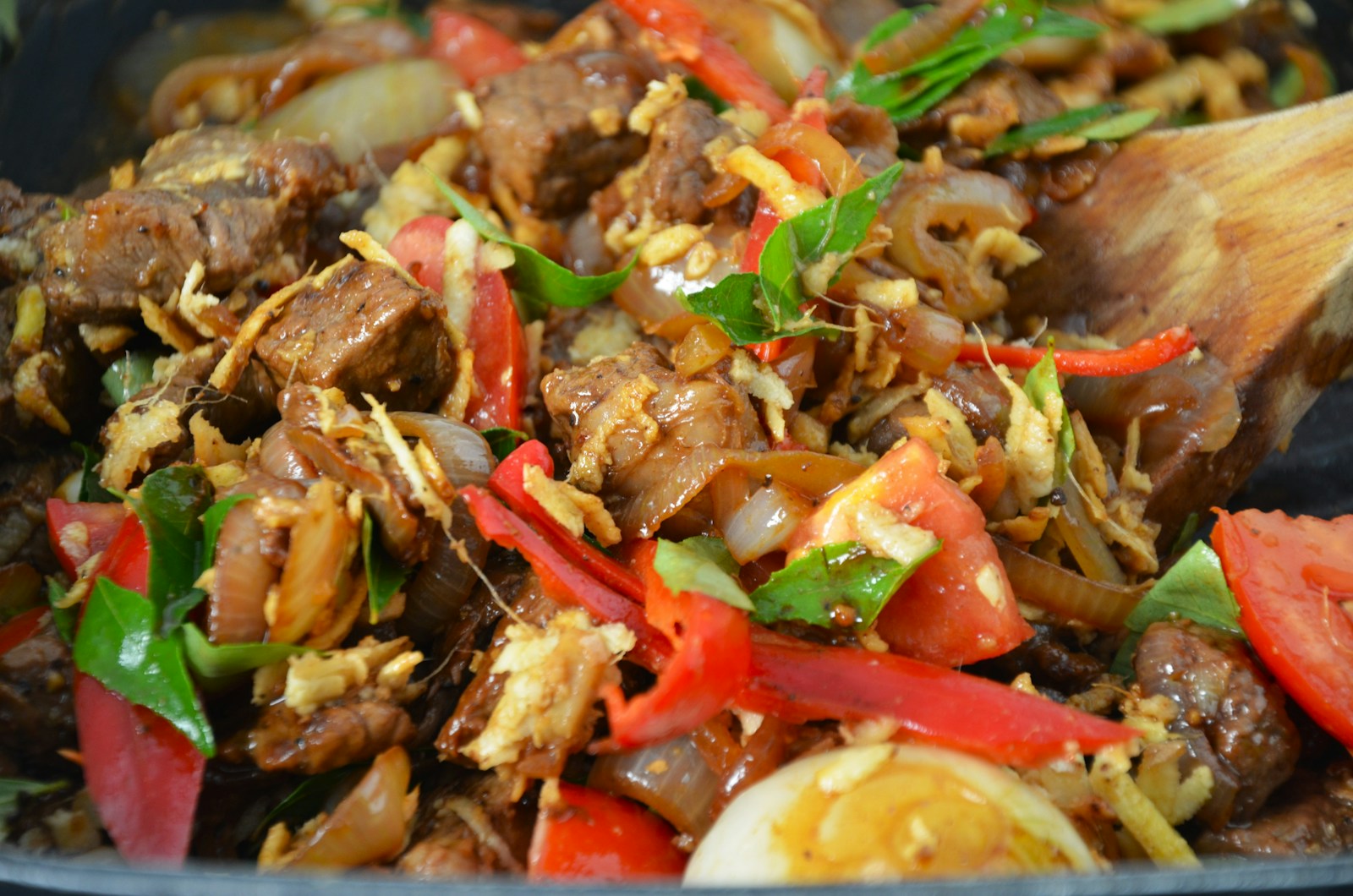
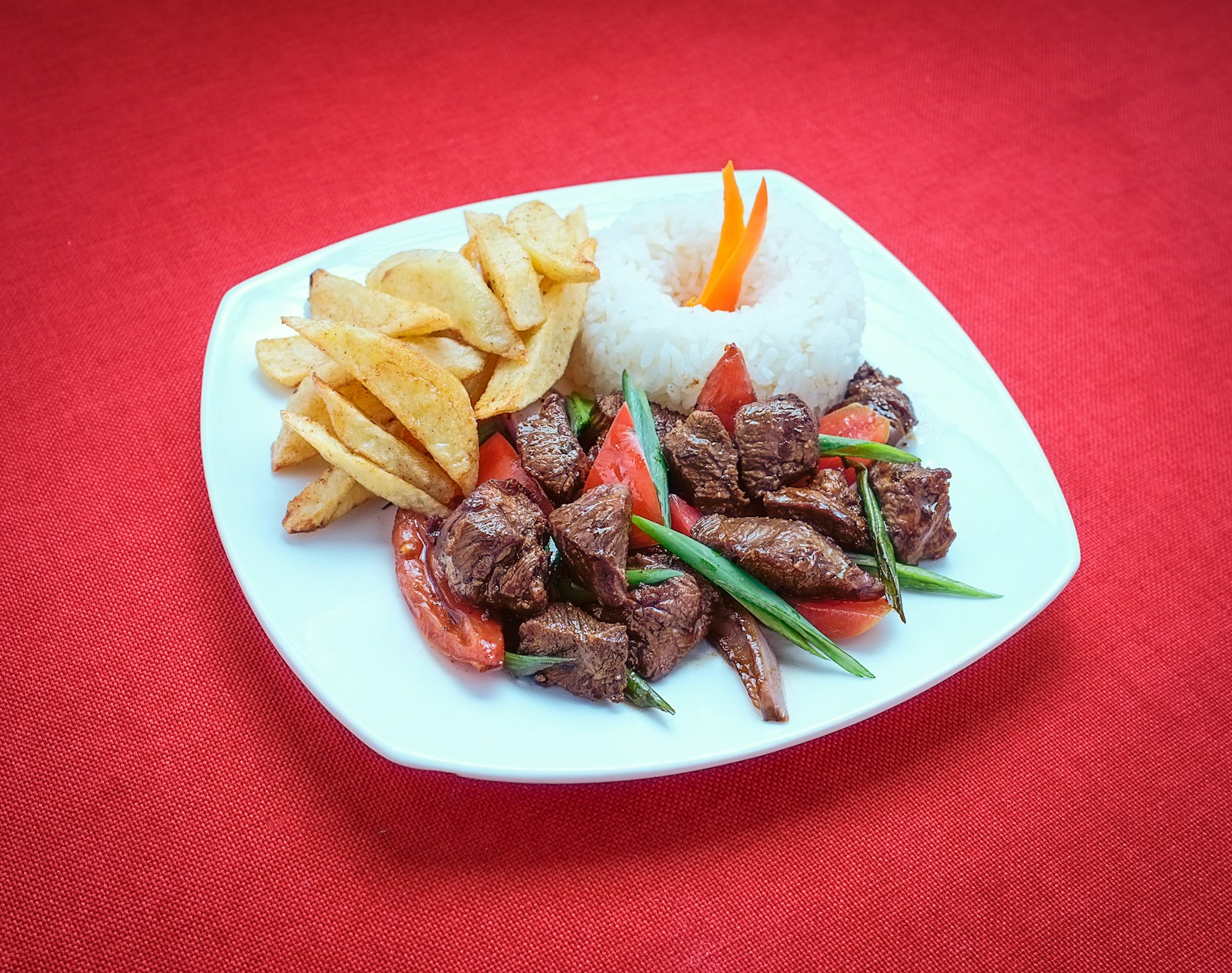
There is something almost defiant about the first time you see a plate of lomo saltado. The beef is there, glossy and seared. The red onion and tomato are there, still holding their shape. The aji amarillo paste stains the sauce a warm, almost amber brown. And then — French fries. A generous heap of crisp, golden fries, tossed directly into the stir-fry. And in case that is not enough, a mound of steamed white rice on the side. Two starches, a stir-fry, a Peruvian chile, soy sauce, red wine vinegar. It should not work. It does not even make sense on paper. Then you take a bite, and the whole assembly clicks into place so naturally that you wonder why every other culture did not arrive at the same conclusion centuries ago.
Lomo saltado is the most famous dish of Peru, and it is also the most honest portrait of what Peruvian food actually is. Peru is a country of accumulated influences — indigenous Quechua and Aymara foodways layered with Spanish colonial cooking, West African slave traditions brought to the coast, Japanese migration in the early twentieth century (which produced the Nikkei cuisine that gave the world ceviche tiradito and sushi-style raw fish), Italian immigration to the interior, and, most decisively for this dish, the mass arrival of Cantonese laborers in the 1850s and 1860s. These Chinese immigrants, originally brought to work on guano islands and sugarcane plantations, settled predominantly in Lima and along the northern coast, where they opened small eateries called chifas. Chifa — a hispanization of the Mandarin “chi fan,” meaning “to eat rice” or simply “to eat” — became the single largest external influence on modern Peruvian cooking.
Gastón Acurio, the chef and restaurateur whose Astrid y Gastón is widely credited with putting modern Peruvian cuisine on the global map, writes in The Art of Peruvian Cuisine that lomo saltado is “the plate that taught Peru to be proud of its chifa.” For decades, Peruvian home cooks regarded chifa as a kind of lesser cuisine — cheap, neighborhood, immigrant. Acurio and a generation of chefs after him argued the opposite: that chifa is where Peruvian ingenuity is most visible, where indigenous produce and Cantonese technique produce something neither culture has alone. Ricardo Zarate, the Lima-born chef behind Los Angeles’s Mo-Chica and Picca, once called lomo saltado “the cleanest possible demonstration of what Peru is.” He was right. One wok, four cultures, fifteen minutes.
The Physics of the Wok
Lomo saltado is fundamentally a stir-fry, and like every proper stir-fry, it demands violent heat. The Cantonese call this wok hei — the “breath of the wok” — the particular smoky char that only develops when a wok or heavy skillet is hot enough to vaporize the aromatic compounds in soy sauce and oil. At home, this means cranking your burner to the highest setting it can produce and heating an empty pan until it is smoking visibly before any ingredient touches it. If your pan is not smoking, it is not hot enough. Restaurant wok ranges reach 100,000 BTU or more; home stoves top out around 18,000. The only way to compensate is to heat longer, cook in small batches, and never crowd the pan.
The corollary to high heat is short contact time. Everything in lomo saltado cooks fast — the beef for 90 seconds, the onions for 60 seconds, the tomatoes for 45. The goal is color and flavor on the surface, not doneness in the middle. Beef should be rare to medium-rare inside; onions should have charred edges but still a crunch; tomatoes should release some juice but not collapse into sauce. If any ingredient loses its shape, the dish has been overcooked. Cook in batches if you must; the alternative — stewing in its own juices — produces something with the right ingredients but none of the character of a real lomo saltado.
The Aji Amarillo Problem
Aji amarillo is the single most important flavor in Peruvian cooking, and it is the ingredient most often missing from home attempts outside Peru. The fresh pepper — bright yellow-orange, the length of a finger, moderately spicy — does not ship well and is rarely available outside Peruvian enclaves in the United States. The paste, however, is widely distributed. Look for Doña Isabel or Inca’s Food brands (both from Peru) in Latin American grocery stores, and in the international aisle of better supermarkets. Amazon and specialty sites like Amigo Foods also stock it. Do not confuse it with aji panca paste, which is a different pepper (darker, milder, less fruity) used in different dishes.
The flavor of aji amarillo is hard to describe precisely. It is spicy, but not violently so — 30,000 to 50,000 Scoville units, similar to cayenne. It is fruity, with a floral edge that suggests apricot or yellow bell pepper without being either. It is lightly smoky when cooked. And it carries a brightness that is specifically, unmistakably South American. The paste goes into lomo saltado twice: once in the marinade (to penetrate the beef) and once in the sauce (for color and aroma). A teaspoon extra near the end can be added to taste; a red Fresno pepper or yellow habanero are emergency substitutes if the paste is unavailable, but the fruity dimension is lost.
The soy sauce and vinegar combination is the other defining flavor. Traditional lomo saltado uses Peruvian soy sauce (sillao) — a local interpretation of Chinese light soy, slightly sweeter and less salty than Kikkoman. If Peruvian soy is unavailable, use regular Chinese light soy sauce (Pearl River Bridge or Lee Kum Kee), not Japanese shoyu. Red wine vinegar is specifically red — not white, not rice, not balsamic. The combination of soy sauce and red wine vinegar is unusual in any cuisine, and it is what gives lomo saltado its signature sweet-sour-salty foundation. The proportion is roughly one-to-one, with the soy slightly leading.
The French Fry Problem
The fries are not a garnish. They are structurally essential to lomo saltado, and their role is textural: they provide the starchy, crisp counterpoint to the beef and the saucy onion-tomato mixture. The ideal lomo saltado fry is double-fried — cooked once at lower heat to soften the interior, drained and cooled briefly, then fried a second time at higher heat to develop a crisp shell that can survive being tossed in sauce at the end. Single-fried potatoes will soften into soggy mush within seconds of hitting the wok.
Use Yukon Gold or russet potatoes, cut into uniform batons roughly one-third of an inch thick. Rinse the cut potatoes in cold water for five minutes to remove surface starch, then pat completely dry. Wet potatoes splatter violently in hot oil and produce soggy fries. Fry first at 325°F for 4 to 5 minutes until tender but pale, then fry again at 375°F for 2 to 3 minutes until deeply golden. Salt immediately after the second fry, while the oil is still clinging to the potatoes. The fries should be added to the wok in the final 30 seconds of cooking, tossed once or twice with a gentle hand, and eaten within a few minutes — after about five minutes in the sauce, even the best double-fried fries begin to lose their crispness.
The Lomo Saltado Components, Layer by Layer
Think of the dish as five separate components that meet on the plate at the last possible moment. Each has its own timing and its own technique.
| Component | Cook Time | Heat Level | Target Texture |
|---|---|---|---|
| Rice | 18 minutes | Low simmer | Fluffy, separate grains |
| First fry (potatoes) | 4-5 minutes | 325°F oil | Tender, pale |
| Second fry (potatoes) | 2-3 minutes | 375°F oil | Crisp, deep gold |
| Beef sear | 90 seconds | Smoking hot | Browned outside, rare center |
| Onion + tomato | 90-105 seconds total | High heat | Charred edges, shape-retaining |
| Sauce reduction + finish | 45-60 seconds | High heat | Glossy, coating |
Ingredients
- 1½ lb (680 g) beef tenderloin, sirloin, or flank steak, cut into ¾-inch strips
- 3 tablespoons soy sauce, divided
- 3 tablespoons red wine vinegar, divided
- 2 tablespoons aji amarillo paste, divided
- 4 garlic cloves, minced
- 1 tablespoon fresh ginger, finely minced
- 1 teaspoon ground cumin
- 1 teaspoon freshly ground black pepper
- 1 large red onion, cut into thick wedges (about ½-inch at widest)
- 2 medium tomatoes, cored and cut into wedges
- 2 fresh aji amarillo chiles (or 1 red Fresno pepper), seeded and sliced
- 3 tablespoons neutral oil (grapeseed or canola), divided
- ¼ cup (60 ml) beef stock or water
- ¼ cup chopped fresh cilantro, plus extra to finish
- 1 lb (450 g) Yukon Gold or russet potatoes, cut into ⅓-inch batons
- 4 cups neutral oil for deep frying (peanut, canola, or grapeseed)
- Fine sea salt, to taste
- Cooked white long-grain rice, to serve alongside
Making It
- Marinate the beef. Cut the beef against the grain into ¾-inch thick strips (slightly thinner for flank or skirt steak). In a medium bowl, combine the beef with 1 tablespoon soy sauce, 1 tablespoon red wine vinegar, 1 tablespoon aji amarillo paste, the minced garlic, ginger, cumin, and black pepper. Toss with your hands to coat evenly. Leave at room temperature for 15 to 20 minutes while you prepare everything else. Do not marinate longer than 30 minutes — the acidic vinegar begins to “cook” the beef surface and produces a mealy texture.
- Prep and first-fry the potatoes. Peel the potatoes (or scrub and leave the skin on — both are traditional) and cut into batons about ⅓-inch thick and 3 to 4 inches long. Rinse in cold water for 5 minutes, drain, and pat completely dry with kitchen towels. Heat 4 cups of neutral oil in a heavy pot or Dutch oven to 325°F (use a thermometer; this matters). Fry potatoes in two batches for 4 to 5 minutes per batch until tender but pale — a paring knife should slide in easily. Transfer to a paper-towel-lined tray.
- Start the rice and ready your mise en place. While the oil comes up for the second fry, start your white rice (long-grain works best for this; 1½ cups dry serves four generously). Have all the stir-fry ingredients within arm’s reach of the stove: the marinated beef, the onion wedges, the tomato wedges, the sliced aji amarillo chiles, the remaining sauce components measured out (soy sauce, vinegar, aji paste, stock), and the chopped cilantro.
- Second-fry the potatoes. Raise the oil temperature to 375°F. Fry the parcooked potatoes in two batches for 2 to 3 minutes per batch, until deeply golden and crisp at the edges. Drain on fresh paper towels and season immediately with salt while still glossy with oil. Keep warm in a low oven (200°F) if your stir-fry is not ready in two minutes.
- Sear the beef. Heat a 12-inch cast-iron skillet or carbon steel wok over the highest heat your stove can produce, until it is smoking visibly — usually 2 to 3 minutes. Add 2 tablespoons of neutral oil, swirl once, and immediately add the marinated beef in a single layer (work in two batches if your pan is small). Do not stir for 45 seconds — let the beef develop a hard sear. Then toss vigorously with a spatula for 60 to 90 more seconds until the outside is deeply browned but the interior remains pink. Transfer to a plate. Do not wipe the pan.
- Char the onion. Return the wok to the highest heat. Add the remaining 1 tablespoon of oil. Add the red onion wedges and sear for 60 seconds, tossing once, until the edges are lightly blackened and the onions retain some crunch. Do not cook them limp.
- Add tomato and chile. Add the tomato wedges and sliced fresh aji amarillo (or Fresno). Stir-fry for 30 to 45 seconds — the tomatoes should just begin to release juice at their edges, not collapse into sauce. Shape retention is the goal.
- Build the sauce. Return the seared beef and any accumulated juices to the wok. Add the remaining 2 tablespoons soy sauce, 2 tablespoons red wine vinegar, 1 tablespoon aji amarillo paste, and the beef stock. Toss vigorously for 30 to 45 seconds, allowing the sauce to reduce and coat everything in a glossy, fragrant film. The aroma at this moment — soy, vinegar, seared beef, charred onion, aji — is one of the most seductive in any kitchen.
- Add the fries and serve. Add the hot, crisp fries directly into the wok. Toss once or twice — gently, with a spatula — to coat the fries in sauce without crushing them. Sprinkle with chopped cilantro. Serve immediately into warmed plates with a generous scoop of white rice alongside each portion. Top with extra cilantro and eat quickly; the fries have about three minutes before the sauce softens them.
Common Mistakes
Lomo saltado rewards preparation and punishes hesitation. The errors that undermine most home attempts:
- A pan that is not hot enough. If you can hold your hand 6 inches above the pan without discomfort, it is too cool. The pan should be smoking before any ingredient hits it.
- Crowding the wok. Beef that touches other beef steams instead of searing. Work in batches of 8 ounces at a time if your pan is not generously sized.
- Single-frying the potatoes. Single-fried potatoes do not survive the toss with sauce. Double-fry always, and serve within 5 minutes.
- Overcooking the vegetables. Onions and tomatoes should retain their shape. Cook them hot and fast, under 2 minutes total combined.
- Marinating the beef too long. 15 to 20 minutes is ideal. Over 30 and the vinegar starts to denature the surface proteins unpleasantly.
- Using the wrong soy sauce. Peruvian sillao or Chinese light soy (Pearl River Bridge) is correct. Japanese shoyu is sweeter and will throw the balance off.
- Skipping the rice. Lomo saltado without rice is a different dish, and a worse one. The rice absorbs the sauce that the fries cannot.
What to Serve With It
Lomo saltado is a complete meal on a single plate, but Peruvians are not minimalists. In Lima, the dish is often preceded by a small portion of causa (a cold layered potato dish with chicken or tuna) or a ceviche. A side of aji verde sauce — a spicy green puree of aji amarillo, cilantro, garlic, lime, and a splash of mayo — is standard, usually served in a small bowl for drizzling over the beef and fries. A simple shredded lettuce salad with lime, salt, and olive oil appears on some tables as a cooling counterpoint.
For beverages, chicha morada (a Peruvian purple-corn drink, lightly sweetened with cinnamon, clove, and pineapple) is the most traditional non-alcoholic pairing. A glass of Malbec from across the border in Argentina works beautifully — the soft tannins handle the char of the beef and the heat of the aji without overwhelming. An Inca Kola (bright yellow, bubblegum-sweet, and the national soft drink of Peru) is the irreverent choice. For another stir-fry that plays with similar east-meets-west dynamics, our Thai basil chicken guide covers a Thai-Chinese fusion with equally fast cooking. For a different weeknight beef dish, Korean bibimbap offers a completely different approach to rice and beef on a single plate.
Storage and Reheating
Lomo saltado is not a dish designed for leftovers. The fries are the problem — they will be soft and soggy by the next day no matter what you do. If you must store leftovers, separate the components: keep the stir-fry portion (beef, onions, tomatoes, sauce) in one container and discard any leftover fries. To reheat, warm the stir-fry in a wok or skillet over high heat for 60 to 90 seconds, just to bring it up to temperature. Serve with fresh rice and, if desired, a fresh batch of quick-fried potatoes.
The stir-fry portion alone keeps reasonably for two days refrigerated and can be eaten over fresh rice as a perfectly respectable lunch. It does not freeze well — the tomatoes and onions lose their structural integrity during thaw. The takeaway: lomo saltado is a here-and-now dish. Plan to eat it within thirty minutes of cooking and scale the recipe to the number of people at the table.
Frequently Asked Questions
What is chifa and why is lomo saltado considered a chifa dish?
Chifa is the Peruvian term for Chinese-Peruvian food, specifically the cuisine that developed after waves of Cantonese immigrants arrived in Lima and the northern coast of Peru in the mid-nineteenth century. The word itself comes from Mandarin “chi fan,” meaning “to eat rice” or “to eat a meal.” Chifa fused Cantonese stir-fry technique with indigenous Peruvian ingredients like aji amarillo, purple corn, and potatoes. Lomo saltado is the most famous chifa dish — unmistakably Chinese in its wok-fried foundation, unmistakably Peruvian in its use of aji amarillo, red wine vinegar, French fries, and white rice on the same plate. There are an estimated 6,000 chifa restaurants in Peru today.
What cut of beef is correct for lomo saltado?
Lomo translates to “loin” — traditionally, beef tenderloin (lomo fino) is the premium choice, and that is what high-end Peruvian restaurants use. For home cooking, sirloin, flank steak, or skirt steak all work excellently and are considerably cheaper. Flank and skirt benefit from being sliced very thin against the grain (⅔-inch or less) to tenderize, while tenderloin and sirloin can handle slightly thicker strips (¾-inch). Chuck and round cuts are too tough for this rapid-cooking method and should be avoided. The key requirement is a cut that can sear in under 90 seconds and still be tender.
Can I skip the fries or use frozen ones?
The fries are structurally essential — they are as much a part of the dish as the beef. Skipping them makes it a different dish entirely. Frozen fries work in a pinch if fried according to package directions until deeply golden and crisp, then added to the wok at the end. Homemade double-fried potatoes are significantly better — the technique of frying once at 325°F to cook through, cooling, then frying again at 375°F to crisp produces fries with an interior as tender as a baked potato and an exterior that stays crisp for several minutes even after being tossed with sauce. Baked or air-fried potatoes do not achieve the necessary crispness and will go soggy the moment they hit the stir-fry.
What is aji amarillo paste and where do I find it?
Aji amarillo is a bright yellow-orange Peruvian chile, moderately spicy (about 30,000 to 50,000 Scoville units, similar to cayenne) with a distinctive fruity, lightly smoky flavor. The paste is made from blanched, seeded chiles pureed into a thick orange sauce, and it is the single most important flavor in Peruvian cooking. Look for Doña Isabel or Inca’s Food brands in Latin American grocery stores, or order from Amazon and specialty sites like Amigo Foods. If you absolutely cannot find it, puree a red Fresno pepper or a yellow habanero with a splash of water and a pinch of turmeric — the color will be close but the fruity flavor cannot be fully reproduced.
Sources
- Serious Eats — Lomo Saltado — Technical breakdown of the wok-heat and fry-timing by the Food Lab team.
- Saveur — A Guide to Peruvian Chifa — Cultural context on the Chinese-Peruvian fusion tradition and its founding dishes.
- USDA FoodData Central — Beef Sirloin — Nutritional profile used for per-serving calculations.
Each serving contains roughly 648 calories, 36 g protein, 28 g fat, 62 g carbohydrates, and 4 g fiber — based on 4 servings using beef sirloin, Yukon Gold fries, and a side of white rice. Sodium is moderate-to-high due to the soy sauce; reduce by using low-sodium soy sauce or decreasing the amount.
Please note: Nutritional estimates are derived from the USDA FoodData Central database and may vary depending on specific brands of soy sauce, vinegar, and the fat content of the beef. This recipe contains soy and wheat (from soy sauce). Nothing in this article should be interpreted as medical or dietary guidance. If you have food allergies, sodium-sensitive conditions, or specific dietary needs, consult a registered dietitian or healthcare provider before preparing this recipe.

Tom Nakamura
Tom learned to cook from his obaachan during summers in Japan - pickling daikon at the kitchen table, watching her stir miso into broth without ever measuring. Later, family trips with cousins took him through markets in Bangkok, Shanghai, and Hanoi, and the food stuck with him. His writing focuses on making authentic Asian techniques accessible to home cooks without diluting the technique or the culture that defines them. He handles Chinese, Japanese, Korean, Thai, Vietnamese, Indian, and Middle Eastern recipes at the publication.