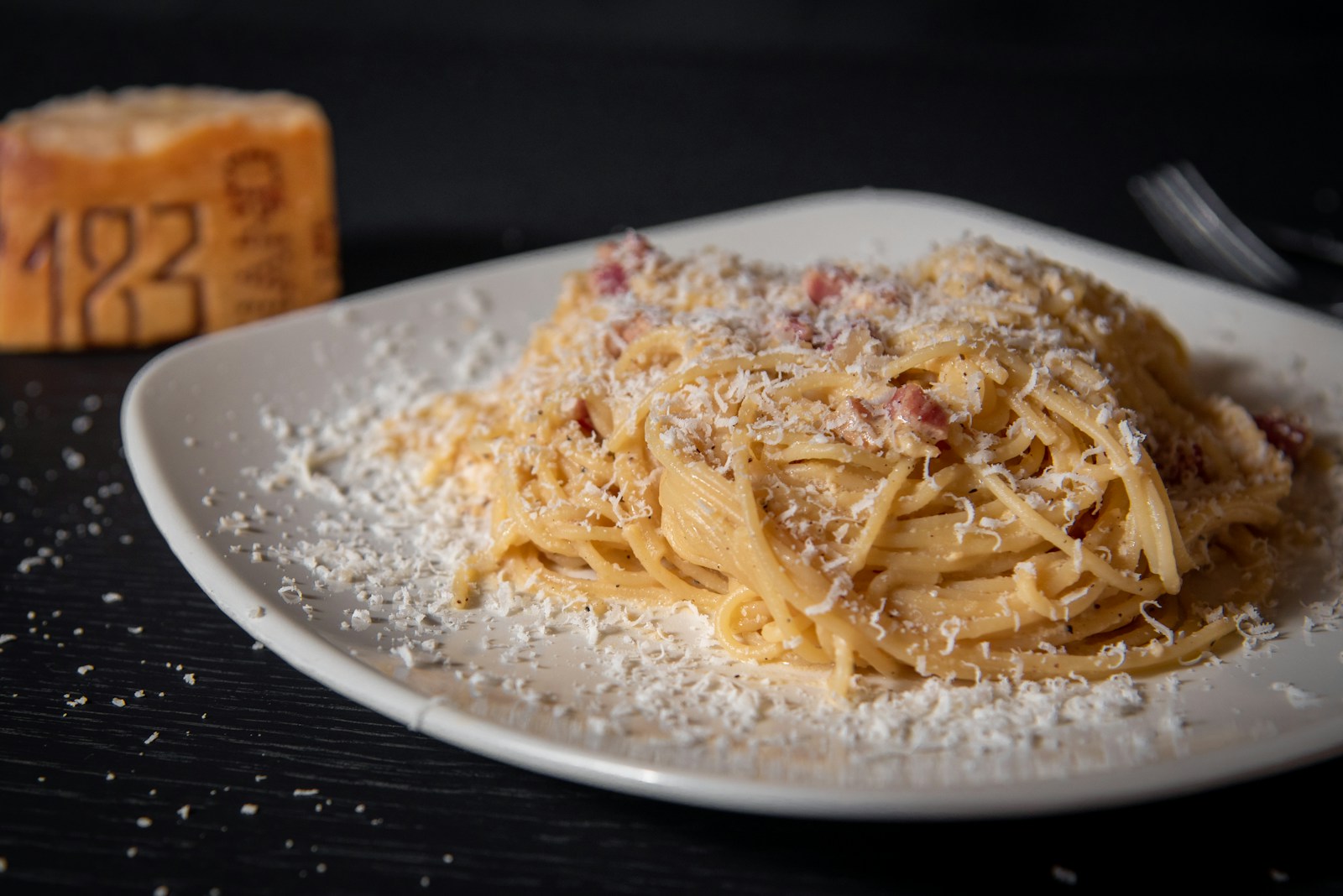
There is a moment, in a good Roman trattoria, when a plate of gricia lands in front of you and you understand, for the first time, what Italian cooking is actually about. The pasta is thick and porous, each rigatoni glossy with a pale amber sauce. Crisp batons of guanciale are scattered through it like gold leaf. Cracked black pepper clings to the ridges. There is no cream, no butter, no egg, no tomato. There is only pork fat and cheese and starchy water, coaxed into an emulsion so silky it seems impossible that four ingredients could produce it. You take a bite, and the first thing you notice is the porkiness — deep, sweet, almost floral — and the second thing you notice is that you have been cooking pasta wrong for most of your life.
Pasta alla gricia is the least famous of the four Roman classics, and I suspect it is the greatest. Cacio e pepe gets the food-writer ink. Carbonara gets the tourists. Amatriciana gets the tomato-pasta crowd. Gricia sits quietly at the center of that quartet, older than all three, the structural backbone from which the others were built. Take gricia and add eggs: you have carbonara. Take gricia and add tomato: you have amatriciana. Take gricia and remove the guanciale: you have cacio e pepe. It is the keystone dish — and once you learn to make it well, the others become easy.
The Roman food writer Katie Parla, who has lived in the city since 2003 and literally wrote the book on its food scene, once told Saveur that gricia is “the pasta that teaches you how Romans think about fat.” She meant this in the most technical sense. Roman pasta cookery is an ongoing meditation on rendered animal fat — how to extract it slowly, how to emulsify it with starch and cheese, how to make the fat disappear into the sauce while leaving behind nothing but flavor. Stanley Tucci, who spent two seasons filming Searching for Italy in Roman kitchens, called gricia “carbonara without the training wheels.” He meant that there is nothing hiding the flaws. No eggs to bind. No tomato to distract. If your emulsion breaks, there is nowhere for it to hide.
The Story of a Shepherd’s Pasta
Gricia is old. Older than tomatoes in Italy, certainly — which is why it has no tomato; the dish was codified before Columbus brought the nightshade back from the Americas. The pasta takes its name from the town of Grisciano, a mountain village in the Lazio region where shepherds and traveling merchants would rest on their way between Rome and the Adriatic coast. The dish was a pastoral one: guanciale cured from the pig they slaughtered each autumn, Pecorino Romano from the flocks they tended year-round, black pepper bought in the Roman markets, and dried pasta that kept for months in a saddlebag. It was the food of men on the road who needed calories dense enough to carry them over the Apennines.
This pastoral origin story matters because it explains the dish’s austerity. Gricia is not stripped down for the sake of minimalism. It is stripped down because its inventors could not carry anything else. That scarcity is what gives the dish its clarity. Every ingredient does three jobs. The guanciale supplies fat, salt, and porky depth. The Pecorino Romano supplies protein, salt, and sharpness. The black pepper supplies heat, aroma, and aromatic lift. The pasta water supplies starch, moisture, and a gentle dissolving agent. Remove any one and the dish collapses. Add anything else and you are making something else.
The Guanciale Problem
Guanciale is the soul of this pasta, and it is also the ingredient most often substituted, usually with unfortunate results. Guanciale is the cured jowl of the pig — the cheek, the flap under the jaw, sometimes including a bit of the neck. It is cured with salt, black pepper, and occasionally a little rosemary or garlic, then aged for three to six months in cool mountain air. The result is something almost entirely fat — a slab of pure, fragrant lard threaded with ribbons of pink muscle. When you render guanciale slowly in a pan, it produces a fat that is sweeter and more complex than any bacon grease, with a perfume that is unmistakably Italian.
Pancetta is the common American substitute, and it is not a substitute. Pancetta is cured pork belly — leaner, saltier, less perfumed, and lacking the gelatinous silk that guanciale renders. Bacon, being smoked, is even further removed; smoked bacon in gricia turns the dish into something that tastes vaguely like a carbonara from a Wisconsin diner. If you cannot find guanciale, ask an Italian deli to order it. Brands like La Quercia (made in Iowa but following traditional methods) or Salumeria Biellese (New York) ship nationally. Whole Foods carries it in their charcuterie case in most major markets. The difference between guanciale and pancetta in a gricia is not a minor improvement; it is the difference between the dish and a reasonable impersonation of the dish.
Cut the guanciale thick. A quarter inch is the right dimension — thick enough to stay tender in the center when the outside crisps, large enough to read as a distinct textural element on the fork. Thin lardons, the ones you see in most home recipes, render their fat too fast and cook through before the outside has developed any color, producing papery, dry pieces that taste only of salt. Thick batons render slowly, brown deeply, and keep a soft, almost melty interior that is one of the pleasures of a well-made gricia.
The Cheese Problem
Buy Pecorino Romano DOP. I wrote about this at length in our cacio e pepe guide, but it bears repeating. The DOP — Denominazione di Origine Protetta — designation guarantees that the cheese was produced in Lazio, Sardinia, or the Grosseto province of Tuscany according to strict traditional standards. Brands like Fulvi, Brunelli, and Locatelli are the reference points. Pecorino Romano is a sheep’s milk cheese, aged eight to twelve months, with a sharpness and a faintly gamey edge that cannot be duplicated with Parmigiano Reggiano. Parmigiano is milder, sweeter, and cow’s milk; it makes a perfectly nice cheese but it makes a nonsensical gricia.
Grate the cheese yourself, on a microplane if possible, on the finest side of a box grater if not. Pre-grated Pecorino from a plastic tub is treated with anti-caking agents — usually powdered cellulose or potato starch — that interfere with emulsification. The cheese will not melt properly into the fat. It will clump. You want the cheese at room temperature before you start; bring the wedge out twenty minutes before cooking. A cold wedge grated straight from the refrigerator releases fat unevenly on contact with heat and is more prone to seizing.
The Four Roman Pastas: A Comparison
To understand gricia is to understand the whole Roman canon. Here is how the four classics relate — the differences are smaller than they appear on a restaurant menu.
| Dish | Key Ingredients | Binding Agent | Character |
|---|---|---|---|
| Cacio e Pepe | Pecorino, pepper, pasta water | Starchy water + cheese emulsion | Austere, cheesy, peppery |
| Gricia | Guanciale, Pecorino, pepper, pasta water | Rendered fat + starch emulsion | Porky, rich, silky |
| Amatriciana | Gricia + tomato | Reduced tomato + fat + starch | Sweet-savory, bright, rustic |
| Carbonara | Gricia + egg yolks | Tempered egg + fat + cheese | Custardy, rich, eggy |
Ingredients
- 1 lb (450 g) dried rigatoni, tonnarelli, or mezze maniche
- 8 oz (225 g) guanciale, cut into ¼-inch thick batons
- 1½ cups (150 g) finely grated Pecorino Romano DOP, plus extra for finishing
- 2 teaspoons whole Tellicherry black peppercorns, coarsely cracked
- 4 quarts (3.8 L) water, for boiling
- Fine sea salt — about 1 teaspoon per quart of water (less than usual, because of the guanciale and cheese)
Making It
- Boil the water, salt it lightly. Bring 4 quarts of water to a rolling boil in a large pot. Add about 4 teaspoons of salt — a teaspoon per quart. Taste the water; it should be mildly savory, not ocean-salty. Gricia is heavily salted by its guanciale and Pecorino, and oversalted pasta water will push the finished dish past the edge of edibility.
- Render the guanciale, cold-start. Place the guanciale batons in a wide, heavy skillet — 12 inches is ideal — while the pan is still cold. Turn the heat to medium-low. Let the fat render slowly for eight to ten minutes, stirring occasionally. This is not a stir-fry. You want the fat to emerge gradually, coating the pan in a golden, fragrant pool. The guanciale will turn a deep amber outside while staying tender inside. When the batons are colored on all sides, add the cracked pepper directly to the fat and toast for thirty seconds, until the kitchen smells sharply aromatic.
- Reserve the guanciale. Turn off the heat. Use a slotted spoon to lift the crisp guanciale pieces out of the pan and onto a small plate. Leave all of the rendered fat and pepper in the skillet. The fat is your sauce base. The guanciale will go back at the end.
- Cook the pasta — short. Drop the pasta into the boiling water and stir for the first thirty seconds. Cook it to two minutes less than the package direction — the pasta will finish cooking in the fat, and heavily al dente is what you want at this stage. Before draining, use a heatproof measuring cup to reserve 2½ cups of the starchy pasta water. That starchy water is more valuable than any ingredient in this recipe aside from the guanciale itself.
- Build the emulsion. Transfer the drained pasta directly into the skillet of guanciale fat. Add 1 cup of the reserved pasta water. Turn the heat to medium. Toss vigorously with tongs for sixty to ninety seconds. The pasta will finish cooking as it absorbs the fat, and the starchy water will begin to thicken and emulsify with the fat, producing a glossy, cloudy sauce that coats every piece of pasta. If the sauce looks watery, toss harder and let more water evaporate. If it looks dry, add a splash more pasta water.
- Add the cheese — off the heat. Remove the skillet from the heat. Let it cool for thirty seconds; this is the critical window. If the pan is too hot when the Pecorino hits it, the cheese will seize instead of melting. Add the grated Pecorino in three separate additions, tossing vigorously with tongs after each, and splashing in a tablespoon or two of pasta water between additions. The sauce will transform from cloudy-fatty to creamy-clinging. By the third addition of cheese, you should have a smooth, glossy sauce that coats every ridge of the rigatoni.
- Finish and plate. Return the crisp guanciale to the pan. Toss once to redistribute. If the sauce has tightened too much, add another splash of pasta water and toss. Plate immediately into wide, warmed bowls — divide among four people. Finish each bowl with an extra crack of pepper and a small flurry of Pecorino shavings grated over the top. Do not garnish with parsley, olive oil, or anything else. A good gricia is complete as it leaves the pan.
A Note from the Roman Trattorias
If you want to taste the authoritative version of gricia, the Testaccio neighborhood in Rome is where you go. Felice a Testaccio, Flavio al Velavevodetto, Da Enzo al 29 — each of these trattorias serves a version of the dish that has been refined over decades of feeding Roman office workers, grandmothers, soccer players, and tourists who had the sense to ask a local for a recommendation. The versions differ in small, telling ways. Felice tosses their pasta in a copper pan over direct heat, creating a slightly caramelized edge to the sauce. Flavio finishes his with an extra grind of pepper and a whisper more Pecorino than seems advisable. Da Enzo’s is almost aggressively salty, the guanciale cut into smaller cubes, the sauce reduced further. Each cook will tell you that theirs is the correct method, and each will be right.
Stanley Tucci, whose Searching for Italy devoted an entire Rome episode to the four classics, made gricia with chef Luciano Monosilio at Pipero al Rex. Monosilio’s technique involves a small addition that purists find controversial: a splash of olive oil at the end, added off the heat, to lift the shine of the sauce. It is not traditional. It is also undeniably good. The point is not that there is one correct version — there is not. The point is that every good version obeys the same underlying laws: cold-start the guanciale, render slowly, never let the cheese meet direct flame, reserve enough starchy water to build the emulsion. Those laws are non-negotiable. Everything else is a matter of style.
Common Mistakes
Gricia fails in predictable ways. Here are the errors that undermine most home attempts:
- Rendering the guanciale too fast. High heat drives off the volatile aromatic compounds and produces bacon-like hard crunch instead of tender-crisp silk. Start cold, go slow.
- Using pancetta or bacon. The dish will be salty, lean, and smoky instead of porky, fatty, and floral. Source guanciale or wait until you can.
- Adding cheese to a hot pan. The Pecorino will seize into strings instead of melting into sauce. Always remove from heat first and let the pan cool briefly before cheese goes in.
- Salting the pasta water heavily. Between the guanciale and the Pecorino, there is enough salt in the dish already. Use about half the salt you would use for a tomato-based pasta.
- Not reserving enough pasta water. You will use more than you think. Reserve 2½ cups even for a four-serving batch — excess water down the sink is free, but mid-recipe shortage is a disaster.
- Pre-grated cheese from a tub. Cellulose and potato starch prevent proper emulsification. Grate your own from a DOP wedge.
What to Serve With It
Gricia is traditionally eaten as the primo, the first course, in a Roman meal. At home, it works beautifully as a weeknight main paired with simple, bitter, or acidic counterpoints that cut through the richness of the guanciale fat. A plate of lightly dressed puntarelle — the bitter Roman chicory with anchovy-lemon dressing — is the classic accompaniment in Rome. Outside Italy, substitute radicchio, endive, or escarole, dressed with just olive oil and red wine vinegar. Roasted broccoli rabe with chili and garlic is another strong pairing, as is a simple shaved fennel salad with lemon and a shower of parsley.
For wine, the Roman answer is Frascati — a crisp, slightly mineral white from the Castelli Romani hills south of the city. A cooler-climate Italian red like a Cesanese or a light Chianti also works. Avoid heavily oaked whites or tannic reds; the fat and salt of gricia overwhelms anything too structured. If you want to build a multi-course Roman supper, follow gricia with a simple secondo like saltimbocca or roasted lamb and potatoes. And if you are working through the four classics, consider our classic carbonara guide next — gricia is the prerequisite course.
Storage and Reheating
Gricia keeps reasonably well for about twenty-four hours in the refrigerator, though the sauce tightens as it cools. To reheat, transfer to a skillet with three tablespoons of water, cover, and warm over low heat for four to five minutes, tossing gently every minute. The goal is to re-loosen the emulsion without breaking it; low and slow is essential. Do not microwave — the sauce will separate into weeping puddles of fat. Gricia does not freeze; the emulsion cannot survive the thaw. For meal planning, scale the recipe precisely to the number of people at the table. This is not a dish that rewards leftovers.
Frequently Asked Questions
What is the difference between gricia, carbonara, and amatriciana?
Pasta alla gricia is the structural ancestor of both. It contains guanciale, Pecorino Romano, black pepper, and pasta water. Add egg yolks and you have carbonara. Add tomato and you have amatriciana. Take away the guanciale and you have cacio e pepe. These four pastas — cacio e pepe, gricia, amatriciana, and carbonara — are known as i quattro classici, the four classics of Roman cooking. Understanding gricia unlocks the other three. The binding technique — emulsifying rendered fat, starch, and cheese — is identical across the quartet; the variables are what gets added on top.
Can I use pancetta or bacon instead of guanciale?
You can, but the dish changes meaningfully. Guanciale is cured pork jowl — fattier, more delicately spiced, and with a distinctive porky-sweet flavor that renders into a glossy, almost floral fat. Pancetta is cured pork belly, leaner and saltier. Bacon is smoked and will dominate the dish. If you must substitute, pancetta is the closer choice. American bacon is a last resort and should be unsmoked if possible. No serious Roman cook will accept either. If you cannot find guanciale locally, order online from a dedicated salumeria — the difference between gricia with guanciale and gricia with pancetta is not subtle.
Why is my sauce watery instead of creamy?
Watery gricia usually means the emulsion never formed. Three common causes: the pasta water was not starchy enough (too much water, not enough pasta, or overcooked pasta that lost its starch); the pan was too hot when the cheese was added, causing it to seize rather than melt; or the pasta was not tossed vigorously enough for the fat and starch to bond. The fix is technique, not more cheese. Let the pasta water reduce and thicken slightly in the guanciale fat before adding cheese, and always let the pan cool briefly before the Pecorino goes in.
What pasta shape is correct for gricia?
Rigatoni and mezze maniche are the traditional Roman choices — short, ridged tubes whose ridges and interior trap the guanciale-rich sauce. Tonnarelli, the square-cut Roman spaghetti, is the long-pasta answer and appears often in Roman trattorias. Bronze-die pasta is strongly preferred over smooth industrial pasta; the rough surface is what holds the sauce. Avoid delicate shapes like angel hair or fettuccine, which cannot carry the weight of the fat and cheese. Look for Italian brands like Rustichella d’Abruzzo, Benedetto Cavalieri, or Martelli.
Sources
- Serious Eats — Pasta alla Gricia — Technical breakdown of the emulsion technique by the Food Lab team.
- Bon Appétit — Pasta alla Gricia — A reference recipe from the test kitchen with notes on guanciale sourcing.
- USDA FoodData Central — Pecorino Romano — Nutritional profile used for per-serving calculations.
Each serving contains roughly 612 calories, 22 g protein, 28 g fat, 68 g carbohydrates, and 3 g fiber — based on 4 servings using semolina rigatoni, guanciale, and Pecorino Romano DOP. Sodium is naturally high due to the cured pork and aged cheese.
Please note: Nutritional estimates are derived from the USDA FoodData Central database and may vary depending on specific brands of pasta, guanciale, and cheese. This recipe contains dairy, wheat, and pork. Nothing in this article should be interpreted as medical or dietary guidance. If you have food allergies, sodium-sensitive conditions, or specific dietary needs, consult a registered dietitian or healthcare provider before preparing this recipe.

Rachel Summers
Rachel grew up in a Pacific Northwest kitchen, learning Sunday roasts from her mother and pie crust from a grandmother who never wrote a recipe down. CookingZone began as a way to save her family's cooking before it was forgotten, and grew when her cousins started sending in their own. Her work covers foundational American, Italian, French, and Mexican recipes, with an emphasis on weekend baking, comfort food, and the techniques that span both European and American home kitchens.